
How to find a good mechanic comes down to one move most people skip: test a shop with a small job before you need a big one. An oil change or tire rotation tells you how they communicate, whether they measure, and whether they try to sell you things. That is a cheap audition for a relationship worth thousands.
On this page: Start small What separates a good shop Questions to ask Red flags Keeping them FAQ
Start with a small job
This is the first step in how to find a good mechanic. Do not meet a new shop for the first time with a $2,000 repair and a deadline. Bring them an oil change, a tire rotation, or a state inspection. Watch what happens. Do they call before doing anything extra? Do they hand you a printed list of scary findings, or a measurement and a timeline? Do they explain in plain language or in jargon designed to end the conversation?
A small job costs you $60 and buys you the single most valuable piece of information in car ownership: whether these people tell you the truth when nothing much is at stake.
What separates a good mechanic from an average one
Good shops measure and show. They will tell you brake pads are at 4 millimeters, not that they are “getting low.” They will show you the leak rather than describing it. They keep your old parts if you ask. They tell you when something can wait, which is the behavior that costs them money today and earns them a customer for a decade.
Certification is a signal but not a guarantee. ASE certification means the technicians passed real tests, and a shop that invests in training usually invests in equipment too. It does not tell you how the front counter treats you, which is where most repair relationships actually succeed or fail.
Questions worth asking on the first visit
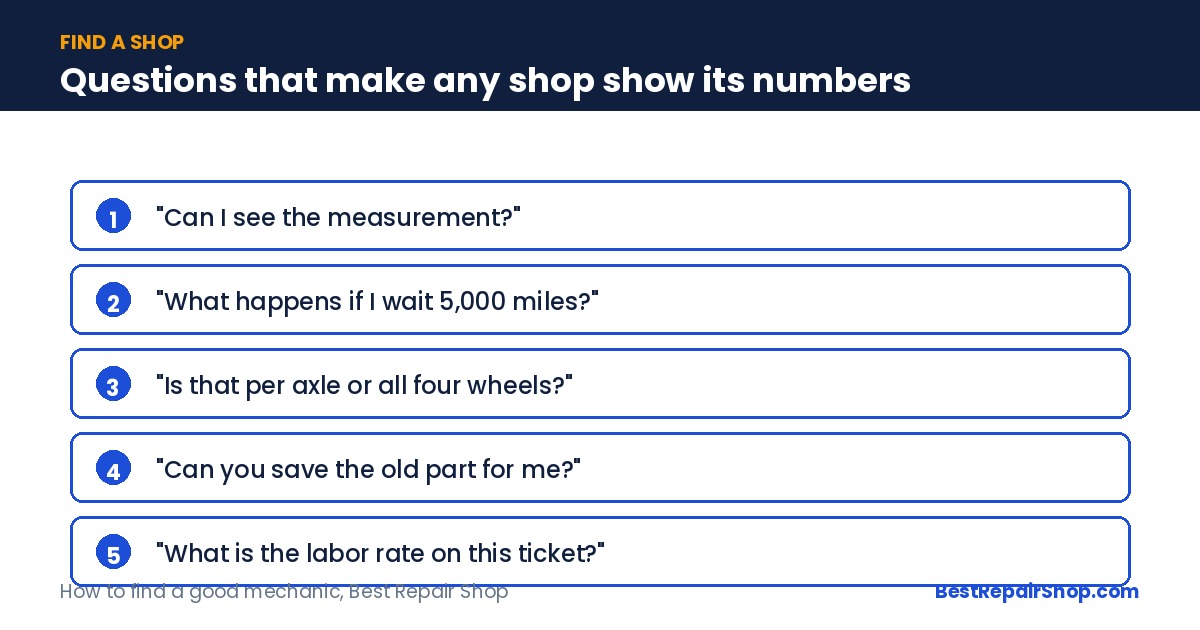
- “Can I see the measurement?” The single best question in this guide.
- “What happens if I wait 5,000 miles on this?” Real problems have specific answers.
- “Is that per axle or all four wheels?”
- “Can you save the old part for me?”
- “What is your labor rate, and how many hours is this job?”
- “Do you warranty parts and labor, and for how long?”
None of these are rude. Every one of them is standard practice for a fleet manager or a shop owner getting work done on their own car. You are allowed to ask questions about how your money is spent, and the FTC’s auto repair basics lays out the estimate and approval rights you already have in most states.
Red flags
Knowing how to find a good mechanic also means knowing what to walk away from. Watch for urgency attached to non-safety items, findings with no measurements, refusal to break a quote into parts and labor, and the free inspection that always finds roughly the same dollar amount of work. One more: a shop that will not put the estimate in writing. That is not a personality quirk, it is a business model.
Before authorizing any large repair, spend thirty seconds checking your VIN at NHTSA’s recall lookup. Recall work is free at a dealership, and plenty of drivers pay independents for repairs the manufacturer would have covered.
When you find a good one, keep them
Learning how to find a good mechanic is the hard part; keeping one is easy. Go back for the small stuff even when a chain is cheaper. Learn the service writer’s name. Say yes to the maintenance they recommend when it matches your manual, and tell them why when you decline something. A shop that knows your car and expects to see you again behaves differently than one that assumes you are passing through.
And when they save you money by telling you that you do not need something, notice it out loud. Leave the review. Send the neighbor. That is how good shops survive in a business where the loudest competitors are the ones selling the hardest.
How to find a good mechanic: your questions answered
Dealer or independent?
Both can be the right answer, so how to find a good mechanic matters more than which sign is over the door. Independent for most out-of-warranty work, typically 20 to 40 percent cheaper on labor. Dealer for recalls, warranty work, and the occasional model-specific problem where their diagnostic tooling genuinely wins.
How much should a second opinion cost?
Often nothing, if you already have a written estimate to hand over. A shop will usually confirm or dispute another shop’s diagnosis for free or for a modest inspection fee, and on a four-figure repair that is the highest-return hour you will ever spend.
Are online reviews useful for finding a good mechanic?
Somewhat. Ignore the star average and read the negative reviews specifically. One angry customer means nothing. Five people describing the same behavior, like surprise charges or work not authorized, is a pattern worth believing.
What to do when a repair goes wrong
Knowing how to find a good mechanic includes knowing what happens when one gets it wrong. Even good shops make mistakes. What separates them is what happens next. Go back to the shop first, in person, with the invoice and a calm description of what changed after the work. A shop that stands behind its labor will re-inspect at no charge, and most reputable independents warranty parts and labor for at least twelve months or twelve thousand miles.
Keep everything in writing from that point: dates, who you spoke to, what they promised. If the shop refuses and you believe the work was defective, your state attorney general’s consumer protection office handles auto repair complaints, and small claims court exists precisely for disputes this size. Bring the old parts if you kept them.
The reason this matters for choosing a shop in the first place: ask about the warranty before the work, not after. The answer tells you how confident they are, and it gives you something concrete to point at if the repair does not hold.