
Finding an auto repair shop you can trust is the single biggest car-money advantage you can have: typically 20-40% cheaper than a dealership and honest about what you do not need. This page teaches you how to find that shop, how to test them, and how to spot the ones to avoid.
On this page: How to find one Read the shop Red flags Questions to ask Second opinions Repair warranty Your rights Directory FAQ
How to find an auto repair shop you can trust
An auto repair shop you can trust behaves differently from the first visit, and you can test for it cheaply. The full method is in our guide: How to find a good mechanic (and keep them). The short version: start with a small job like an oil change or tire rotation, watch how they communicate, and judge them on measurements and explanations rather than price alone. A shop that shows you the worn part and the number on the gauge is a shop you can grow old with.
Read the shop before you hand over the keys
You can learn most of what you need in the first ten minutes, before any work is authorized. An auto repair shop you can trust tends to give itself away in small, checkable ways.
Look for a digital vehicle inspection. Good shops now text you a report with photos of the actual part on your actual car, a measurement next to it, and a green, yellow, or red rating. That single practice removes almost all of the guesswork from trusting a stranger, because you stop taking their word for anything and start looking at your own brake pad.
Check the certifications, then check what they cover. ASE certification is earned per technician and per specialty, so “ASE certified” on the door means at least one person passed at least one test. Ask who is working on your car and what they are certified in. Shop-level programs such as AAA Approved Auto Repair add an inspection and a dispute process, which is worth something real if a job goes wrong.
Then read the counter. Are prices for common services posted? Does the advisor write things down or wave them off? Is anyone being pressured while you stand there? How a shop treats the customer ahead of you is the most accurate preview you will get of how it treats you.
Red flags on any estimate
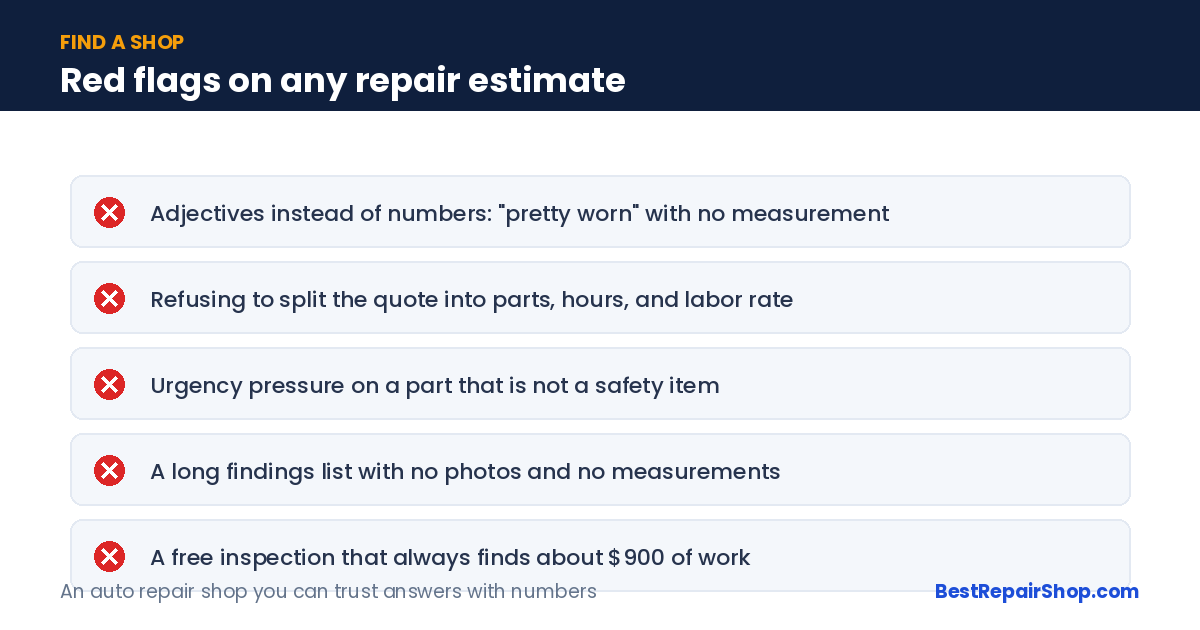
- Adjectives instead of numbers: “pretty worn” instead of “3 millimeters left”.
- Refusing to break a quote into parts, hours, and labor rate.
- Urgency pressure on a non-safety item: “I wouldn’t drive home on this” for a cabin filter.
- A long list of findings with no measurements and no photos.
- A “free inspection” that always finds exactly $900 of work.
Questions that make any shop honest
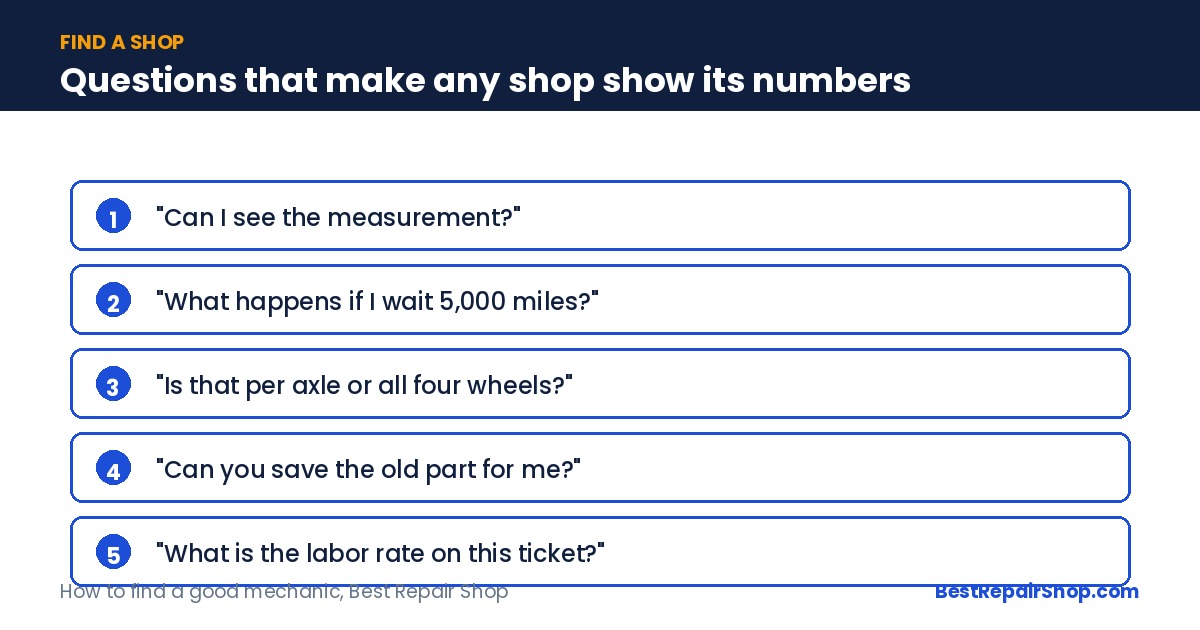
- “Can I see the measurement?” Thickness, wear, or reading. Honest shops love this question.
- “What happens if I wait 5,000 miles?” Real problems have concrete answers.
- “Is that per axle or all four?” The most expensive ambiguity in brake quotes.
- “Can you save the old part for me?” Standard practice at good shops.
- “What is the labor rate on this ticket?” You are allowed to ask. It is your money.
How to get a second opinion without poisoning it
Most people get second opinions wrong by leading the witness. Walking in and saying “the other place wants $1,400 for a transmission” tells the second shop exactly what number to beat and exactly what to look for. You have just replaced an independent diagnosis with a negotiation.
Do it clean instead. Describe only the symptom, the same way you described it the first time, and let them reach their own conclusion. If both shops land in the same place, you have your answer, and you have probably found an auto repair shop you can trust twice over. If they do not, ask each one to explain the other’s finding, and listen for which explanation uses measurements.
You will usually pay a second diagnostic fee. On a four-figure repair that $100 is the cheapest insurance available, and no reasonable shop is offended by it. A shop that reacts badly to the idea of a second opinion has answered a question you did not have to ask.
The repair warranty tells you what a shop believes
Ask the warranty question before the work, not after. The common tiers are 12 months or 12,000 miles, 24 months or 24,000 miles, and 36 months or 36,000 miles, whichever comes first. Shops in nationwide networks such as NAPA AutoCare or TechNet often honor their warranty at member shops across the country, which matters if the repair fails three states from home.
Two details decide whether the warranty is real. Does it cover parts and labor, or parts only, which leaves you paying to have a failed part replaced twice? And is it written on the invoice, or just said out loud? An auto repair shop you can trust puts the term in writing without being pushed, because a shop backing its work for three years is telling you what it thinks of that work.
What the law already gives you
Consumer protection rules cover more of this than most drivers realize. Depending on your state, a shop may be required to give you a written estimate before work starts, to get your approval before exceeding it, and to return your old parts if you ask. The FTC’s auto repair basics is the clearest plain-English summary, and reading it once changes how you talk to a service advisor.
Two more free protections worth using: check your VIN for open recalls at NHTSA before paying for any repair, because recall work is free at a dealer, and always ask whether a part carries a warranty and for how long. A shop confident in its work will tell you without hesitating.
Already have a quote in hand?
Check it against the fair-price table on the cost guides page. If your quote is far outside the range, get a second opinion before you approve. A second opinion on a four-figure repair is never rude; it is the industry standard that good shops expect.
A directory you will actually be able to trust
We are building a state-by-state directory: every auto repair shop you can trust, listed against published standards, with local labor rate data so listings can be judged against real numbers. Shops will earn their way in with transparency, not with a subscription fee. If you run a shop that works this way, watch this page.
Trust questions, answered straight
Are chain stores always a bad idea?
No, but their incentives are different: service advisors often work on commission against quotas. Chains are fine for tires, batteries, and simple services. For diagnosis and judgment calls, an independent shop with a good local reputation usually serves you better.
Do I have to use the dealer while my car is under warranty?
No. Federal law stops a manufacturer from voiding your warranty simply because an independent shop did routine work, as long as the work was done correctly and you keep the receipts. Warranty repairs themselves are still the dealer’s job and should cost you nothing.
Are online reviews worth anything here?
Read them for pattern, not for score. Ignore the five-star reviews that say “great service” and the one-star reviews that are about the wait. Look for repeated specifics: people saying they were shown the part, or people saying the price changed after approval. Those repeat because they are true, and that pattern is how an auto repair shop you can trust shows up in public before you ever walk in.
How do I complain about a shop that ripped me off?
Start with the owner directly and bring the numbers, not just the anger. If that fails: your state attorney general’s consumer protection office, the BBB, and an honest review that sticks to verifiable facts. Keep every receipt and the old parts if you have them.