
A steady check engine light means schedule a diagnosis soon, and yes, you can usually keep driving to work in the meantime. A flashing check engine light means stop driving now: an active misfire is dumping raw fuel into your catalytic converter, and that part costs $900 to $2,400 to replace.
On this page: Steady light Flashing light Get the code free What to tell the shop When to do nothing FAQ
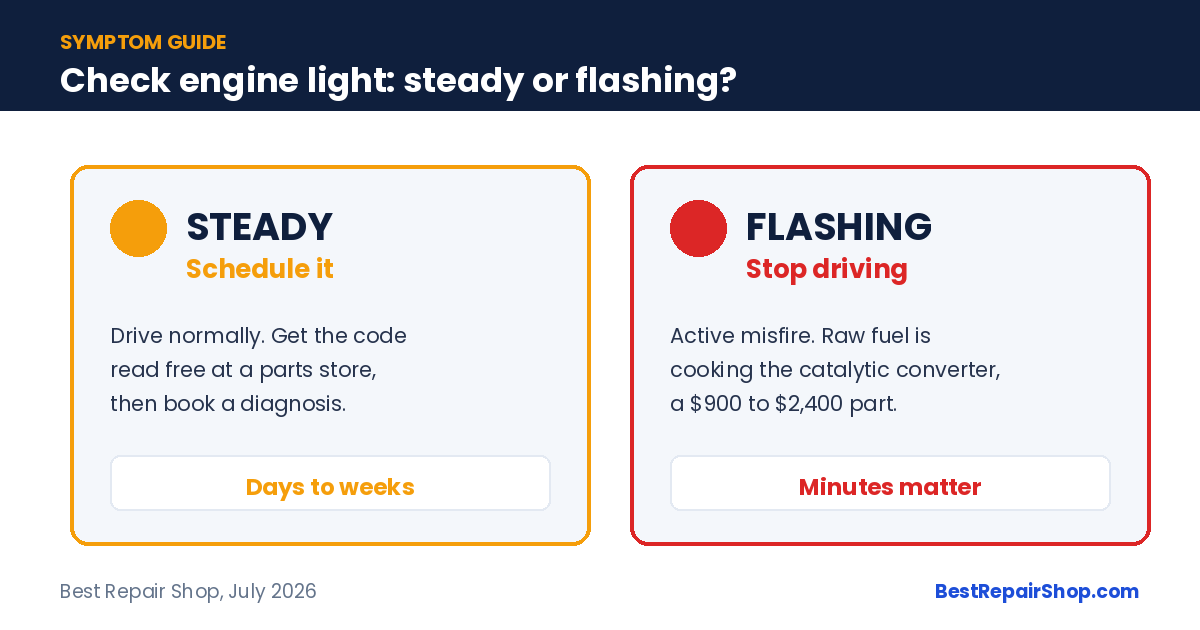
Steady check engine light: schedule it, don’t panic
A steady check engine light is the computer saying “I logged a fault worth looking at.” It covers everything from a loose gas cap to a failing oxygen sensor. The car is not telling you to pull over; it is telling you to find out. Most steady-light causes will not strand you this week, but ignoring the light for months lets a $30 fix grow into a $1,000 one, and it also means a second, more serious fault cannot get your attention because the light is already on.
Flashing check engine light: stop driving
A flashing light means an active misfire is happening right now. Unburned fuel is passing into the exhaust and burning inside the catalytic converter, which is not built for that heat. Minutes of flashing-light driving can do what years of normal driving cannot: kill the converter. The tow costs less than the converter every single time. This is one of the few genuine stop-now situations in car ownership.
First step: get the code read free
Before you pay anyone anything, get the code. Most major parts stores (AutoZone, O’Reilly, Advance) will read it free in the parking lot, and a $25 Bluetooth OBD2 scanner does the same job forever. The code alone does not diagnose the car, but it turns “the light is on” into “P0420, catalyst efficiency below threshold,” and that changes every conversation that follows.
| Common code | What it usually means | Typical fix range |
|---|---|---|
| P0455 / P0457 | Evap leak, often the gas cap | $0-$150 |
| P0171 / P0174 | Engine running lean, vacuum leak or MAF sensor | $100-$400 |
| P0301-P0308 | Cylinder misfire, plugs, coils, or injectors | $150-$600 |
| P0420 / P0430 | Catalytic converter efficiency | $900-$2,400 |
| P0128 | Thermostat stuck open | $150-$350 |
Ranges are national, independent-shop figures for common cars, July 2026. A code is a starting point, not a diagnosis: P0420 sometimes means a $60 oxygen sensor upstream is lying, not that the converter is dead. That is exactly what a good diagnostic hour is for.
One free check first: some emissions and engine faults are covered by open recalls or extended warranties. Run your VIN through the NHTSA recall lookup before you authorize anything expensive.
What to tell the shop
Say the code, when the light came on, and what the car was doing at the time: cold morning, highway speed, hard acceleration, after fueling. Those details cut diagnostic time. Then ask what the diagnosis will cost and whether it is credited toward the repair. A fair diag fee runs $75-$150, and paying it once for a real answer beats paying twice for a guess. If a shop quotes a big repair from the code alone with no testing, that is a second-opinion situation.
Know what you are owed on paper, too. The FTC’s auto repair basics explains your right to a written estimate and to approve any work that exceeds it, which matters most on diagnostic jobs where the scope can grow.
When you don’t need a repair at all
If the light came on right after a fill-up, tighten the gas cap until it clicks and drive a few days; evap codes clear themselves once the system seals. If the light is steady, the car drives normally, and the code is a one-time evap or a stale misfire logged on one cold morning, clearing it and watching for a return is a legitimate strategy. A code that comes back is information. A code that does not was weather.
Check engine light FAQ
Will the check engine light turn itself off if the problem goes away?
Yes. Most codes clear themselves after the computer sees several consecutive good drive cycles. If the gas cap was the issue, the light typically goes off within two or three days of driving.
Can I pass inspection or emissions with the light on?
No. A lit check engine light is an automatic emissions failure in every state that tests. And clearing the code the night before does not work: the computer reports “not ready” until it has run its own checks over a few days of driving, and inspectors see that too.
Is it the gas cap? Everyone says it’s the gas cap.
Often enough that it is worth checking first, since the fix is free. But the gas cap story only fits evap codes like P0455. If the code is a misfire or a sensor fault, no amount of cap-tightening will help, which is why reading the code beats guessing.
The light is on but the car drives fine. How long can I really wait?
Get the code read this week (it is free), then decide with the actual number in hand. Weeks is usually fine for evap and thermostat codes. Misfire and lean codes deserve days, not weeks, because they can cascade into converter damage. And a flashing light means now.
What a real diagnosis actually involves
It helps to know what you are paying for. Reading the code takes seconds; finding the cause takes judgment. For a lean code, a technician checks fuel trims at idle and at speed, smoke-tests the intake for vacuum leaks, inspects the mass airflow sensor, and compares live sensor data against what the engine should be doing. That is an hour of skilled work with equipment most people do not own.
This is why two shops can quote different repairs from the same code. One tested and one guessed. When you call around, ask what the diagnostic fee includes and whether they test or replace parts until the light goes out. Parts-cannon diagnosis is the most expensive way to fix a car, because you pay for every wrong guess.