
Alternator replacement cost runs $350 to $900 at an independent shop in 2026, parts and labor included. A remanufactured unit on an easy access engine lands near $350 to $600, while a new OEM unit buried in a tight bay pushes $600 to $900. Before you approve any of it, get the free charging system test at a parts store, because plenty of dead alternators turn out to be tired batteries.
On this page: Fair range Test first Why quotes swing Reman vs new The upsell FAQ
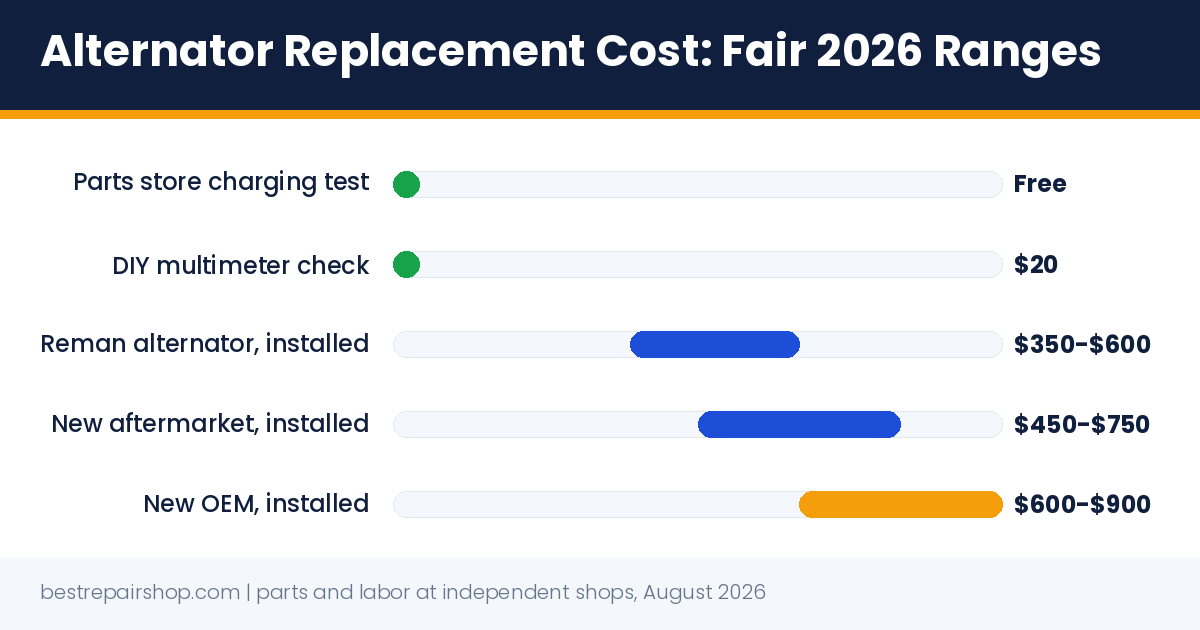
Alternator Replacement Cost: The Fair 2026 Range
The invoice has three lines that matter: the part, the labor, and the test that justified both. Alternator replacement cost breaks down to roughly $150 to $500 for the part and one to two and a half hours of labor at $75 to $200 per hour, landing most cars between $350 and $900 all in.
Access explains more of that spread than the part does. On most four cylinder sedans the alternator sits on top of the engine and comes out in about an hour. On some V6 and all wheel drive layouts it hides under the intake manifold or behind an axle, and the labor doubles. Same part, honest difference.
| What you are paying for | Fair 2026 price |
|---|---|
| Parts store charging test | Free |
| DIY multimeter check | $20, the cost of the meter |
| Remanufactured alternator, installed | $350-$600 |
| New aftermarket alternator, installed | $450-$750 |
| New OEM alternator, installed | $600-$900 |
| Shop electrical diagnosis | $75-$200 per hour |
Ranges are national, independent-shop figures, August 2026. Dealers typically run 20 to 40 percent above the top of these numbers for the same job. Compare the rest of your quote against our costs hub before you sign anything.
The $20 Test That Comes First
Never buy an alternator on a guess. Every major parts store will test your charging system for free in the parking lot, and a $20 multimeter does the same job at home. A healthy battery reads about 12.6 volts with the engine off and 13.5 to 14.7 volts with it running. Stuck below 13 while running means the alternator is not charging; the full walkthrough is in our step by step alternator test.
The reason testing matters: weak batteries overwork alternators, and failing alternators kill batteries, so shops see both and some quote both. If the car just clicks and will not start, that is usually the battery side of the system; our clicking no start guide sorts that out in five minutes.
Why Quotes Swing From $350 to $900
Three things move the number. First, part choice: remanufactured versus new OEM is a $200 to $400 spread on the same shelf. Second, access, which sets the labor hours. Third, amperage: trucks and cars with heated everything run high output units that simply cost more.
One honest add on is worth saying yes to. The serpentine belt has to come off for this job, so if yours is due, replacing it now adds only the price of the belt and no extra labor. That is the good kind of while we are in there.
Reman, New, or Used: Picking the Part
A remanufactured unit, a factory core rebuilt with new wear parts, is the fair default for most cars and usually carries a one to three year warranty. New aftermarket sits in the middle. New OEM costs the most and makes sense on newer cars still worth the premium. A $50 junkyard pull is a gamble: when it fails, you pay the labor twice.
A fair alternator replacement cost quote names the part type and brand, and the warranty in writing. Twelve months and 12,000 miles on parts and labor is the floor a good shop offers; many reman units carry more. Per the FTC’s auto repair basics, you can also ask for the old part back, which keeps everyone honest.
The Invoice Padding to Watch
The classic combo move is alternator plus battery plus belt plus a terminal service, quoted as one number. Sometimes the battery really is dead: getting drained flat repeatedly by a failing alternator can finish an older one, and a fair replacement runs $150 to $300 installed. But ask the shop to charge and retest the battery first, which any parts store does for free.
Terminal cleaning as a $40 line item is a wire brush and two minutes; ask for it to be included. And a second battery quoted at the AGM price of $200 to $350 only belongs on cars that came with an AGM battery from the factory. Ask which yours is. A shop that answers plainly is a keeper.
Alternator Cost Questions, Answered
Can I drive with a failing alternator?
Only to the shop, and pick a close one. Once charging stops you are running on the battery alone, which gives you somewhere between 20 minutes and an hour before the car dies, often in traffic. Turn off the AC, radio, and everything else you can to stretch it.
Is alternator replacement cost cheaper if I do it myself?
Often, yes. A reman part runs $150 to $400, and on an accessible engine the swap is one to two hours with hand tools, saving $200 to $400 in labor. Disconnect the battery first, always. If the alternator hides under the intake manifold, the honest answer is to pay a shop.
How long does an alternator last?
Most last 80,000 to 150,000 miles, which for many drivers is seven to twelve years. Heat, long idling with big electrical loads, and a chronically weak battery all shorten that. Replacing only what failed, not the whole charging system, is the fair play in most cases.
Battery or alternator: how do I tell which one is dead?
Jump start the car. If it starts and keeps running, the battery side is the likely problem. If it dies again within minutes with the dash lights dimming, the alternator is the likely culprit. A free charging system test at a parts store settles it in ten minutes, before anyone quotes you anything.
Keep going
- What a fair battery swap costs: car battery replacement cost
- Before you approve the job: 7 questions to ask a mechanic
- Find a shop worth trusting: how to find a good mechanic