
Here is how to test alternator output in one sentence: put a $20 multimeter on the battery and read 12.4 to 12.7 volts with the engine off, then 13.5 to 14.7 volts with it running. Inside that running range, the alternator is charging. Outside it, you have a charging problem, and ten minutes of testing just saved you from buying a $150 to $300 battery you did not need.
On this page: The numbers 5 steps No multimeter Free tests Reading results Costs FAQ
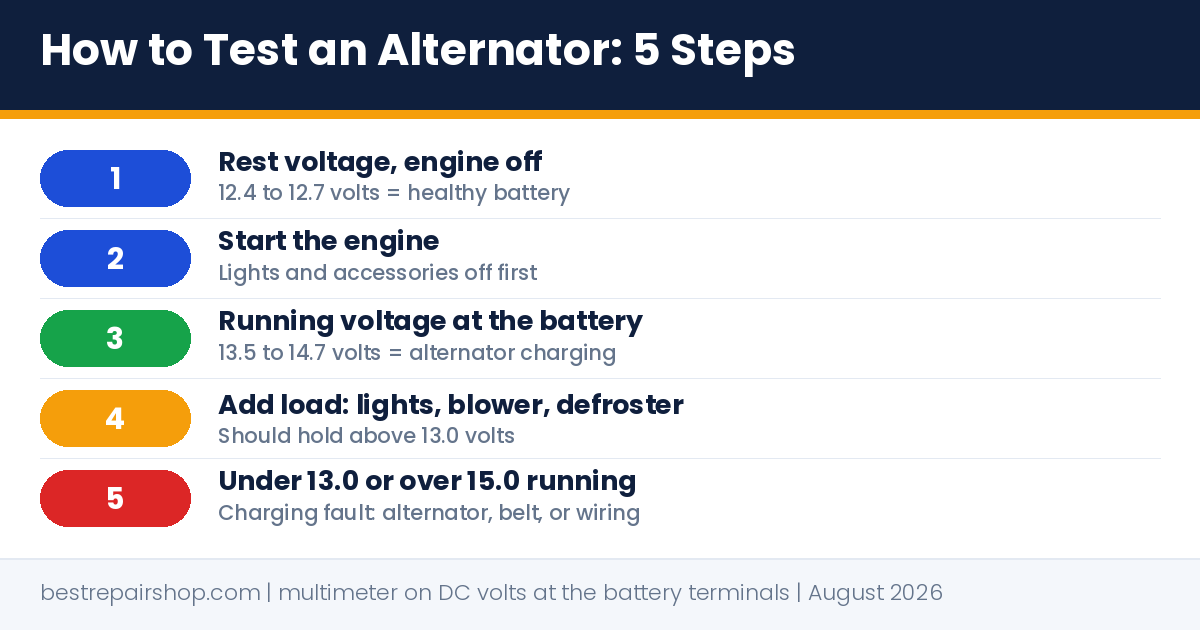
The Two Numbers That Tell You Everything
I have watched a lot of people buy batteries the way you buy lottery tickets: hopefully. The car would not start, the parts counter was open, and $200 later the real problem, a tired alternator, was still bolted to the engine. Two voltage readings would have told the whole story.
Reading one: battery at rest. With the engine off and the car sitting for at least an hour, a healthy battery reads 12.4 to 12.7 volts. Reading two: battery with the engine running. Now the alternator is in charge, and the same terminals should read 13.5 to 14.7 volts. No jump means no charging, and no new battery will fix that for long.
How to Test Alternator Output in 5 Steps
Step 1: set up. Buy any basic multimeter, $20 to $40, and turn the dial to DC volts, the 20 volt setting if it has one. Park, engine off, lights and accessories off. Pop the hood and find the battery.
Step 2: rest voltage. Touch the red probe to the battery positive terminal and the black probe to negative. Write the number down. 12.4 to 12.7 volts is healthy; around 12.0 it is half dead, and below 11.8 it may not start the car at all.
Step 3: start the engine and measure again at the same terminals. You want 13.5 to 14.7 volts. If the number barely moved from your rest reading, the alternator is loafing.
Step 4: add load. Headlights on, blower on high, rear defroster on. Voltage will dip, but a healthy charging system holds above 13.0 volts. Sagging into the 12s under load is a charging system waving a white flag.
Step 5: judge it. Under 13.0 volts running, or over 15.0, means a charging fault: alternator, belt, or wiring. In range with a weak rest reading, the battery itself is the patient. That is how to test alternator output, start to finish, and it is the same test a shop starts with.
No Multimeter? Use the Headlight Test
The folk version of how to test alternator health costs nothing. At night, park facing a wall, engine idling, headlights on. Have a helper rev it gently to about 2,000 rpm. Healthy system: the beam stays steady or brightens just slightly. Failing system: the lights noticeably dim at idle, flicker, or swing bright and dim with engine speed.
It is crude and will not catch a marginal alternator, but paired with a battery warning light or a whine from the front of the engine, it is reason enough to get real numbers before spending real money.
Free Charging System Tests at Parts Stores
Most national parts chains will test your battery and charging system free in about five minutes. Take it. Just remember who is holding the tester: a store that sells batteries and alternators. Treat the printout as data, not a verdict, and ask for the actual voltage numbers, not just the words “replace recommended.”
The FTC’s auto repair guide makes the same point about repair decisions generally: get the findings in writing and you are free to say no. More warning-sign guides live in our symptoms library.
Battery or Alternator: Reading Your Results
Low rest voltage but a strong 13.5 plus running voltage: the battery is weak and the alternator is fine. Healthy rest voltage but a running reading stuck near 12: the alternator is not charging. Both readings low: check the simple stuff first, corroded terminals and a loose or glazed serpentine belt, because a $6 cleaning brush has ended plenty of “alternator jobs.”
A rapid clicking when you turn the key is usually a starved battery, not a dead starter; we walk through it in car clicking and not starting. And if the verdict really is the alternator, know what the job should cost before anyone quotes you: our alternator replacement cost guide has the fair 2026 numbers.
What Ten Minutes of Testing Saves You
This is the invoice math that makes knowing how to test alternator output worth your Saturday morning. Guess wrong on a battery and you are out $150 to $300 with the original problem still under the hood. Guess wrong the other way and you pay for an alternator when a battery would have done.
| Item | Fair range |
|---|---|
| Basic multimeter, one time buy | $20-$40 |
| Parts store charging test | Free |
| Car battery, installed | $150-$300 |
| AGM battery, installed | $200-$350 |
| Alternator, replaced | $350-$900 |
| Shop diagnostic hour | $75-$200 |
Ranges are national, independent-shop figures, August 2026. Dealers typically run higher; your region and your specific car move the numbers too.
FAQ
Can I test an alternator by disconnecting the battery while the engine runs?
No. That trick worked on carbureted farm trucks and can destroy the electronics on anything built this century, sending a voltage spike through modules that cost more than the alternator. Use a multimeter instead.
What voltage means the alternator is bad?
With the engine running, anything consistently under 13.0 volts means the alternator is undercharging, and anything over 15.0 means it is overcharging, which cooks batteries. The healthy running range is 13.5 to 14.7 volts.
Will a failing alternator turn on the check engine light?
Usually you get the battery-shaped warning light first, and on many cars low system voltage will eventually trip the check engine light too. Dim headlights, slow power windows, and lost radio presets are common companions. Our check engine light guide covers how to pull the codes free.
How long can I drive with a failing alternator?
Once the alternator quits, you are running on whatever the battery has left: often 30 minutes to an hour by day, much less at night with lights and wipers. Drive straight home or to the shop, and skip every accessory you can.