
A battery light on while you are driving means the charging system has stopped feeding the battery, and the car is now running on stored power alone. Most cars have 20 to 60 minutes before they stall. Turn off every accessory you can, skip any extra stops, and head straight home or to a shop. The usual fix is an alternator at $350 to $900, not a battery.
On this page: What it means The 4 things How far you can go Battery or alternator Costs FAQ
What that little battery icon really means
The battery icon is one of the most misread lights on the dash. It rarely means the battery itself is bad. It means the charging system, usually the alternator, has stopped sending power back to the battery while you drive. Your car is now spending savings with no paycheck coming in.
Every electrical system in the car, spark included, is drawing from stored battery power. When that runs out, the engine quits, wherever you happen to be. That is why a battery light on the highway deserves quick, calm action instead of a shrug. Our symptoms library translates the rest of what your car is telling you.
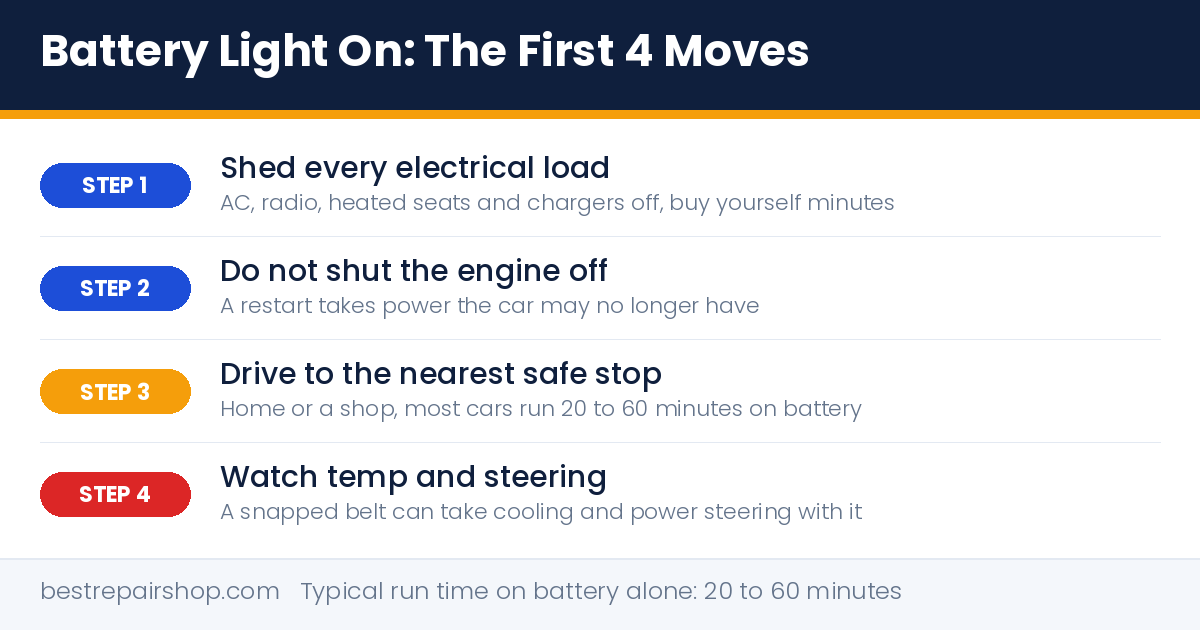
Battery light on while driving: do these 4 things
1. Shed every electrical load you can. Turn off the AC blower, the radio, the heated seats, and unplug the phone chargers. Headlights stay on if it is dark, safety first, but everything optional goes dark. Every amp you cut buys minutes.
2. Do not shut the engine off until you are somewhere safe. Restarting takes a big gulp of battery power, and a car with a dead charging system may not have it. Skip the drive-through and the gas station; keep it running.
3. Head to the nearest good stopping point. Home if it is close, a repair shop if one is on the way. At night or in the rain, with headlights and wipers pulling power, your window shrinks fast, so pick the closer option.
4. Watch the temperature gauge and the steering feel. On many cars, one serpentine belt drives the alternator, the water pump, and the power steering pump. If that belt snapped, the temperature needle will climb and the wheel will get heavy. If either happens, pull over and call the tow.
How far can you actually go
Drivers always ask how long a car will run with the battery light on. A healthy battery can typically run a modern car for 30 to 60 minutes with the loads trimmed, and an older or weaker battery gives you noticeably less. Plan on 20 minutes and be glad for more.
When voltage sags low enough, the fuel injection, the ignition, and the computer all quit at once, and that can happen at speed. If the dash starts flickering or the gauges twitch, you are in the final minutes. Get off the road while the car can still move itself.
Is it the battery or the alternator?
Nine times out of ten, a charging warning traces back to the alternator or its belt, not the battery. Batteries tend to fail quietly, as a slow crank on a cold morning, and they last 3 to 5 years. Alternators fail loudly, with a warning light in the middle of a drive. Most shops and parts stores will test the whole charging system in about 15 minutes. You can also do it yourself with a $20 multimeter; our guide on how to test an alternator walks through it in 5 steps.
Beware the parts-cannon fix. A new $150 to $300 battery feels like an easy answer, but if the alternator is dead, it will drain it in under an hour and strand you twice. Test first, then buy. And if tomorrow morning you get a click instead of a crank, that is a different clue; see our guide to a car that clicks and will not start.
What the fix usually costs
Here is what the common fixes behind this light cost at independent shops.
| Repair | Fair price | Notes |
|---|---|---|
| Charging system test | Free-$100 | Free at most parts stores |
| Battery cable cleaning | $0-$50 | Corroded terminals mimic bigger failures |
| Serpentine belt | $100-$250 | The cheap fix when it is just the belt |
| Alternator replacement | $350-$900 | The most common repair for this light |
| Battery replacement | $150-$300 | AGM batteries run $200-$350 |
Ranges are national, independent-shop figures, August 2026. Ask for the charging test numbers in writing before approving an alternator; the FTC’s auto repair basics guide backs you up on getting a written estimate first. For the full breakdown of parts, labor, and the reman-versus-new question, see our alternator replacement cost guide, and the costs hub covers fair prices for every common repair.
FAQ
Can I keep driving with the battery light on?
Only far enough to reach somewhere safe. With the battery light on, you are on borrowed time, usually 20 to 60 minutes. Finishing a road trip on it is a tow bill waiting to happen. Stop at the first sensible place and get the charging system tested.
Will a jump start fix it?
No. A jump start treats a dead battery, and your problem is the system that charges it. Jumping the car will get it running, but only until the borrowed charge runs out. If you do need a jump to reach the shop, connect the cables in the safe order: red to the dead battery, red to the donor, black to the donor, black to bare metal on the dead car.
Why did the light come on and then go off?
A flickering or intermittent light usually points to a failing voltage regulator, worn alternator brushes, or a belt that slips when wet or cold. Intermittent does not mean fine; it means failing slowly. Get it tested this week, on your schedule, instead of next week on the side of the road.
Does it mean I need a new battery?
Usually not; the alternator is the common culprit. But a battery that has been run flat by a bad alternator, especially one already 3 to 5 years old, may never fully recover. Have both tested together. If the battery fails, expect $150 to $300 installed; our car battery replacement cost guide shows the fair numbers by type.