
An automotive diagnostic trouble code is the five-character label your car records when a system drifts out of spec, and you can read it for free at most parts stores or with a $20 to $40 plug-in scanner. The first letter tells you the family: P for powertrain, B for body, C for chassis, U for network. Reading the code costs nothing. Turning it into a verified cause is the part worth paying a shop $75 to $200 for.
On this page: Code anatomy The 5 families Generic vs brand Free reads Fair next steps Costs FAQ
What the five characters mean
Pull a code and you get something like P0420. The first letter names the system. The second character tells you who wrote the definition: 0 is generic, the same on every car sold in the United States since 1996, and 1 is manufacturer-defined. The third character points at the subsystem, and the last two digits name the specific fault. P0420 reads as powertrain, generic, emissions, catalyst efficiency below threshold. We walk that exact code end to end in our P0420 guide.
The third character is the one worth memorizing, because every automotive diagnostic trouble code uses the same map: 1 and 2 are fuel and air metering, 3 is ignition and misfire, 4 is emissions, 5 is speed and idle control, 6 is the computer itself, 7 and 8 are transmission. One digit tells you which end of the car is complaining before you spend a dollar.
The 5 automotive diagnostic trouble code families
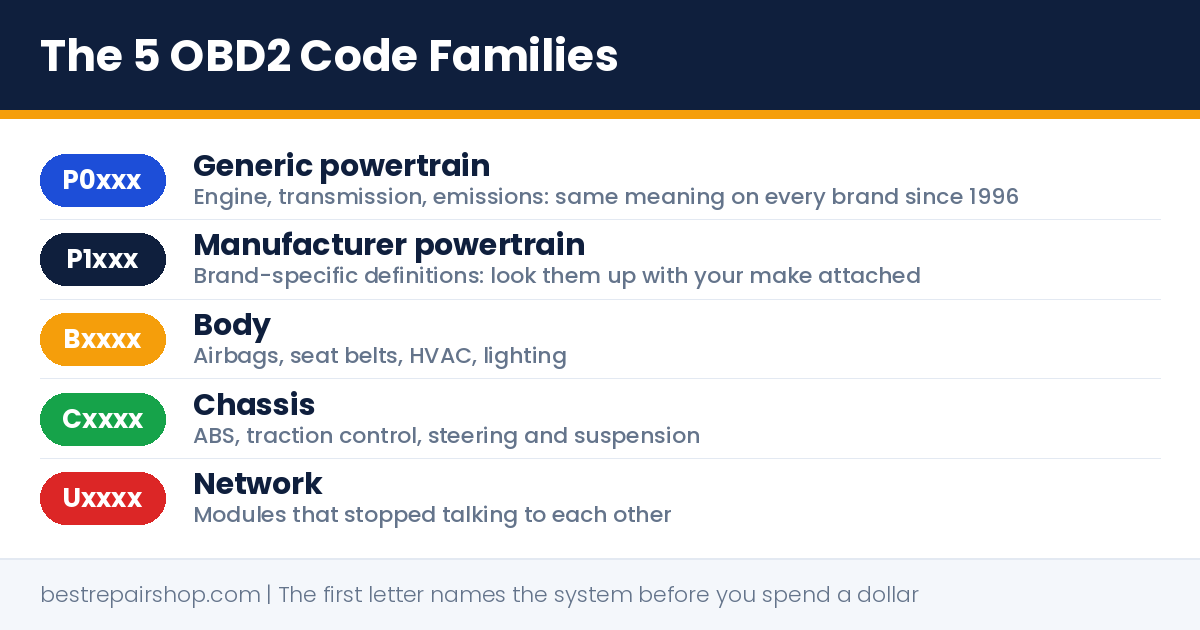
P0 codes are generic powertrain: engine, transmission, fuel and emissions faults with the same meaning on every brand. Roughly nine out of ten codes you will ever pull live here, and any cheap reader handles them.
P1 codes are manufacturer powertrain. The letter is the same, but the definition belongs to your automaker, so a bargain scanner may show a blank or borrowed description. Look P1 codes up with your make attached, not from a generic obd2 codes list.
B codes cover the body: airbags, seat belts, HVAC, lighting. C codes cover the chassis: ABS, traction control, steering and suspension sensors. U codes are network faults, which means two computers stopped talking to each other. A U code sitting next to a pile of others is often the breadcrumb, not the crime.
Generic vs manufacturer: why the second character matters
The 0 versus 1 split decides how far a free reader gets you. Generic definitions are public and standardized, so the dtc codes a parts store prints are trustworthy as written. Manufacturer codes change meaning between a Ford and a Honda, and a $20 tool will happily guess at a brand-specific definition. When that character is a 1, treat the printed description as a rumor until confirmed for your make.
3 ways to read codes without paying
First, parts stores. AutoZone, O’Reilly and Advance pull codes free in most states and hand you a printout. Second, a Bluetooth OBD2 dongle for $20 to $40 turns your phone into a permanent reader. Third, check the federal side: run your VIN at NHTSA’s recall lookup, since some faults are known defects the dealer must fix for free.
Write down every code before anyone clears anything. Clearing erases the freeze-frame data a good technician uses, and the light returns anyway if the fault is real. If the light is on right now, our check engine light guide covers the steady versus flashing question first.
What a fair shop does with your code
A code names a circuit or a condition, never a part. P0420 does not mean buy a catalytic converter; it means the computer saw catalyst efficiency drop, which an exhaust leak or a lazy sensor can fake. A fair shop treats an automotive diagnostic trouble code as the starting line: they verify it, test the circuit, and put the code number and tests on a written estimate before you approve anything. The FTC’s auto repair basics page backs you up on requiring that estimate up front.
Expect a diagnostic hour at $75 to $200, and ask whether it credits toward the repair, since many independents apply it. A shop that quotes a big-ticket part from the code alone, with no testing, is guessing with your money. Our guide to finding a good mechanic lists the other tells, and the symptoms library decodes the other warning lights.
What chasing a code costs
Here is the honest math on chasing an automotive diagnostic trouble code in 2026. The read should be free. The diagnosis is worth paying for. The guess is the expensive line on the menu.
| Item | Fair range |
|---|---|
| Code read at a parts store | Free |
| Bluetooth OBD2 scanner you keep | $20-$40 |
| Shop diagnostic hour | $75-$200 |
| O2 sensor replaced on a guess | $150-$400 |
| Catalytic converter, the P0420 worst case | $900-$2,400 |
Ranges are national, independent-shop figures, August 2026. Our check engine light diagnosis cost guide breaks down what is fair by shop type.
Code reading FAQ
Will disconnecting the battery clear a code?
It clears the memory, but it also wipes the readiness monitors your state emissions test looks for, so you can fail an inspection with no light on. And if the fault is real, the code returns within a few drive cycles.
Is it safe to drive with the light on?
A steady light with no drivability change usually buys you a few days to get it read. A flashing light means an active misfire is dumping raw fuel into the exhaust, which can cook a $900 to $2,400 catalytic converter in minutes. Pull over and call for a tow on that one.
Do free parts store readers pull ABS and airbag codes?
Usually not. The free counter tools speak generic powertrain, so the B, C and U families typically need a bidirectional scanner at a shop. If your ABS or airbag light is on, budget for a diagnostic hour.
What is a permanent automotive diagnostic trouble code?
A permanent code, or PDTC, cannot be cleared by a scanner or a battery disconnect. The computer erases it on its own only after it verifies the fix across enough drive cycles. Emissions programs in several states now check for them, which killed the old clear-it-and-test trick.