
The AutoZone check engine light check is genuinely free: an employee plugs a reader into your OBD2 port, pulls the code, and prints it with no purchase required, and O’Reilly and Advance do the same. What you are getting is a code read, not a diagnosis. That difference is why shops charge $75 to $200 for testing, and why the smart move is to take the free code and leave the recommended parts list on the counter.
On this page: How it works The honest part Where upsells start When to pay Costs FAQ
How the AutoZone check engine light check works
Park, walk in, ask for a code read. A counter employee brings a handheld reader to your car, plugs it into the OBD2 port under the dash, and pulls whatever codes are stored. You leave with a printout listing each code, a plain-English description, and a list of parts the system associates with it. The whole thing takes about five minutes, no appointment needed.
Two caveats. A few states restrict parking-lot reads, so call ahead if your local store hesitates. And most chains have stopped clearing codes for liability reasons, which is fine, because you should not clear a code before the fault is fixed anyway.
The honest part: what the free read does well
The code itself is real. Generic powertrain codes are standardized on every car sold since 1996, so the P0301 on an AutoZone check engine light printout is the same P0301 a $150 diagnostic session would start from. For triage, that is worth a lot: you learn whether you are looking at a loose-gas-cap code or a misfire, and you can call shops quoting a code number instead of describing a mystery light.
The free read also beats guessing about urgency. A steady light with an evap code can wait for a convenient appointment; a flashing light cannot. Our check engine light guide sorts that out, and while you are at it, run your VIN at NHTSA’s recall page, because some faults are recall repairs the dealer owes you for free.
Where the upsell starts: the parts list
The printout’s recommended-parts section is where a free read quietly turns into a $300 mistake. The system maps each code to parts the store sells, and that mapping ignores the most important rule in diagnostics: the sensor reporting a problem is usually not the part that caused it. An oxygen sensor code often traces to a vacuum leak. A misfire code can be a $7 spark plug or a failing coil. A P0420 can be an exhaust leak faking out a healthy converter.
Nobody behind the counter is a villain here. They sell parts, and the printout is a parts-selling document. The honest way to use it: keep the code, ignore the shopping list, and spend your money on testing or a verified fix. Throwing an O2 sensor at a code costs $150 to $400 and leaves the real fault in place about half the time we see it tried.
When paying a shop beats the free read
Pay for a real diagnosis when the light is flashing, when the car drives differently, when the same code returns after a repair, or when the fault is in the ABS, airbag or network families the counter reader cannot see. A diagnostic hour at $75 to $200 buys a technician testing circuits and confirming the cause, and many independents credit that fee toward the repair if you approve the work. Ask before you book; it is the question that separates good shops fast.
Get the estimate in writing before any work, with the code number on it. The FTC’s auto repair basics page confirms you are entitled to that. Our good mechanic checklist and the rest of the trust hub cover how to vet the shop before you hand over a key.
What each path costs
Every AutoZone check engine light visit should end with you holding a code and an unspent wallet. The costs start with what you do next, and the cheapest next step is rarely the parts counter.
| Item | Fair range |
|---|---|
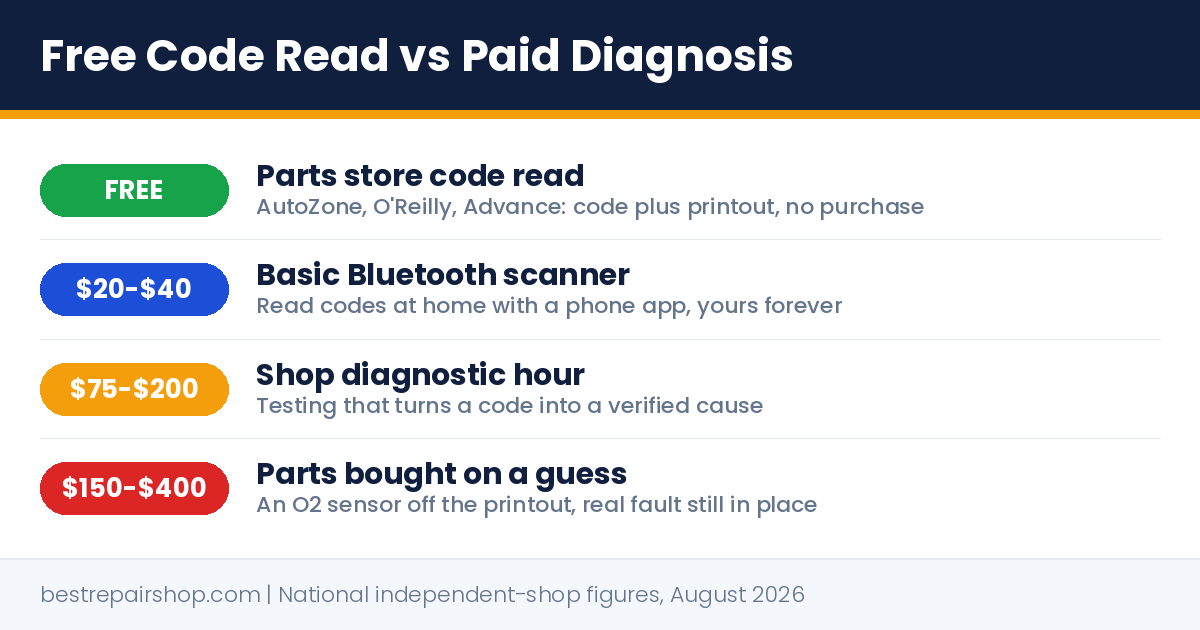
| Parts store code read (AutoZone, O’Reilly, Advance) | Free |
| Bluetooth OBD2 scanner you keep | $20-$40 |
| Independent shop diagnostic hour | $75-$200 |
| O2 sensor bought off the printout | $150-$400 |
| Catalytic converter if the guess was wrong | $900-$2,400 |
Ranges are national, independent-shop figures, August 2026. Our check engine light diagnosis cost guide breaks down what is fair by shop type, including when a diagnostic fee should be waived.
Free code read FAQ
Is the AutoZone check engine light check really free?
Yes. No purchase, no obligation, and the printout is yours to keep. The store makes its money when the printout convinces you to buy parts, which is exactly why the read is free. Take the code, say thanks, and feel zero pressure at the register.
Will the store clear my code?
Most locations no longer clear codes, and a few states restrict reads entirely. It rarely matters: if the fault is real the light returns within a few drive cycles, and permanent codes cannot be cleared by any handheld tool at all. Fix the fault first and the light goes out on its own.
Should I buy the part listed on the printout?
Not from the code alone. Codes report symptoms, and the listed part is the most commonly associated one, not a verified cause. If the gamble is cheap, like a gas cap or a spark plug, it can be a reasonable bet. Past $100, pay for testing first.
Does the free read cover ABS, airbag or traction lights?
Generally no. Counter readers speak generic powertrain, and the B, C and U code families need a more capable scanner. If one of those lights is on, skip the parts store and go straight to a shop, because those systems earn their diagnostic hour.