
Most engine ticking noise is your car talking, not screaming: normal injector clatter, or a valvetrain tap that starts out cheap to fix. Check the dipstick first, because low oil causes more ticking than anything else and the fix can cost $6. A tick that survives a fresh oil change usually lands between $150 and $1,500, while a deep knock that speeds up with rpm means park the car today.
On this page: Normal ticks Check oil first Lifter tick Exhaust leak Stop driving signs Costs FAQ
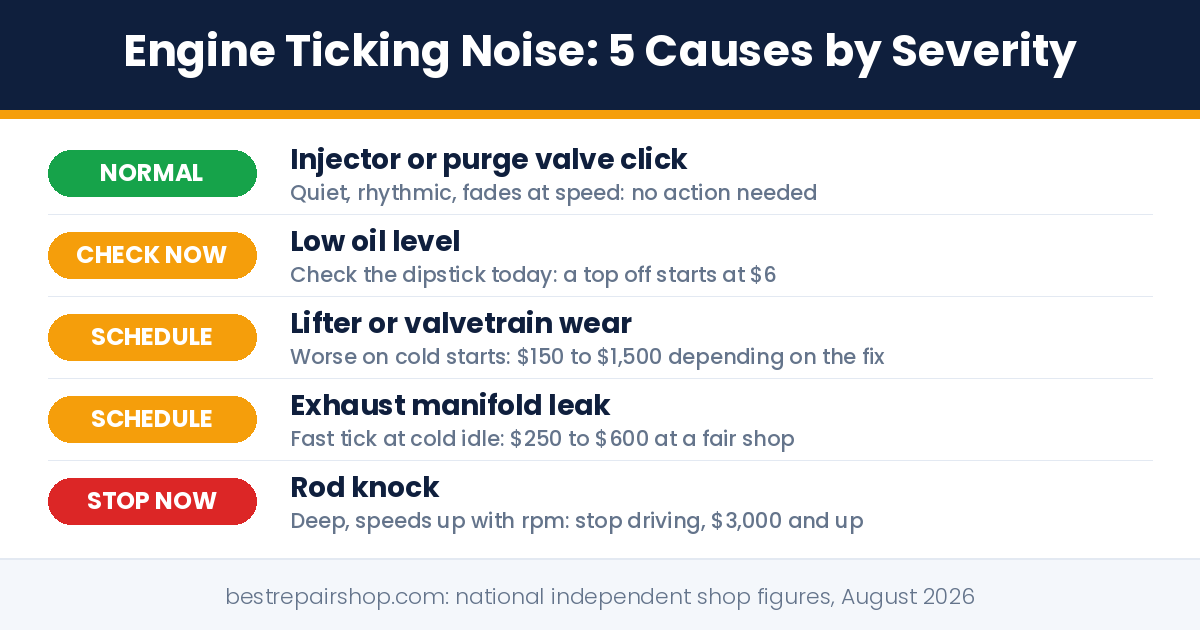
What an engine ticking noise usually means
Your engine has dozens of small parts that click on purpose. Fuel injectors pulse open and closed thousands of times a minute, and on many direct injection engines they are simply loud. The purge valve for the fuel vapor system clicks rhythmically at idle too. These ticks are quiet, steady, and fade into the background once you are moving. If the sound has been there since you bought the car and never changes character, it is very likely the engine’s normal voice.
The engine ticking noise that deserves attention is the one that is new, that gets faster as the engine revs, or that changes with temperature. Speed and timing are the clues a good tech listens for, and you can hear them yourself from the driver’s seat with the radio off.
Check your oil before you spend a dollar
Low oil is the single most common cause of a new tick, because the valvetrain at the top of the engine is the first place to lose oil pressure. Park on level ground, wait five minutes, and pull the dipstick. If it reads low, top off with the oil grade printed on your cap: a quart runs $6 to $15 and the tick often quiets within minutes.
If you are low, also ask why. An engine that burns or leaks a quart between changes needs watching, not panic. Our guide to how often to change your oil covers honest intervals, and the oil change cost guide shows what a fair shop charges: $65 to $125 for synthetic.
Lifter tick: the cold morning complainer
Hydraulic lifters are small oil-filled cushions that take up slack in the valvetrain. When they wear or bleed down overnight, you get a tick that is loudest on a cold start and softens as oil circulates. A fresh oil change in the correct viscosity quiets many of them. On engines with mechanical adjusters, a valve adjustment at $150 to $300 does the job.
If a lifter has physically failed, the tick stays loud warm or cold. Replacement is real labor, $500 to $1,500 depending on how deep the engine design buries them. It is not an emergency in the first days, but a collapsed lifter left ticking for months can wear the camshaft and multiply the bill.
Exhaust manifold leak: the tick that fades as it warms
A cracked exhaust manifold or failed gasket makes a fast tick or puff at cold idle, because hot gas escapes the gap on every cylinder firing. As the metal warms and expands, the gap closes and the sound fades or disappears. That warm-up pattern is the giveaway. A gasket job at an independent shop runs $250 to $600. Fix it sooner rather than later: exhaust leaks upstream can skew sensor readings and can let fumes reach the cabin.
When ticking means stop driving
A rod knock is the sound nobody wants: deeper than a tick, it speeds up exactly with engine rpm and gets louder under load. It means a bearing deep in the engine is dying, and driving on it turns a big repair into a replacement engine at $3,000 to $7,000. If your tick is deep, rhythmic, and rev-dependent, or the oil pressure light flickers, stop driving and get a tow.
One more free check: some engines have known factory defects that cause ticking and knocking, and a few have been recalled for it. Run your VIN at the NHTSA recalls lookup before you pay for any diagnosis. If a recall covers your engine, the repair is free.
What each fix costs in 2026
| Fix | Fair 2026 price | Urgency |
|---|---|---|
| Top off low oil | $6-$15 | Today |
| Synthetic oil change | $65-$125 | This week |
| Valve adjustment | $150-$300 | Within a month |
| Exhaust manifold gasket | $250-$600 | Within a month |
| Lifter replacement | $500-$1,500 | Soon, before cam damage |
| Rod bearing or engine | $3,000-$7,000 | Stop driving now |
Ranges are national, independent-shop figures, August 2026. Diagnosing an engine ticking noise takes a shop under an hour, so a diagnostic charge above $200 deserves a question. Browse our full symptoms library if the sound you hear is more of a squeal, grind, or hum.
FAQ
Is it safe to drive with an engine ticking noise?
Usually yes, briefly. A quiet, steady tick that does not change with rpm is normal on many engines. A new tick with a full dipstick can wait days, not months. A deep knock that speeds up with the engine, or any tick with the oil light on, means stop driving immediately.
Can an oil change fix a ticking engine?
Often, yes. Low oil, old thinned-out oil, or the wrong viscosity are behind a large share of lifter ticks. A fresh change in the grade your oil cap specifies costs $65 to $125 at a shop and is the cheapest diagnostic step there is. If the tick survives the change, then it is time for a real inspection.
Why does my engine only tick when cold?
Two favorites: lifters that bled down overnight and refill as oil circulates, and exhaust manifold leaks that seal themselves as the metal expands. Both are schedule-it repairs, not emergencies. Note whether the tick fades in the first two minutes and tell your shop, because that detail narrows the diagnosis fast.
What is the difference between a tick and a knock?
Pitch and depth. A tick is light and metallic, from the top of the engine, and often steady at idle. A knock is deeper, comes from low in the block, and rises and falls exactly with rpm. Ticks are usually hundreds of dollars. Knocks are usually thousands, and every mile driven adds to it.