
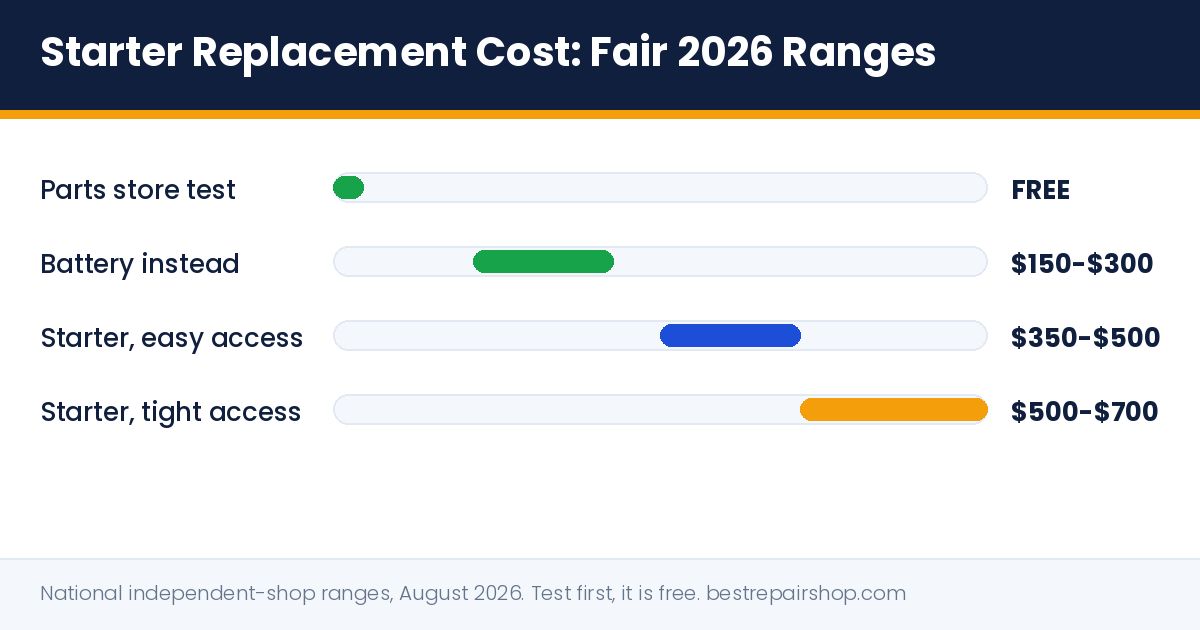
A fair starter replacement cost in 2026 is $350 to $700 parts and labor at an independent shop. Easy-access starters land near the bottom of that range; starters buried under an intake manifold push the top. Before you approve anything, get the free starter and battery test at a parts store, because a $150 to $300 battery fixes half the “bad starter” no-starts I have seen invoiced.
On this page: Fair price Free test first Battery or starter Why prices vary 2026 numbers FAQ
Starter Replacement Cost: What Is Fair in 2026
The invoice has three lines that matter: the part, the labor, and the diagnosis that should have happened first. A quality new or remanufactured starter runs $150 to $350 at retail parts pricing. Labor runs one to three hours at $75 to $200 per hour depending on where the starter lives. Put together, $350 to $700 covers the honest middle of the market for most cars and light trucks.
Where invoices go sideways is part markup. A shop quoting $480 for a starter that retails at $220 is padding, not profiting fairly; a reasonable markup is 25 to 50 percent over their cost. The FTC’s auto repair basics back you up here: get a written estimate before work starts, and ask for the part brand, part number, and your old starter back.
The Free Test to Do Before You Spend a Dime
If the car will start with a jump, drive it straight to a chain parts store. Most will test your battery, starter draw, and charging output in the parking lot for free, in about 15 minutes, no appointment. That one stop tells you which of three parts is actually guilty, and it can save you the entire starter replacement cost when the real problem is a tired battery.
If the car will not move at all, use your ears. One solid loud click with bright headlights points at the starter or its wiring. A rapid machine-gun clicking points at a weak battery or corroded connections. We break down every version of that sound in our guide to a car that clicks but will not start.
Battery, Starter, or Alternator: Reading the Clues
Cranking that got slower over weeks, on a battery past year three, is usually the battery: $150 to $300 installed, and you can price it in our battery replacement cost guide. A battery that keeps dying after replacement, or a car that stalls while driving, points at the alternator instead: see our alternator replacement cost guide and the $20 multimeter test before buying anything.
The starter earns the blame when the battery tests good, the lights are bright, and the engine still will not spin, or spins only after several tries. Heat soak is another tell: a starter that works cold but refuses after a hot highway run is a classic failing starter. A shop that swaps parts in that order, cheapest test first, is a shop worth keeping.
Why the Same Job Runs $350 at One Shop and $700 at Another
The biggest variable in starter replacement cost is not the part, it is access. On many 4-cylinder sedans the starter sits in the open, low on the block: one hour of labor, done. On plenty of V6 and V8 layouts it hides under the intake manifold or behind exhaust plumbing, and honest book time jumps to three hours before anyone has done anything wrong.
The other variables are part tier and shop rate. A dealership using a factory-new starter at a $180 per hour rate will land 20 to 40 percent above an independent using a quality remanufactured unit. That premium buys a badge on the box, not a better crank. If the quote tops $700 on a common vehicle, ask which of these three variables put it there and make them show the book time.
Fair 2026 Numbers at a Glance
| Item | Fair 2026 range |
|---|---|
| Battery, starter, charging test at a parts store | Free |
| Battery, if that is the real fault | $150-$300 |
| Starter, easy access | $350-$500 |
| Starter, tight access, intake or shields off | $500-$700 |
Ranges are national, independent-shop figures, August 2026. One more free check before you pay: run your VIN through NHTSA’s recall lookup. Starter and ignition wiring issues occasionally appear as recalls, and recall repairs cost you nothing at the dealer.
FAQ
How long does starter replacement take?
One to three hours in most cases. Easy-access starters are an hour of labor; buried ones take two to three because of the parts that must come off first. If a shop quotes four or more hours, ask them to show you the published book time for your engine.
Can you jump start a car with a bad starter?
No. A jump feeds the battery, and the starter is downstream of it. If a jump gets you going, your problem was the battery or its connections, which is good news for your wallet. The old trick of tapping the starter body while someone turns the key can free a stuck solenoid once or twice, but it is a tow-avoider, not a repair.
How long do starters last?
Typically 100,000 to 150,000 miles, and plenty outlive the car. Short-trip city driving wears them fastest because each mile comes with more start cycles. There is no maintenance schedule for a starter: you replace it when it fails the test, not before.
Is it cheaper to replace a starter myself?
If the starter is accessible, yes: the part is $150 to $350, the job is two bolts, two wires, and a battery disconnect, and DIY cuts the starter replacement cost roughly in half. Expect a core charge refunded when you return the old unit. On buried starters, the shop’s three hours are earned, and most DIYers are happier paying for them.