
How long do tires last? Most all-season tires go 50,000 to 70,000 miles or about 6 years, whichever comes first. Performance tires wear out in 25,000 to 40,000, and no tire should serve past 10 years regardless of tread. Two free driveway tests, a quarter and a glance at the date code, tell you where yours stand today.
On this page: Miles by tire type The 6 signs Two free tests Make them last longer FAQ
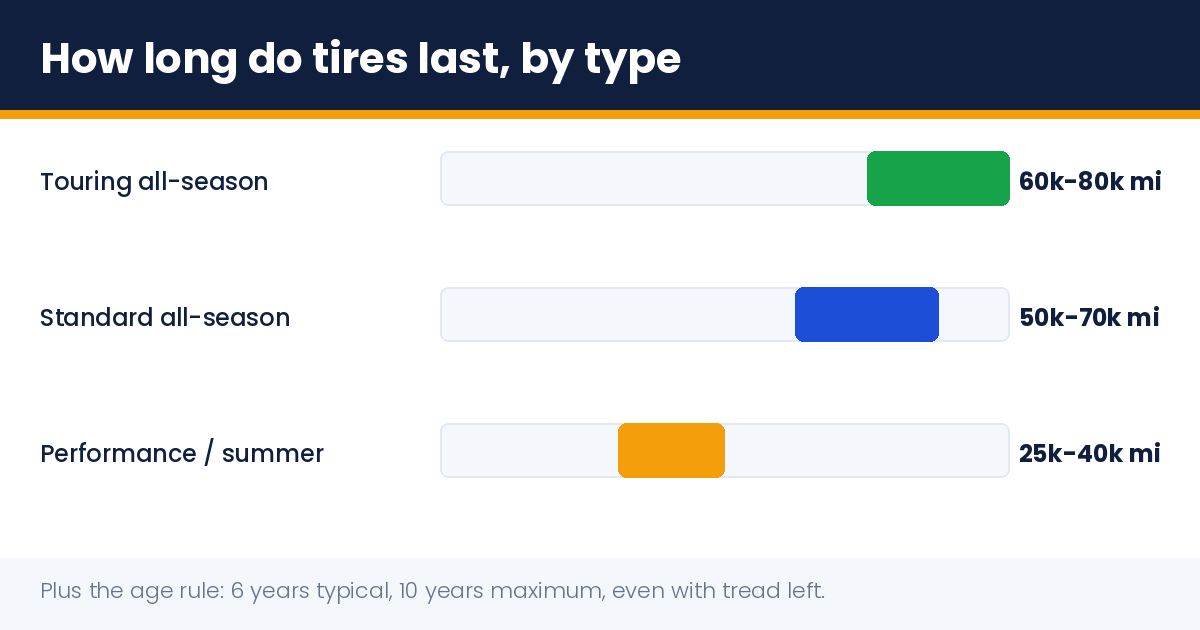
How long do tires last by type
| Tire type | Honest lifespan | Note |
|---|---|---|
| Touring all-season | 60,000-80,000 mi | The long-life champions |
| Standard all-season | 50,000-70,000 mi | Most cars ride on these |
| Performance / summer | 25,000-40,000 mi | Grip is traded for wear |
| Winter tires | 4-6 seasons | Soft compound; never run them all summer |
| Any tire, by age | 6 years typical, 10 max | Rubber ages even parked |
Figures reflect common manufacturer warranties and real-world averages as of July 2026. Your mileage literally varies: alignment, pressure, rotation habits, and how you corner move any tire thousands of miles in either direction, which is what the rest of this page is about.
The 6 honest signs your tires are done
1. Tread at the wear bars. Every tire has raised bars molded across the grooves at 2/32 inch, the legal limit in most states. Tread flush with the bars is a today problem, not a someday one.
2. Failing the quarter test. The details are below, but the summary is: if Washington’s head stays fully visible in the groove, the tire is at or under 4/32 and wet-weather grip is already fading fast.
3. Age past 6 years. Rubber hardens and micro-cracks with time whether you drive or not, which is why how long do tires last is a two-part question: miles and years. The date code below settles it.
4. Sidewall cracking or bulges. Fine web-like cracks mean aged rubber. A bulge means broken internal cords, and that tire is a blowout scheduling its own date; it gets replaced this week, not watched.
5. Uneven wear. Bald shoulders with a good center (underinflation), a bald center (overinflation), or one scrubbed edge (alignment) all end tires early. The tire is telling on another problem; replacing it without fixing the cause buys the same failure twice.
6. Repeated pressure loss or vibration. A tire that needs air weekly or hums and shakes at speed has something wrong inside the story, and our tire pressure light guide walks the leak-vs-sensor half of it.
The two free tests, in 60 seconds
The quarter test: insert a quarter upside down in the tread groove. Tread touching Washington’s head means 4/32 or better, fine for now. Head fully visible: start shopping. (The old penny test marks 2/32, the legal floor; by the time you fail Lincoln, you were done a while ago.) Check inner, middle, and outer grooves on each tire, because wear is rarely even.
The date code: find “DOT” on the sidewall and the last four digits, week and year. 3221 means week 32 of 2021, making that tire five years old in mid 2026. Past six years, inspect yearly and budget for the change; past ten, replace regardless of how much tread remains. NHTSA’s TireWise backs both habits with the crash data behind them.
How to make tires last longer (real numbers)
Three habits meaningfully change the answer to how long do tires last. Correct pressure, checked monthly, prevents the shoulder wear that ends tires 20 percent early and quietly saves fuel. Rotation every 5,000 to 8,000 miles evens the front-rear wear difference, worth roughly 10,000 miles of total life on many cars, and often free where you bought the tires. And an alignment when the car pulls, or after any big pothole hit, stops the single fastest tire-killer there is: a scrubbed edge can eat a new tire in under 10,000 miles. None of the three costs much, and together they usually add a year or more of service.
Tire lifespan FAQ
How long do tires last if I barely drive?
Age wins the race instead of miles: figure 6 years of confident service and 10 as the hard ceiling, even on a garage queen. Sun, heat, and time harden rubber whether or not it rolls.
Should I replace all four tires at once?
In pairs at minimum, with the newer pair on the rear (it keeps the back of the car planted in the wet, which is the stability that matters). All-wheel-drive cars are stricter: mismatched tread depths can strain the drivetrain, so many AWD makers require all four together.
Is it worth patching an older tire with a nail in it?
A $20 to $40 patch on a tire with 3+ years or 20,000+ miles left is great money. The same patch on a 7-year-old tire failing the quarter test is delaying a purchase by one rainstorm. Tread and date decide, not the nail.
Do cheap tires wear out faster?
Not reliably; some budget tires carry long warranties and some premium performance tires are gone in 25,000 miles. Wear rating and warranty miles are printed for exactly this comparison, so shop on those numbers, not the brand’s advertising budget.