
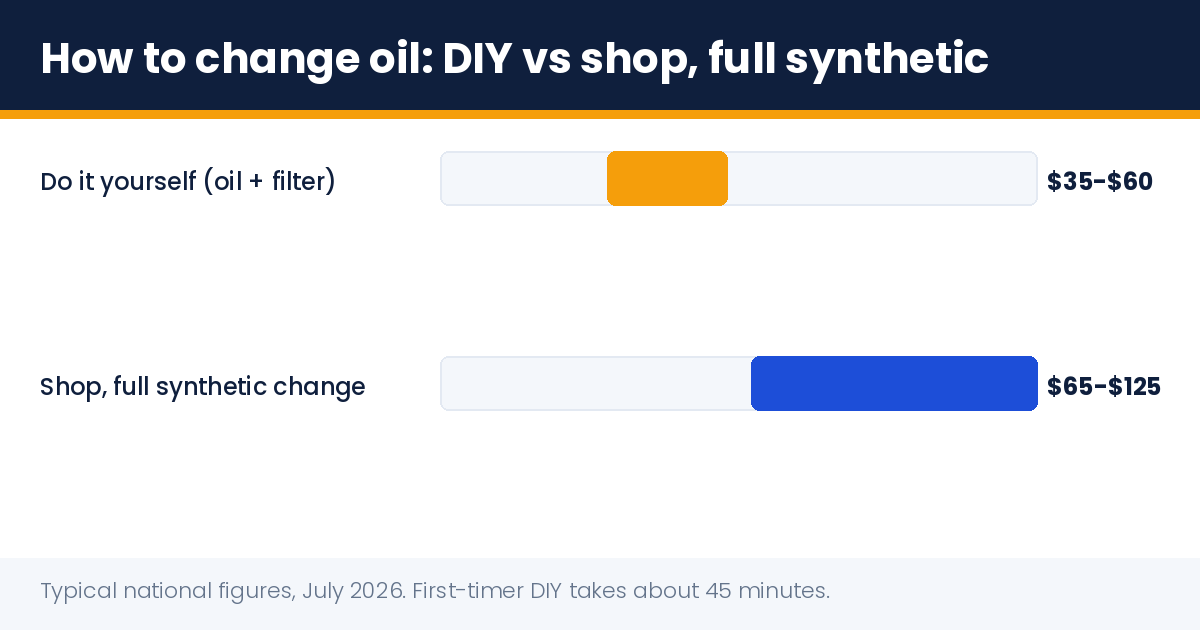
Learning how to change oil takes about 45 minutes and costs $35 to $60 in oil and filter, against $65 to $125 for a full synthetic change at a shop. You need a wrench, a drain pan, a filter, and the right oil. The whole job comes down to two bolts done right and one number from your owner’s manual.
On this page: What you need The 9 steps The two bolts Common mistakes Old oil disposal FAQ
What you need before you start
Before you learn how to change oil on your specific car, check your owner’s manual for two numbers: oil capacity (usually 4.5 to 6 quarts) and viscosity (0W-20 and 5W-30 are the common ones). Then gather: the right oil, the right filter for your engine, a drain pan, a wrench that fits your drain plug, a filter wrench, gloves, and a way to get under the car safely, meaning ramps or a jack plus jack stands. Never work under a car held only by a jack.
| Item | Typical 2026 cost | Note |
|---|---|---|
| 5 quarts full synthetic | $25-$45 | Match the viscosity in your manual |
| Oil filter | $5-$15 | Quality brand, correct part number |
| Drain pan, funnel, gloves | $15-$25 | One-time buy, lasts years |
| Shop change, full synthetic | $65-$125 | What you are saving against |
How to change oil in 9 steps
- Run the engine 2 to 3 minutes so the oil flows, then shut it off and set the parking brake.
- Raise the front on ramps or jack stands on flat ground. Shake-test the car before you go under.
- Place the drain pan under the drain plug, offset toward the rear, because the stream arcs.
- Loosen the drain plug counterclockwise with a wrench, then thread it out by hand and let the oil drain 5 to 10 minutes until it drips.
- Reinstall the drain plug with a new crush washer if your car uses one. Snug plus a quarter turn. Not gorilla tight.
- Move the pan under the filter, spin the old filter off, and check that its rubber gasket came off with it.
- Wipe the mounting surface, smear a fingertip of fresh oil on the new filter’s gasket, and spin it on hand tight plus a three-quarter turn.
- Lower the car and fill with the manual’s capacity through the filler cap, using a funnel. Pour the last half quart slowly.
- Start the engine 30 seconds, shut it off, wait 2 minutes, check the dipstick, top to the full mark, and check for drips at the plug and filter. Reset the oil life monitor.
The two bolts that decide everything
Almost every DIY oil change problem traces to the drain plug or the filter. The drain plug wants clean threads, a fresh crush washer, and moderate torque: snug, then about a quarter turn. Overtightening strips the threads in a soft aluminum pan, and that mistake turns a $40 oil change into a $400 repair. The filter wants its gasket oiled and hand tight plus three quarters of a turn. Too loose and it weeps; too tight and the next person needs a chisel. If you remember nothing else about how to change oil, remember those two settings.
The mistakes that cause leaks and worse
The classic is the double gasket: the old filter’s rubber ring stays stuck to the engine, the new filter seals against it badly, and the engine pumps its oil onto the road in minutes. Always look at the old filter and confirm the gasket came off with it.
Second is overfilling, which can foam the oil and starve the engine; fill to the manual’s number, not “a little extra for luck.” Third is draining the transmission by mistake on cars where the two plugs sit near each other; the oil drain plug is on the very bottom of the engine’s pan, and when in doubt, look up your engine before loosening anything. Fourth is forgetting the monitor reset, which leaves the car guessing wrong about its next change for months.
Old oil disposal is free
Pour the used oil into the empty jugs with a funnel and take it to any major auto parts store; nearly all accept used oil and filters free. Never pour it on the ground or into a drain, and most states make that illegal on top of being ugly. The whole disposal errand takes ten minutes on your next parts run.
DIY oil change FAQ
Does changing my own oil void the warranty?
No. Federal law protects your right to do your own maintenance. Keep receipts for oil and filters and note the date and mileage, so you can show the schedule was followed if a warranty claim ever comes up. The FTC’s auto repair guide covers this directly.
How long does a DIY oil change take?
Plan on 45 minutes the first time and closer to 25 once you have done it twice. The oil draining is most of the wait, and coffee fits nicely inside it.
Is learning how to change oil really worth the money?
On full synthetic, typically $40 or more per change once you own the basic tools. The bigger win for many people is control: you know exactly what oil went in and exactly how tight both bolts are.
What if I strip the drain plug or cannot get the filter off?
Stop and get help before forcing anything. A stuck filter yields to a $7 strap wrench. Stripped plug threads have real fixes (oversize plugs, thread inserts) that a good shop handles routinely, and knowing how to pick that shop keeps the save cheap.