
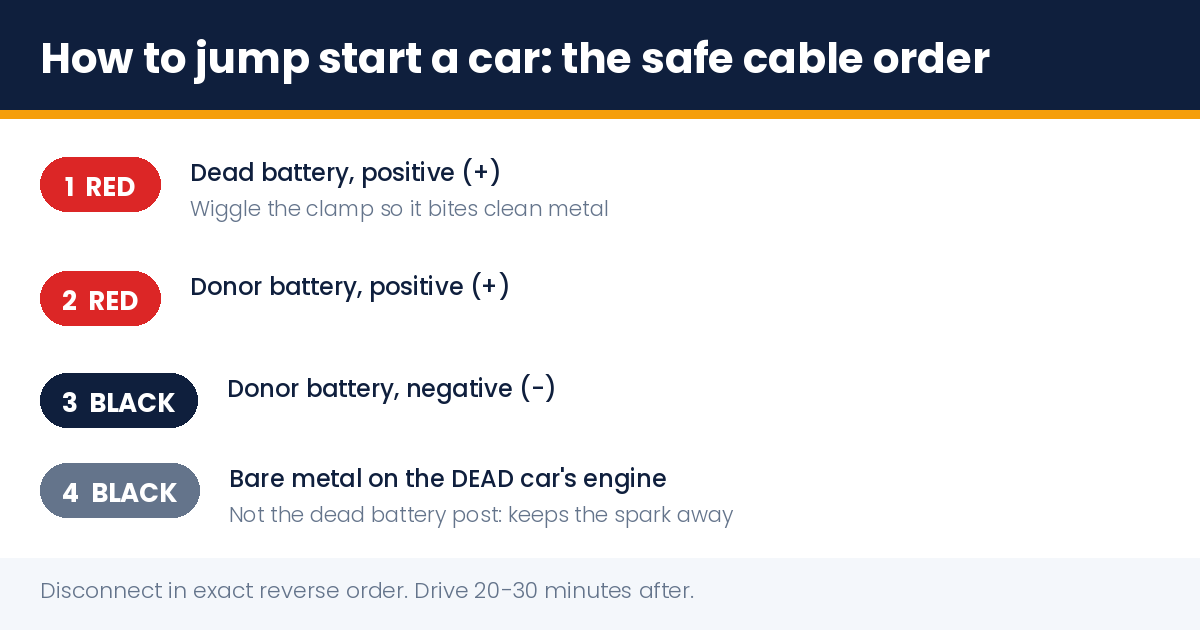
How to jump start a car, in one line: the safe cable order is red to the dead battery’s positive, red to the good battery’s positive, black to the good battery’s negative, black to bare metal on the dead car’s engine, away from the battery. Start the donor car, wait 2 to 3 minutes, then start the dead car. Disconnect in reverse order, and drive the revived car 20 to 30 minutes.
On this page: Before you clamp The 7 steps Why ground last If it will not start After the jump FAQ
Before you clamp anything
How to jump start a car safely begins before the cables. Look at the dead battery first. If the case is cracked, bulging, leaking, or the battery is frozen (possible after sub-zero nights if it was already weak), do not jump it; that is a tow and a replacement. Otherwise: park the donor car close, nose to nose or side by side, without the cars touching. Both cars off, keys out, headlights and accessories off, parking brakes set. Find each battery’s positive terminal (marked +, often under a red flip cover) and wipe off any corrosion crust so the clamps bite clean metal.
How to jump start a car in 7 steps
- Untangle the cables and keep the four clamps from touching each other from here on.
- Red clamp to the dead battery’s positive (+) terminal. Wiggle it so it grips metal, not paint or crust.
- Red clamp to the donor battery’s positive (+) terminal.
- Black clamp to the donor battery’s negative (-) terminal.
- Black clamp to bare metal on the dead car’s engine: an unpainted bolt head or bracket, at least a foot from the battery. Not the dead battery’s negative post.
- Start the donor car and let it idle 2 to 3 minutes, a little longer in the cold, then try the dead car. If it cranks weakly, wait 2 more minutes and try again.
- Once running, remove the clamps in exact reverse order: engine ground, donor negative, donor positive, dead positive. Keep them from touching until they are all off.
Why the last clamp goes to bare metal
The final connection always makes a small spark. A charging battery vents hydrogen, and a spark directly over the vents is the one genuinely dangerous moment in a jump start. Grounding to the engine block moves that spark a safe distance away and completes the same circuit. It costs nothing to do it right, which is the best kind of safety advice.
If it clicks, or will not take the jump
| What you hear | What it usually means | Next move |
|---|---|---|
| Rapid clicking | Not enough power reaching the starter | Re-seat clamps, wait 5 min, retry |
| One solid click | Often the starter, not the battery | See the clicking no-start guide |
| Nothing at all | Bad clamp contact or a dead-dead battery | Clean terminals, check ground point |
| Starts, then dies when cables come off | Alternator is not charging | Shop visit, not a new battery first |
Ten minutes into how to jump start a car with no progress, the problem stops being charge level. Clicking sounds are the battery world’s most misread signal, and we keep a whole walkthrough for them in the car clicking but not starting guide. The short version: rapid clicking is usually power, single click is usually starter, and a jump that will not take after ten minutes of donor charging is telling you the problem is not charge level.
After the jump: the battery is on notice
Drive 20 to 30 minutes so the alternator can put real charge back, and make your first stop somewhere you would not mind a second jump, just in case. Then be honest about why it died. Left the lights on? Fair, forgiven. Died on its own after 4 or 5 years of service?
It will do it again soon; most batteries live 3 to 5 years, and a free load test at any parts store settles it in five minutes. That is the same test-before-you-buy habit the FTC’s auto repair guide recommends for every repair decision. Prices and the ways shops pad them are in our battery replacement cost guide.
Jump start FAQ
Can jump starting damage my car’s electronics?
Done in the right order with both cars off at hookup, the risk to modern cars is very low. The damage stories mostly come from reversed polarity (red to negative), which is why matching red to + twice is the step to be slow and certain about.
Is a jump box better than cables?
For most people, yes. A $60 to $120 lithium jump pack lives in the trunk, needs no second car, and uses the same connection rules: red to +, black to bare metal, in that order. Cables still win in deep cold and for repeated attempts, since the donor car brings unlimited charge.
How long do I need to drive afterward?
20 to 30 minutes of normal driving, highway if convenient. A 5 minute trip to the driveway puts back almost nothing, and the next cold morning will prove it.
Does the order really matter that much?
The circuit works in several orders; the safety does not. Positive connections first and the final ground on bare metal keep the unavoidable spark away from the battery’s vent. It is one habit, learned once.