
Probably not, if nobody measured anything. A transmission flush ($150-$300) is rarely what your car needs; a transmission fluid change ($100-$250) at the interval in your owner’s manual usually is. The one-question test: ask what the fluid looked like. If there is no answer, there was no inspection, and the recommendation came from the menu, not from your car.
On this page: Flush vs fluid change The one-question test When it is legitimate When to skip it Red flags FAQ
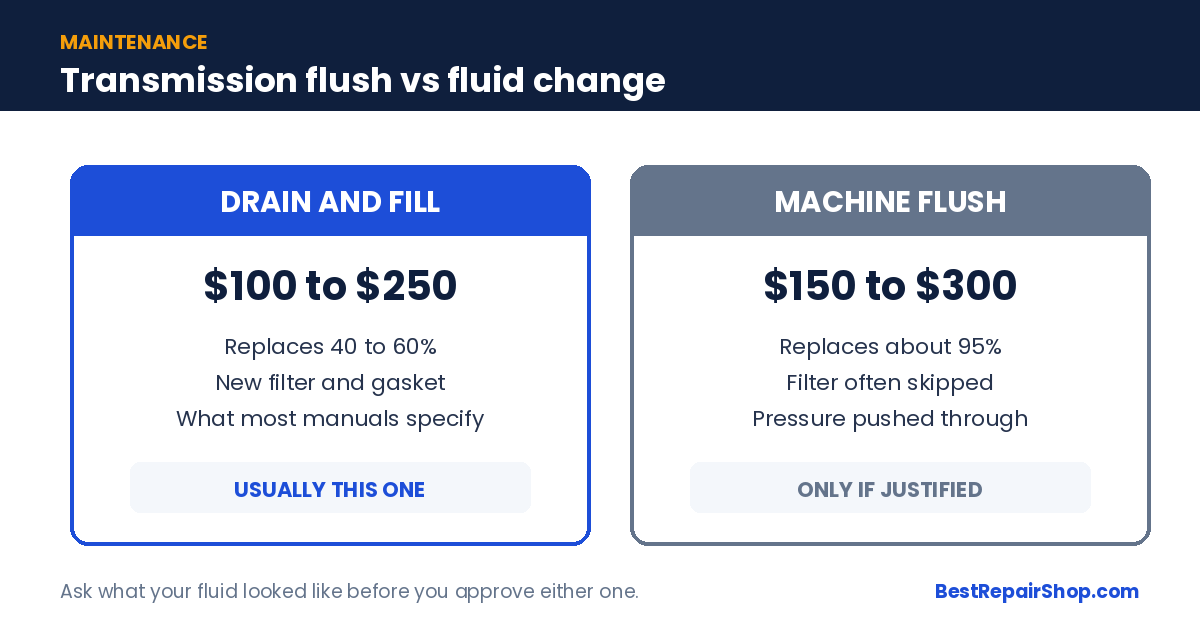
Transmission flush versus fluid change: not the same service
A fluid change (also called a drain and fill) drains what gravity gives, replaces roughly 40-60% of the fluid, and usually includes a new filter where fitted. It is the service most manufacturers actually specify. A transmission flush uses a machine to push out nearly all the old fluid under pressure. It sounds more thorough, and shops like it because the machine does the work while the ticket grows.
| Service | What it does | Fair price | When it makes sense |
|---|---|---|---|
| Drain and fill | Replaces 40-60% of fluid, new filter | $100-$250 | At the manual’s interval, typically 30k-60k miles |
| Flush (machine exchange) | Replaces ~95% of fluid under pressure | $150-$300 | Contaminated fluid, or a specific manufacturer procedure |
| Doing nothing yet | Nothing | $0 | Fluid is red, clear, and within interval |
Prices are national independent-shop ranges, July 2026. Dealer prices run higher, and some sealed “lifetime fluid” transmissions have their own rules entirely, which is a conversation worth having with a transmission specialist rather than a quick-lube counter.
The one-question test
“What did the fluid look like?” Healthy automatic transmission fluid is red to light brown and nearly odorless on the dipstick or fill check. Dark brown with a burnt smell means the fluid is overdue. Metal glitter in it means the damage already happened. A shop that recommends any transmission service without being able to describe your fluid is selling a menu item, not maintenance. This one question, asked politely, ends most upsells on the spot.
When the service is legitimate
Real reasons to change transmission fluid: you are at or past the interval in the owner’s manual, the fluid is visibly darkening, you tow or haul regularly (which shortens the interval), or you bought a used car with no service history and want a known baseline. Those are measurements and facts, and a fluid change in those cases is money well spent. Note that every one of those cases is served by the cheaper drain and fill, not the machine flush.
When you don’t need it
If the fluid is red, the car shifts smoothly, and you are inside the manual’s interval, you need nothing, whatever the printout says. And there is one famous caution on the other end: on a very high-mileage transmission that has never been serviced, a pressure flush can dislodge deposits that were quietly sealing worn clutch packs. If a transmission has 150,000 unserviced miles and still shifts fine, get a specialist’s opinion before anyone hooks up a machine. Sometimes the honest answer is a gentle drain and fill; sometimes it is leave it alone.
Red flags at the counter
- The flush is recommended at every oil change visit, regardless of mileage.
- Nobody can tell you what your fluid looked like.
- The recommendation cites “severe service” but nobody asked how you drive.
- You are quoted a flush on a sealed transmission the shop never opened.
- Scare language (“catastrophic failure”) attached to a maintenance item on a healthy car.
If you are told the work is required to keep your warranty valid, check that claim before you pay. The FTC’s auto repair guidance covers what a shop can and cannot require, and routine maintenance done elsewhere does not void a factory warranty.
Transmission flush FAQ
The quick-lube place says every 30,000 miles. My manual says 60,000. Who wins?
The manual, every time. The people who built the transmission set the interval. The 30,000-mile version exists because it doubles the number of services they sell over the life of your car.
Can a transmission flush fix rough shifting?
Occasionally, if the roughness was caused by degraded fluid and caught early. But rough shifting is more often a symptom of wear or a control issue, and fresh fluid does not un-wear clutch packs. Diagnose first, service second. Paying $250 to “try” a flush on a slipping transmission is a common and expensive dead end.
Is the transmission filter part of the service?
With a proper drain and fill on transmissions that have a serviceable filter, yes, it should be included, and the pan gasket with it. Machine flushes often skip the filter entirely, which is worth knowing when you compare a $150 flush against a $220 drain-fill-and-filter and assume the flush is the better deal.
What about manual transmissions?
Simpler and cheaper: gear oil changes run $60-$150 and the interval is typically 30,000-60,000 miles. The same one-question test applies. Someone should be able to tell you what came out.
How to check your own transmission fluid
On cars that still have a transmission dipstick, you can answer the fluid question yourself in five minutes and walk into the shop already knowing. Doing this before anyone quotes you a transmission flush changes the conversation. Park level, run the engine until it reaches operating temperature, leave it idling in park unless your manual says otherwise, then pull the dipstick, wipe it, reinsert it fully, and pull it again.
Look at three things. Color: bright red to light brown is healthy, dark brown is overdue, and black is late. Smell: clean fluid smells faintly sweet, burnt fluid smells like scorched toast. Texture: rub a drop between your fingers, and if you feel grit or see metallic sparkle, stop and see a transmission specialist rather than a quick-lube counter.
Many newer cars have sealed transmissions with no dipstick, and checking those requires a lift and a fill plug. If that is your car, the honest answer is that you cannot verify it yourself, which makes choosing a shop you trust matter more than usual.