
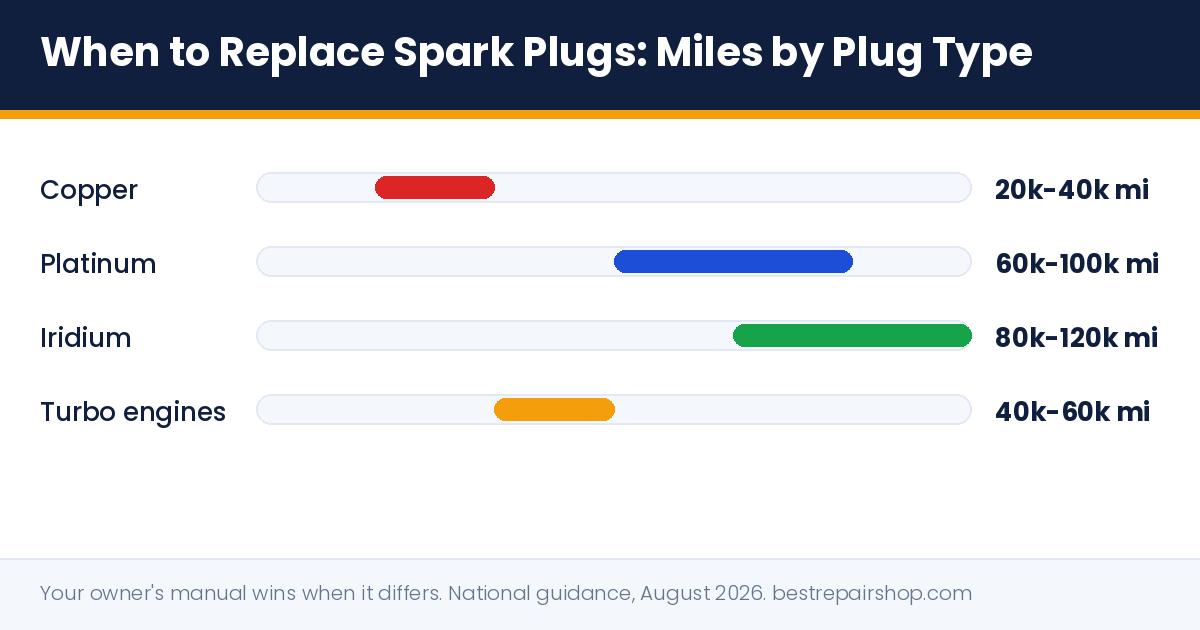
Most engines need new plugs every 30,000 to 120,000 miles depending on plug type: copper around 20,000 to 40,000, platinum around 60,000 to 100,000, and iridium up to 120,000 miles. The honest answer on when to replace spark plugs starts with the interval printed in your owner’s manual, then listens for five warning signs. A full set runs about $150 to $400 installed at an independent shop.
On this page: Intervals by type 5 warning signs Find your spec If you wait Fair cost FAQ
When to Replace Spark Plugs: Intervals by Type
The metal on the plug tip sets the clock. Copper plugs are the old standard: cheap, conductive, and short-lived, usually done by 20,000 to 40,000 miles. Single and double platinum plugs stretch that to roughly 60,000 to 100,000 miles. Iridium and extended-life iridium plugs are the marathon runners, rated for 80,000 to 120,000 miles on many modern engines.
Two cautions before you trust those numbers. First, your owner’s manual wins every time, because some engines are hard on plugs no matter the metal: many turbocharged and direct-injection engines call for new plugs at 40,000 to 60,000 miles even with iridium installed. Second, never downgrade: swapping factory iridium for copper to save $40 costs more in fuel and repeat labor within a year.
5 Honest Signs Your Plugs Are Done
Mileage is the schedule, but your car talks too. These five symptoms tell you when to replace spark plugs earlier than the schedule says.
1. Rough idle. A healthy engine idles smooth and steady. Worn plugs make it stumble, shake, or hunt at a stoplight, because one or more cylinders is firing late or weakly.
2. Hard starts. Long cranking before the engine catches, especially on cold mornings, is a classic worn-plug complaint. The gap has eroded wider, and the spark has to jump farther than the coil can comfortably push.
3. Misfires or a flashing check engine light. A steady light with a P0300 series code often points to plugs or coils. A flashing light means an active misfire that can overheat your catalytic converter, so ease off and get the code read soon. Our check engine light guide walks you through it.
4. A fuel economy slide of 1 to 3 mpg. Weak spark burns fuel incompletely. If you track fill-ups and see a slow decline with no other change, plugs are the cheap suspect to check first.
5. Hesitation or jerking under acceleration. If the car stumbles when you ask for power, worn plugs are one of the six common causes we cover in our guide to a car that jerks when accelerating.
Find Your Exact Interval in 2 Minutes
You do not have to guess when to replace spark plugs on your specific car. Open the owner’s manual to the maintenance schedule, usually near the back, and scan the 30,000, 60,000, and 100,000 mile columns for “spark plugs.” No manual in the glovebox? Every automaker posts them free online.
Then confirm what is actually in the engine. If you bought the car used, assume nothing: a previous owner may have installed cheap copper plugs in an engine specced for iridium. Any shop can pull one plug and identify the type and its condition in ten minutes, and the plug’s wear tells the truth even when the service records do not.
What Waiting Too Long Really Costs
Plugs do not fail like a light bulb; they fade. As the gap erodes, the ignition coil works harder to jump it, and the coil is the expensive part. Coils that run overloaded for months fail early, at $80 to $300 each installed. Chronic misfires also push raw fuel into the exhaust, which can cook a catalytic converter, a $900 to $2,400 repair. Skipping a $200 plug job to protect a $1,500 converter is bad math.
There is also the stuck-plug problem. Plugs left in an aluminum head past 120,000 miles can seize, turning a routine job into extraction work billed by the hour. The honest rule for when to replace spark plugs is simple: on time or a little early, never late.
The Fair Price for a Spark Plug Job
The plugs themselves run $6 to $25 each. Labor is the swing: four plugs sitting on top of a 4-cylinder take under an hour, while V6 plugs buried behind an intake manifold can take three. Our full spark plug replacement cost guide breaks down fair 2026 prices for 4, 6, and 8 cylinder engines and the upsells to skip.
| Engine layout | Fair total, parts and labor |
|---|---|
| 4-cylinder, plugs on top | $120-$250 |
| V6, plugs accessible | $200-$350 |
| V6, intake removal required | $300-$500 |
| V8 truck or SUV | $250-$450 |
Ranges are national, independent-shop figures, August 2026. Dealers typically run 20 to 40 percent higher for the same work. The FTC’s auto repair basics say you are entitled to a written estimate first; a good plug quote lists the plug brand and part number, so ask for both.
FAQ
Can spark plugs really last 100,000 miles?
Yes, if they are iridium or double platinum and the automaker rates them for it. The catch is turbocharged and direct-injection engines, which run hotter cylinder pressures and often cut that to 40,000 to 60,000 miles. The question of when to replace spark plugs is answered by your manual, not the parts box.
Should I replace ignition coils at the same time?
Not automatically. Coils are replace-on-failure parts, and most outlast two sets of plugs. The exception is a coil that has already failed on a bank that is expensive to reach; replacing its neighbors while the intake is off can be reasonable. A blanket “all new coils” line on a plug estimate deserves a polite no.
Can I change spark plugs myself?
On many 4-cylinder engines, yes: a socket set, a torque wrench, and patience will do it in an hour. Gap each plug to spec, thread by hand to avoid cross-threading, and torque to the listed value. If the job requires removing an intake manifold, most owners are happier paying a shop.
Will new spark plugs improve gas mileage?
If the old ones were worn, expect 1 to 3 mpg back. What new plugs will not do is beat your engine’s healthy baseline, so treat “performance plug” fuel-saving claims with a raised eyebrow.