
Pull over and shut the engine off. If your temperature gauge is climbing past three quarters or the warning light is on, the safest move is to turn the AC off, the heater on full, get to the shoulder, and stop the engine within two minutes. Driving a car overheating past that point is what turns a $180 thermostat into a $1,500 to $3,000 head gasket.
On this page: First 2 minutes Causes Mistakes Repair costs Prevention FAQ
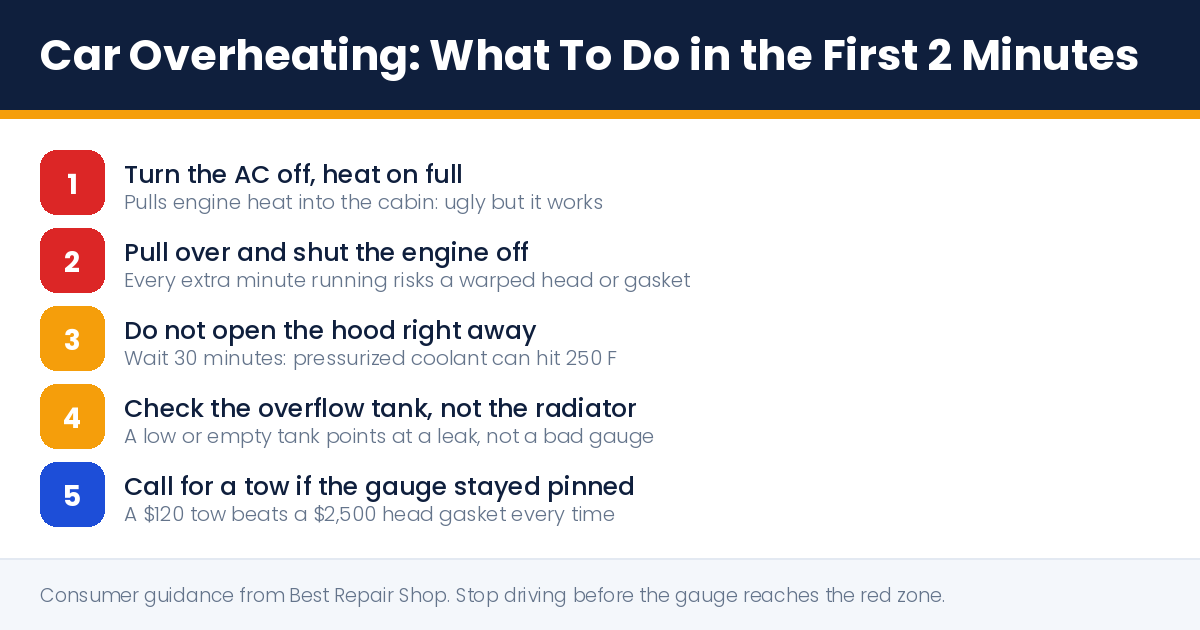
The First 2 Minutes: 5 Things to Do Right Now
Turn the air conditioning off first. The compressor loads the engine and its condenser sits right in front of the radiator, so switching it off drops heat two ways at once. Then turn the heater on full with the fan at maximum. It is miserable in July, but the heater core is a second small radiator that can pull enough heat out of the coolant to buy you a mile or two.
Next, find somewhere safe to stop and shut the engine down. Most drivers try to make it home. That is the expensive choice: an engine running while starved of coolant can warp an aluminum head in under five minutes. Once stopped, leave the hood closed for 30 minutes. Cooling systems run near 15 psi, which pushes the boiling point of coolant close to 250 degrees Fahrenheit, and cracking a hot radiator cap releases all of that at once.
After it cools, check the plastic overflow tank rather than the radiator itself. If that tank is dry you have lost coolant somewhere, and topping it off is a patch rather than a fix. If the gauge stayed pinned in the red, call a tow. A tow runs about $100 to $150 in most metro areas, cheap next to a bill twenty times that size.
Why Car Overheating Happens: 6 Common Causes
Almost every case of car overheating traces back to one of six things. Low coolant from a slow leak is the most common, usually at a radiator hose, the water pump weep hole, the radiator end tanks, or the heater core. A stuck thermostat is next: a $15 part that fails closed and blocks flow entirely, which is why a car can go from normal to red in about ninety seconds.
A failed cooling fan or fan relay shows up as overheating in stop and go traffic while the temperature is fine at highway speed, because airflow at 50 mph does the fan’s job for it. A failing water pump whines or leaves a crusty pink trail behind the belt. A clogged radiator, common past 100,000 miles without a coolant service, overheats gradually under load. A blown head gasket pushes combustion gas into the cooling system, which is why bubbles in the overflow tank are a bad sign.
If the check engine light came on at the same time, the two are usually related: a coolant temperature or thermostat efficiency code often confirms what the gauge already told you. Our guide to a check engine light on covers reading those codes first.
3 Mistakes That Turn a Repair Into a Replacement
Most car overheating bills get bigger after the breakdown, not during it. The first mistake is pouring cold water into a hot engine. Rapid contraction cracks cast iron and aluminum alike. If you must add water roadside, wait until the engine is cool to the touch and add it slowly. The second is ignoring the gauge because the car seems fine.
The third is treating a coolant top off as a repair. Coolant is not consumed in a healthy sealed system, so if you add it every few weeks you are paying for a leak on the installment plan. A shop can pressure test the system in under an hour and show you where it is going. Expect the standard $75 to $200 diagnostic hour, credited toward the repair if you have the work done there.
What Overheating Repairs Cost in 2026
Prices below assume an independent shop, parts and labor, on a common four or six cylinder vehicle. Dealer pricing typically runs 20 to 40 percent higher, and European models sit at the top of every range.
| Repair | Typical cost | Notes |
|---|---|---|
| Cooling system pressure test | $75-$200 | Standard diagnostic hour, often credited |
| Coolant flush and fill | $100-$180 | Maintenance, not a leak repair |
| Thermostat replacement | $180-$450 | Cheap part, labor drives the price |
| Radiator hose | $150-$350 | Upper hose is usually the cheaper side |
| Cooling fan or fan motor | $400-$800 | Check the relay and fuse first |
| Water pump | $500-$1,100 | Do the timing belt at the same time if due |
| Radiator replacement | $500-$1,200 | Aluminum and plastic units fail at the seams |
| Head gasket | $1,500-$3,000 | The bill you are avoiding by stopping early |
Ranges are national, independent-shop figures, July 2026. Get the leak located before you approve any part, and see our repair cost guides for comparable numbers on other systems.
How to Keep It From Happening Again
Preventing car overheating is mostly a monthly habit. Look at the overflow tank once a month with the engine cold. The level should sit between the minimum and maximum marks, and the coolant should be bright, not rusty or oily. Replace coolant on the schedule in your owner’s manual, which is typically every five years or 100,000 miles on long life formulas. Squeeze the upper radiator hose when cold: it should feel firm and springy, not mushy or rock hard.
Watch the small tells. A sweet syrup smell after a drive means coolant is escaping. A green, orange, or pink puddle under the nose is not condensation. If your vehicle has an open recall involving the cooling system, the fix is free at a dealer; check your VIN against the NHTSA recall database before you pay anyone.
Frequently Asked Questions
Can I drive a short distance with the car overheating?
Only far enough to reach a safe place to stop, and only with the heater on full. Even a mile at high temperature can warp a head. If the gauge is pinned or steam is visible, stop and call a tow.
How much coolant loss is normal?
None. A sealed cooling system does not consume coolant. If the tank drops between oil changes there is a leak, a head gasket failure, or a bad cap, and a pressure test identifies which.
Is it safe to use plain water instead of coolant?
Water works roadside and beats running dry. It boils sooner, offers no freeze protection, and does not inhibit corrosion, so have the system drained and refilled properly within a few days.
Why does my car only overheat in traffic?
That points at the cooling fan, the fan relay, or the fan clutch on older trucks. At highway speed, airflow through the grille does the fan work, so the fault only shows when the car sits still. It is one of the cheaper causes here.
Keep going
- All symptom guides: what your car is telling you
- How to find a good mechanic before you need one
- How often to change your oil, honestly
For your rights on estimates and authorizations before a shop touches your car, the FTC guide to auto repair basics is the plainest summary available.