
That car rotten egg smell is hydrogen sulfide, and it almost always means your catalytic converter is no longer finishing its chemistry. A replacement runs $900 to $2,400, but the real culprit is sometimes an upstream fix as cheap as $150 to $400. Get it diagnosed within days, not weeks: every mile of sulfur-rich exhaust pushes the converter closer to being the bill.
On this page: What it means Catalytic converter Running rich Battery Repair costs Why act now FAQ
What a Car Rotten Egg Smell Is Telling You
Gasoline carries a small amount of sulfur. A healthy engine and catalytic converter convert it into odorless sulfur dioxide, and you never know it was there. When something in that chain slips, the sulfur leaves the tailpipe as hydrogen sulfide instead, and hydrogen sulfide is the exact compound that gives rotten eggs their reputation. So the smell is not random. Your car is telling you where to look.
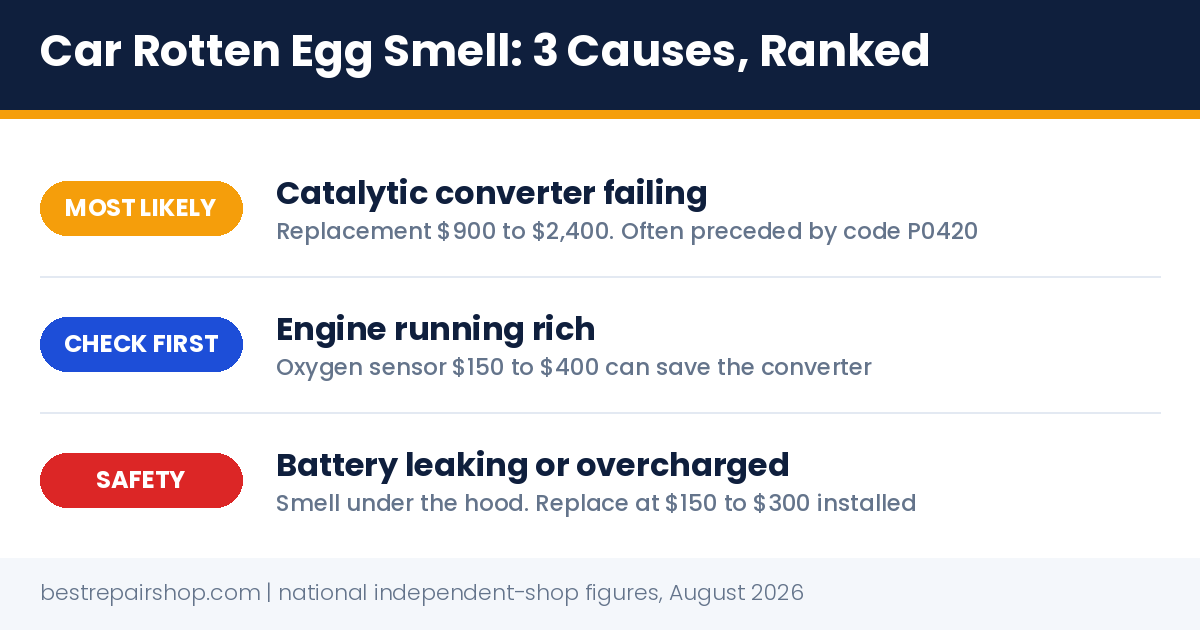
A car rotten egg smell has three realistic causes, and they are not equally likely. In shop practice the catalytic converter leads by a wide margin, a fuel system running rich comes second, and a leaking or overcharged battery is the rare but urgent third. Here is how to tell them apart before anyone quotes you anything.
Cause 1: A Failing Catalytic Converter (Most Likely)
The converter is a honeycomb of precious metals that finishes burning what the engine could not. When it clogs, overheats, or simply wears out after 150,000 miles or so, sulfur passes through half-processed and you get that sulfur smell from the tailpipe, strongest under hard acceleration or right after a highway pull. A converter on its way out often brings friends: sluggish acceleration, falling fuel economy, and eventually a check engine light with code P0420. Our P0420 guide covers that code in detail.
Here is the part an honest shop will tell you and a bad one will not: converters rarely die of old age alone. They are usually killed by something upstream, misfires, a bad oxygen sensor, or a rich fuel mix that overheats the honeycomb. Replacing a converter without fixing the killer means buying a second converter later. A proper diagnosis of a car rotten egg smell always starts upstream, not at the most expensive part.
Cause 2: The Engine Is Running Rich
Running rich means too much fuel for the air coming in. The extra fuel overwhelms the converter, and the sulfur in it comes through as smell. Common triggers are a lazy oxygen sensor, a stuck fuel pressure regulator, or a coolant temperature sensor that keeps the engine in cold-start mode. The good news is money: an oxygen sensor runs $150 to $400, a fraction of converter money, and fixing it early can save the converter entirely.
The tell is that the smell comes and goes with how the engine is working, and it often arrives with rough idle, black-tinged exhaust, or a fuel smell mixed in. If you are also smelling raw gasoline, that is a different and more urgent conversation, covered in our guide to a car that smells like gas.
Cause 3: A Leaking or Overcharged Battery
If the smell is under the hood rather than at the tailpipe, check the battery. A failing battery, or a healthy one being overcharged by a faulty voltage regulator, can vent sulfuric acid gas that smells exactly like rotten eggs. Look for a swollen case, wet or crusty spots around the terminals, or the smell getting stronger near the battery box.
This is the do-not-wait version of the smell. Vented acid eats wiring, battery trays, and paint, and a swollen battery can fail suddenly. Replacement runs $150 to $300 installed for most cars, and our battery replacement cost guide breaks down fair prices. If the battery tests fine, have the charging voltage checked before buying anything.
What Each Fix Honestly Costs
| Repair | Fair price | Notes |
|---|---|---|
| Diagnosis | $75-$200 | One diagnostic hour; often credited toward the repair |
| Oxygen sensor | $150-$400 | The cheap fix that can save the converter |
| Fuel pressure regulator | $150-$350 | Common rich-running culprit |
| Battery, installed | $150-$300 | AGM types $200-$350 |
| Catalytic converter | $900-$2,400 | Fix the upstream cause first or you will buy two |
Ranges are national, independent-shop figures, August 2026. Before approving anything, ask what killed the converter and what the shop found upstream. The FTC’s auto repair guide backs you up on getting the diagnosis in writing.
Why You Should Not Wait
A car rotten egg smell rarely fixes itself, and the failure math runs one direction. A $250 sensor ignored for months becomes a $1,500 converter. A venting battery becomes corroded cables and a no-start at the worst time. Hydrogen sulfide in the cabin is also genuinely unpleasant at best and a health irritant at worst. Roll the windows down, and book a diagnostic visit this week, not this month. One honest hour of diagnosis is the cheapest thing on this entire page.
FAQ
Is it safe to drive with a rotten egg smell?
For a short trip to a shop, usually yes, with windows cracked. It is not safe to ignore for weeks: the underlying causes get more expensive, and if the source is the battery, it can fail without more warning. Treat it as a this-week appointment.
Can bad gasoline cause the smell?
Occasionally. A tank of higher-sulfur fuel can produce a faint version of the smell that clears within a tank or two. If the smell survives a fill-up at a different station, stop blaming the gas and get the car looked at.
Will the smell always come with a check engine light?
No. The smell often shows up before the computer sets a code, which makes it an early warning worth using. If the light is on too, have the code read free at many parts stores, then start with our check engine light guide.
Does a car rotten egg smell mean the converter was stolen?
No. A stolen converter announces itself with a loud exhaust roar, not a smell. The rotten egg odor means the converter is present but struggling, or that the problem is upstream of it entirely.