
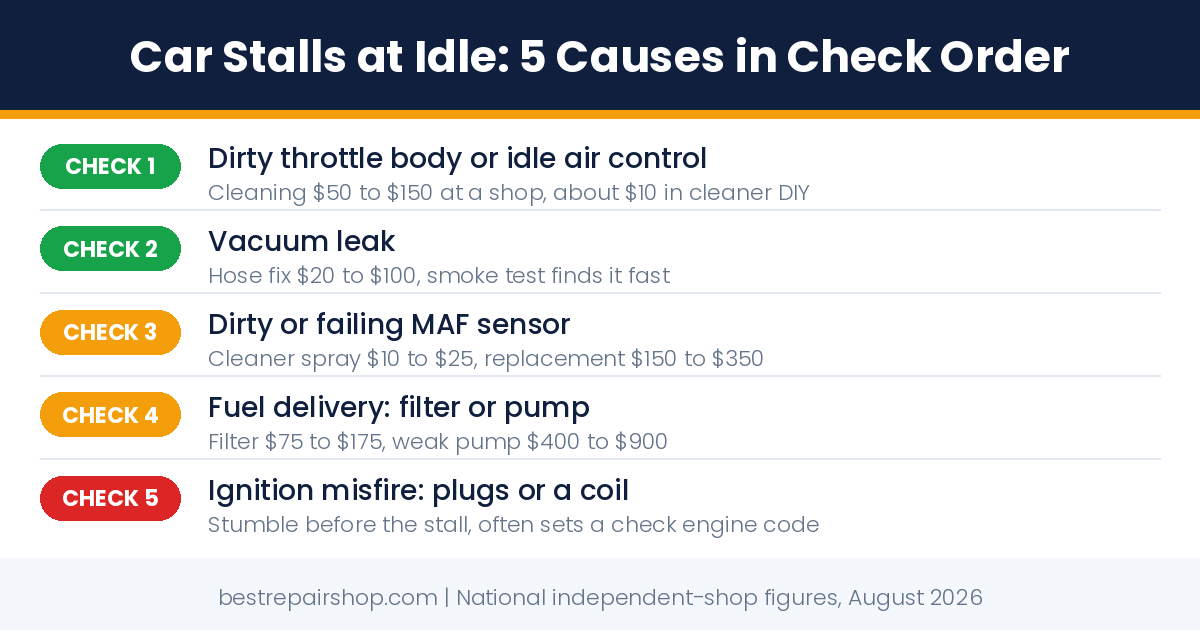
When your car stalls at idle, it is telling you it cannot hold the slow, steady mix of air, fuel, and spark that idling demands. The five usual causes, in the order a good shop checks them, run from a $50 to $150 throttle body cleaning to a $400 to $900 fuel pump. Most stalling fixes land under $200, and the first two checks cost almost nothing.
On this page: Why it stalls 5 causes in order Free checks Repair costs When it is serious FAQ
Why a Car Stalls at Idle but Runs Fine at Speed
Idle is the hardest thing your engine does all day. At 60 mph it is gulping air and fuel with plenty of momentum to smooth over small problems. At a red light it is balancing on 600 to 900 rpm, and a tiny air leak, a lazy sensor, or one weak cylinder is enough to tip it over.
That is why a car stalls at idle long before it ever stumbles on the highway. The good news: the same logic that makes idle fragile makes the diagnosis orderly. Good shops check the cheap, common causes first, in the order below.
The 5 Causes, in the Order a Good Shop Checks Them
1. Dirty throttle body or idle air control. This is the most common reason a car stalls at idle, especially past 80,000 miles. Carbon builds up right where the small amount of idle air squeezes through. A shop cleaning runs $50 to $150; a can of throttle body cleaner is about $10 if you are comfortable opening the intake.
2. Vacuum leak. A cracked hose or leaking intake gasket lets in air the computer never measured, so the idle mix goes lean and the engine dies. Listen for a hiss, and watch for an idle that surges high then drops. The hose itself is often $20 to $100; finding it is the labor, and a smoke test finds it fast.
3. Dirty or failing MAF sensor. The mass airflow sensor tells the computer how much air is coming in. When it reads wrong, idle goes wrong first. A $10 to $25 can of MAF cleaner fixes a surprising number of these; a replacement sensor runs $150 to $350 installed.
4. Fuel delivery. A clogged filter or a tired pump can feed the engine enough fuel at speed but starve it at idle, particularly on hot restarts. A filter is $75 to $175. A failing pump, often announced by a whine from the tank, is the expensive one at $400 to $900.
5. Ignition misfire. Worn spark plugs or a weak coil make one cylinder quit at low rpm. You will usually feel a stumble or shake before the stall, and it often sets a check engine code. If the engine also jerks when accelerating, ignition moves to the top of the list.
3 Free Checks Before You Pay Anyone
First, listen. With the engine idling, open the hood and listen for a sharp hiss, which points to a vacuum leak. Second, look at the intake. A loose clamp between the air filter box and the throttle body is a free fix, and a filthy filter chokes idle air; our guide on when to change your engine air filter includes a 10 second check.
Third, read the codes. If the check engine light is on, most parts stores will read it at no charge, and our check engine light guide translates what the code families mean. Arriving with a code and a symptom description saves paid diagnostic time.
What Each Fix Costs
| Fix | Fair price |
|---|---|
| Throttle body cleaning | $50-$150 |
| Vacuum hose replacement | $20-$100 |
| MAF sensor cleaning (DIY) | $10-$25 |
| MAF sensor replacement | $150-$350 |
| Fuel filter replacement | $75-$175 |
| Fuel pump replacement | $400-$900 |
| Diagnostic hour | $75-$200 |
Ranges are national, independent-shop figures, August 2026. Most shops bill one diagnostic hour, $75 to $200, to pin down why a car stalls at idle, and a fair shop applies that fee toward the repair. Before you approve anything, see what a reasonable check engine light diagnosis costs so the first line of the invoice does not surprise you.
When Stalling Is Serious
A stall at a stop sign is an annoyance. A stall that takes your power steering and brake assist with it in moving traffic is a safety problem, so treat repeated stalling as a this-week repair. If the engine will not restart, or stalls with the oil pressure or temperature light on, stop driving and have it towed.
When you do head to a shop, ask for the cause in writing before you approve a fix. The FTC’s auto repair basics guide backs you up: you are entitled to a written estimate and your old parts back in most states. A shop that says “it needed a tune up” without naming the failed part is guessing on your dime.
FAQ
Why does my car stall at idle but drive fine?
Because idle runs on a small, precisely metered trickle of air and fuel, small faults show up there first. A minor vacuum leak or dirty throttle body barely matters at 3,000 rpm but can kill the engine at 700 rpm. That gap between idle and driving is itself a diagnostic clue.
Can low oil cause a car to stall at idle?
Not usually in a direct way, but some engines with variable valve timing behave badly at idle when oil is very low or very old. Check the dipstick first, it is free. A flickering oil pressure light at idle is a separate, urgent problem.
Is it safe to keep driving if my car stalls at idle?
Short trips to the shop, generally yes. Daily driving, no. Every stall in traffic is a moment with reduced steering and braking assist, and stalls tend to get more frequent as the underlying cause worsens. Get it diagnosed within the week.
How much does it cost to fix a car that stalls at idle?
Most fixes land between $50 and $350: cleanings, hoses, sensors. The expensive outcome is a fuel pump at $400 to $900. A good shop reaches the pump diagnosis by testing fuel pressure, not by replacing cheaper parts one at a time at your expense.