
Every auto body repair near me search returns a wall of ads, insurer partners, and five star reviews that tell you almost nothing. Run six checks before you sign: your right to choose the shop, real certifications, a written teardown estimate, parts disclosure, paint match policy, and a lifetime workmanship warranty. Fair 2026 ranges run from $75 to $350 for paintless dent removal up to $1,000 to $2,500 for quarter panel work.
On this page: Your rights Certifications The estimate Paint and parts Warranty Fair prices FAQ
What Auto Body Repair Near Me Results Will Not Tell You
The map results are ranked by ads and distance, not by weld quality, and the most important fact in collision repair never appears on the search page: you, not your insurance company, choose the shop. An adjuster can recommend their direct repair program partners, and some of those shops are excellent, but they cannot require you to use one. That pressure has a name, steering, and most states prohibit it.
Why the pressure exists: DRP shops agree to the insurer’s labor rates and parts preferences in exchange for referral volume, so the shop is serving two masters and only one of them owns the car. An independent shop you picked yourself answers a single question: what does this car need. Build your shortlist with the same habits from our trust guides.
Certifications That Mean Something, and Logos That Do Not
I-CAR Gold Class is the first thing I look for: it means the shop puts its techs through current collision training every year, and only a minority of shops clear that bar. Manufacturer certifications matter more every year too, because modern cars are aluminum, high strength steel, and a nervous system of sensors that must be recalibrated after a hit, not just painted over.
So ask one question: are your techs I-CAR trained, and are you certified by my car’s manufacturer? A good shop answers in ten seconds. A shop that redirects you to a wall of generic logos has also answered.
Demand a Written Teardown Estimate
An estimate from three photos is a guess with a signature line. Real collision damage hides behind the bumper cover and under the trim, and an honest shop says so up front: the number can move after teardown, and every supplement gets documented in writing. What you want on paper is labor hours and the rate, every part listed with its type, paint and materials as their own line, and who calls whom when hidden damage appears.
The FTC’s auto repair basics page is blunt about your right to a written estimate and authorization before work begins. And while the car is in the shop anyway, run your VIN through the NHTSA recall lookup: a body visit is the cheapest time to catch an open recall.
Paint Match and Parts: Where Cheap Work Shows First
Your estimate will name one of three part types: new OEM, aftermarket, or recycled. You have the right to know which is on the sheet, and it is worth pushing for OEM on structural and safety parts. On a cosmetic bumper cover, a quality aftermarket part can be a fair savings; the sin is not the part, it is the part nobody told you about.
Paint is where corners glow in the dark. Matching a ten year old metallic without blending into the next panel is close to magic, so a fair estimate usually includes blend time on the adjacent panel. Ask how they handle corrosion protection and seam sealer on welded repairs too, because skipped sealer is invisible on delivery day and very visible three winters later.
The Warranty Question That Sorts Shops in One Sentence
Ask: what is your warranty on workmanship and paint? The answer you want is lifetime, for as long as you own the car, in writing. Parts carry the maker’s warranty, but the welds, the panel gaps, and the paint are the shop’s signature. A shop that hedges to ninety days on paint is telling you exactly how long they expect it to look right.
Fair 2026 Prices When You Compare Auto Body Repair Near Me Quotes
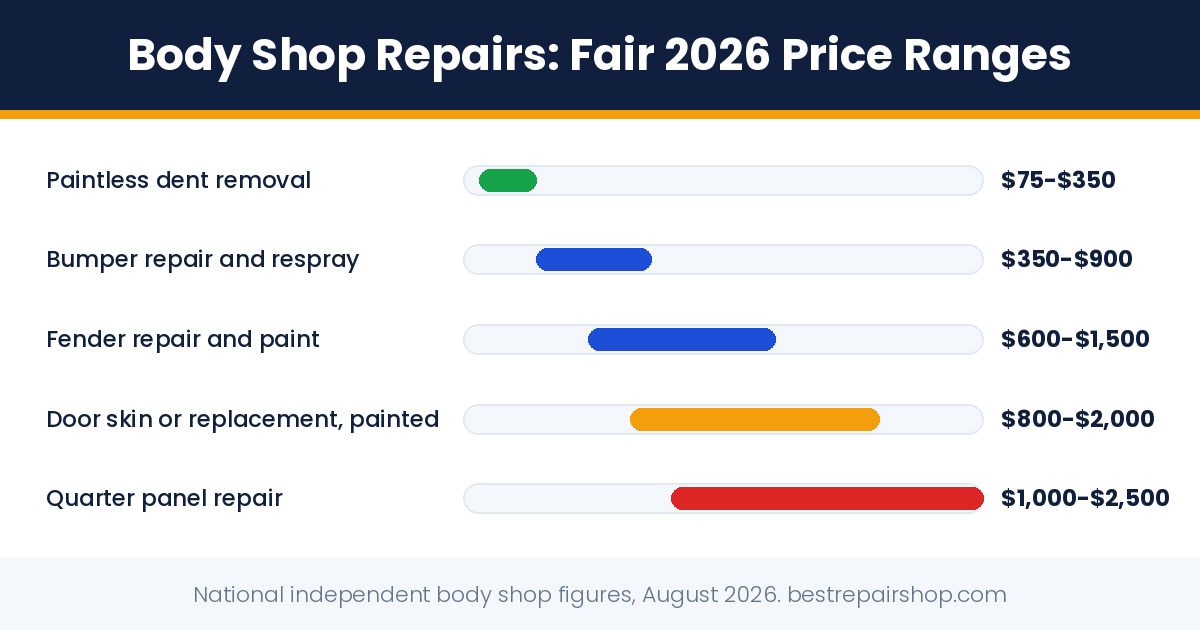
Body work swings with paint, parts, and region; the honest national ranges look like this.
| Repair | Fair 2026 range | Notes |
|---|---|---|
| Paintless dent removal | $75-$350 | Small dents with unbroken paint |
| Bumper repair and respray | $350-$900 | Cover repair plus refinish |
| Fender repair and paint | $600-$1,500 | Usually includes blending the next panel |
| Door skin or replacement, painted | $800-$2,000 | A quality recycled door can trim the bill |
| Quarter panel repair | $1,000-$2,500 | Welded panel with corrosion protection |
Ranges are national, independent-shop figures, August 2026. Body labor runs $60 to $120 per hour by region. If a quote lands far outside these ranges in either direction, ask why: a suspiciously low number usually means recycled parts nobody mentioned or paint steps nobody plans to perform. Compare the line items, never just the bottom line.
Auto Body Repair Near Me: Quick Answers
Should I get more than one estimate for body work?
For anything over about $1,000, yes, pull two or three written estimates from your auto body repair near me shortlist. You are not hunting the lowest number; you are comparing line items. When one shop lists blend time and corrosion protection and another does not, you have learned where the cheap quote comes from.
Can my insurance company force me to use their shop?
No. In every US state the vehicle owner chooses the repair shop. Insurers can recommend direct repair partners and those shops can be good, but a claim cannot be denied because you picked your own shop.
Are OEM parts worth insisting on?
For structural parts, airbag components, and anything a sensor bolts to, yes. For cosmetic panels, certified aftermarket or clean recycled parts can be a fair trade. The non negotiable part is disclosure: every part type belongs on the estimate before you sign.
How long should a body shop keep my car?
A bumper respray runs two to three days, a moderate hit one to two weeks, and a major collision repair can run two to six weeks when parts are slow. What matters is communication: a good shop gives you a target date, then reports supplements and delays in writing.