
Seven points settle the dealership vs independent mechanic question, and price is only the first. Out of warranty, a good independent shop typically runs 20 to 40 percent less on the same repair, with labor at $75 to $200 per hour against metro dealer rates that regularly clear $175. Under warranty or on a recall, the dealer is the right answer, and the recall work costs you nothing.
On this page: Price gap · Dealer wins · Recalls · Independent wins · Decide · FAQ
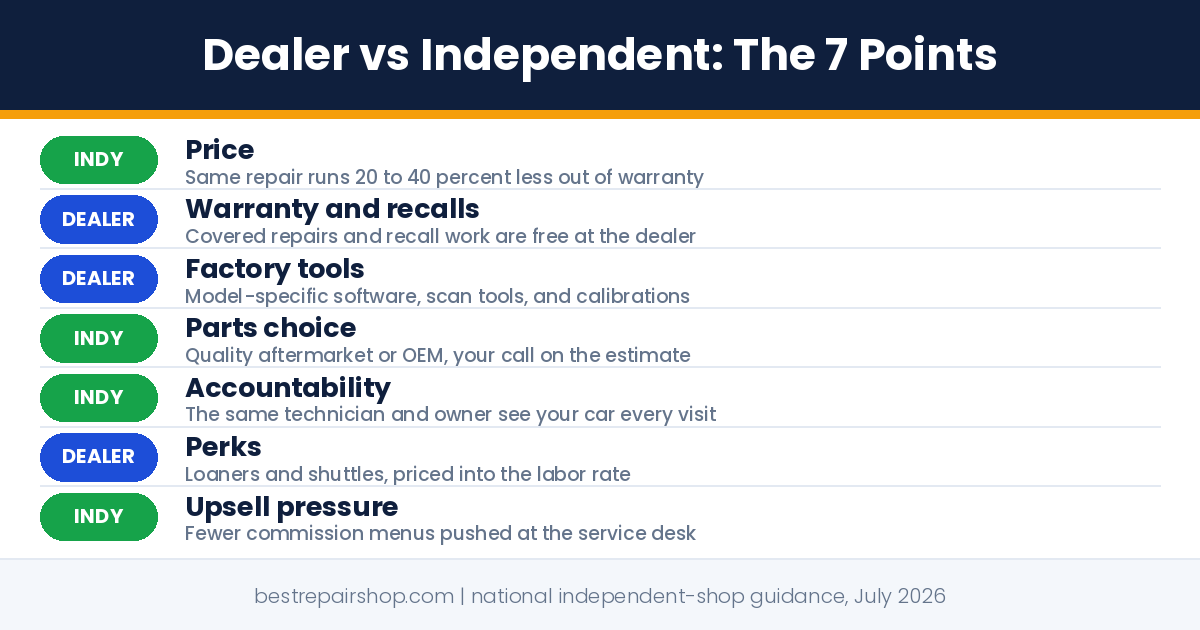
Dealership vs Independent Mechanic: The Price Gap
The gap starts with the labor rate and compounds from there. Dealers carry showroom real estate, factory-mandated equipment, and a service department that is expected to produce profit, and the hourly rate reflects all three. Independents carry a building and payroll. Then parts widen it: dealers quote OEM parts at list price, while an independent can quote you OEM or a quality aftermarket line and let you pick. Here is how that lands on four common invoices.
| Repair | Dealership | Independent shop |
|---|---|---|
| Brake pads, per axle | $180-$400 | $130-$320 |
| Diagnostic hour | $150-$250 | $75-$200 |
| Battery, installed | $200-$400 | $150-$300 |
| Alternator replacement | $500-$1,100 | $350-$900 |
Ranges are national, independent-shop figures, July 2026, with the dealership column reflecting typical metro dealer pricing for the same jobs. See our brake job cost guide and battery replacement cost guide for the full breakdowns.
3 Points the Dealer Wins
First, warranty work. If the repair is covered, the manufacturer pays the dealer and you pay nothing, so there is no comparison to run. Second, factory tooling. On late model cars, some jobs genuinely need the manufacturer’s software: module programming, over-the-air update repairs, and camera or radar calibrations after windshield or bumper work. A well equipped independent can do many of these, but the dealer can always do them.
Third, the comfortable stuff: loaner cars, shuttles, espresso machines. Enjoy them with clear eyes, because they are financed by that labor rate. A perk you pay $60 an hour extra for is not a perk, it is a rental.
Recalls Are Free, Full Stop
Safety recalls are repaired at the dealer at no charge, no matter where you normally service the car and no matter how you bought it. Run your VIN through the NHTSA recall lookup a couple of times a year. If a shop of either kind tries to charge you for work that is covered by an open recall, that is a walk-out moment.
4 Points the Independent Shop Wins
Price you have seen. Parts choice is the second: on an older car, a $95 quality aftermarket alternator instead of a $240 OEM unit is the difference between fixing the car and debating it. Third is accountability. At an independent, the person who diagnosed your car often owns the building, and the same technician sees it every visit. At a dealership you are usually talking to a service advisor who is paid partly on what they sell, and the technician changes with the schedule.
Fourth is upsell pressure. Dealers run inspection menus by mileage, and those menus are where flushes and “while we are in there” items breed. Independents upsell too, but the good ones know their reputation is the whole business. Our 7 questions to ask before approving a repair works on both kinds of shop, and federal FTC guidance backs your right to a written estimate and your old parts at either counter.
How to Decide in 2 Minutes
Under factory warranty, or fixing an open recall: dealer, every time. A model-specific electronic fault on a nearly new car: dealer, or an independent that specializes in your brand. Everything else, which is most of what a car needs in its life, brakes, batteries, suspension, fluids, tires: a vetted independent shop. Treat the dealership vs independent mechanic choice as a per-job decision, not a loyalty program, and you will get the best of both. Our guide on how to find a good mechanic and the rest of the trust hub show how to do the vetting once and coast on it for years.
Fast Answers
Does using an independent shop void my warranty?
No. Federal law protects your right to service the car anywhere, and the manufacturer must prove an aftermarket part or outside service caused a failure before denying a claim. Keep dated invoices that show the work and the fluids used, and the warranty question takes care of itself.
Are dealership parts better than what independents install?
Dealer parts are OEM, which is a known quantity, not automatically a better one. Top-tier aftermarket brands often come off the same production lines. The honest independent move is quoting you both options with prices, then letting you choose.
Why are dealer labor rates so much higher?
Real estate, factory-required tooling, and corporate profit targets, plus factory-trained technicians on your specific brand. That training matters on complex model-specific faults. On a brake job or a battery, you are paying the premium without collecting the benefit.
When is the dealership vs independent mechanic choice not even close?
Three cases make the dealership vs independent mechanic call for you: warranty repairs, open recalls, and jobs that need factory software on a late model car all belong at the dealer. Routine wear items on an out-of-warranty car belong at a good independent, where the same work typically costs 20 to 40 percent less.