
How often to change oil in 2026: every 5,000 to 7,500 miles for most cars, and 7,500 to 10,000 for many running full synthetic. The 3,000 mile rule died with carburetors. Your owner’s manual and your oil life monitor beat any sticker on the windshield, and short-trip city driving means the shorter end of the range, not the longer one.
On this page: Honest intervals Oil life monitor Severe service High mileage oil Synthetic vs conventional DIY or shop FAQ
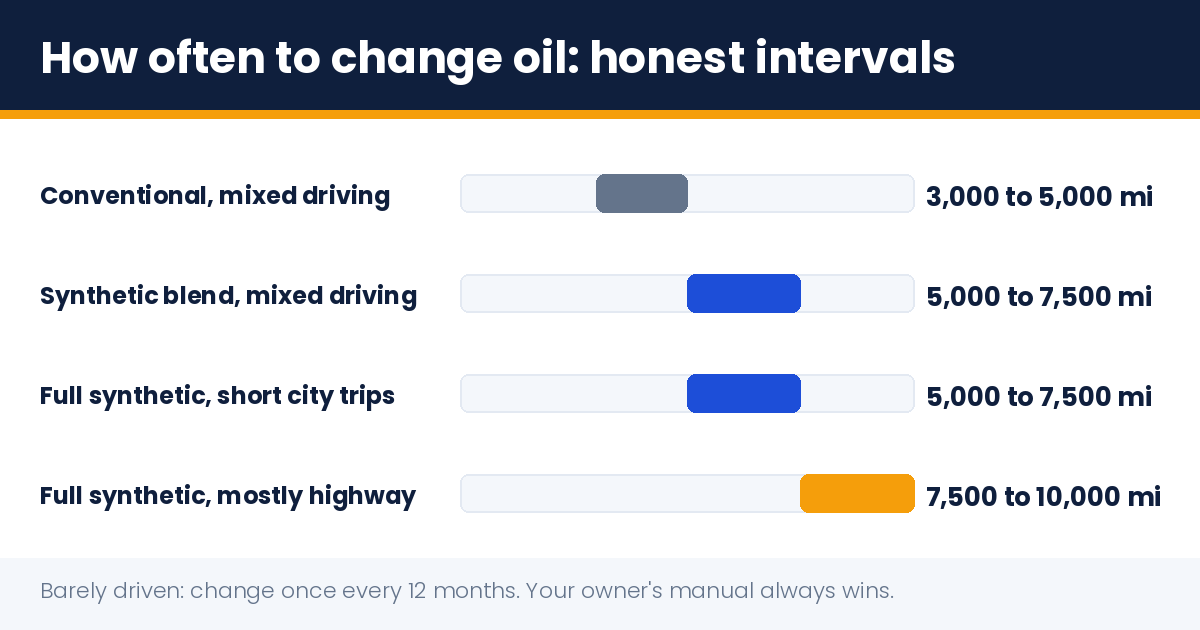
How often to change oil: the honest intervals
The 3,000 mile interval was real advice in 1980, and it survives today because it sells oil changes. Modern engines run tighter tolerances, modern oils resist breakdown far longer, and every automaker publishes an interval for your exact engine in the owner’s manual. That number, not the lube shop sticker, is the one that matters. Here is where the ranges land for most drivers.
| Your situation | Honest interval | Why |
|---|---|---|
| Conventional oil, mixed driving | 3,000-5,000 mi | Conventional breaks down faster, especially in heat |
| Synthetic blend, mixed driving | 5,000-7,500 mi | The most common modern recommendation |
| Full synthetic, mostly highway | 7,500-10,000 mi | Steady temps and long runs are easy on oil |
| Full synthetic, short city trips | 5,000-7,500 mi | Short trips never burn off moisture and fuel in the oil |
| Any oil, barely driven car | Once every 12 months | Oil ages in the pan even when the car sits |
Ranges reflect common automaker recommendations as of July 2026. When your manual and this table disagree, the manual wins. It was written for your engine; this table was not.
Trust your oil life monitor (with one catch)
Most cars built since the mid 2010s track oil life in software. The better systems do not just count miles: they watch engine temperature, cold starts, trip length, and load, then estimate how much life the oil has left. That estimate is honest and usually conservative. Changing at 20 to 30 percent remaining is a sound habit, and changing at 70 percent remaining is paying for oil the old fill still had in it.
So the modern answer to how often to change oil is: ask the car. The catch: the monitor assumes someone reset it at the last change. A quick lube tech who skips the reset leaves the system lying to you for the whole interval. After any oil change, confirm the reading shows 100 percent before you drive off. It takes ten seconds and it is the single most common oil monitor problem we hear about.
“Severe service” probably means you
Every manual lists two schedules, normal and severe, and most drivers assume severe means towing a trailer through Death Valley. Read the definition and it usually includes trips under 5 miles, stop-and-go traffic, extreme heat or cold, and dusty roads. That is a normal American commute, and it changes how often to change oil for real people. If most of your driving is short hops where the engine barely warms up, use the severe schedule, which typically cuts the interval by about a third. Moisture and fuel that never boil off are what turn oil into sludge, and short trips are how they get there.
High mileage oil: worth it past 75,000 miles?
High mileage formulas add seal conditioners and extra detergents aimed at engines past roughly 75,000 miles. They are not snake oil: the conditioners can slow small seep-type leaks and the detergents help engines that missed some changes along the way. The honest advice is simple. If your higher-mileage engine runs clean and does not leak, regular full synthetic on schedule is already doing the job.
If you see seepage at the valve cover or you are topping off between changes, the extra $5 to $15 per change for high mileage oil is a cheap experiment that sometimes pays off. It will not fix a real leak; a torn gasket is a repair, not an additive problem.
Synthetic vs conventional, the short version
Full synthetic resists heat, holds viscosity, and flows better on cold starts. Conventional is cheaper per quart and fine for older, simple engines on short intervals. The math has mostly settled the argument: synthetic costs $20 to $40 more per change but honestly stretches how often to change oil by 1.5 to 2 times, so the per-mile cost is close to a wash and the engine protection is better. Most 2026 engines, especially anything turbocharged, specify synthetic and it is not optional for them. Whichever you run, the number on the bottle (0W-20, 5W-30) must match the manual. Viscosity is an engineering spec, not a preference.
Do it yourself or pay the shop?
A shop oil change with full synthetic typically runs $65 to $125 in 2026; doing it yourself costs $35 to $60 in oil and filter and about 45 minutes. If that trade sounds good, our step-by-step guide to changing your own oil covers the whole job, including the two bolts that cause almost every DIY problem.
If you would rather pay, pay happily but check the work: correct oil on the receipt, no drips under the car the next morning, and the oil life monitor reset to 100 percent. The FTC’s auto repair guide is blunt that a clear invoice is your best protection, and that applies to a $70 oil change as much as a $2,000 repair.
Oil change interval FAQ
Is changing oil every 3,000 miles bad?
Not bad for the engine, just bad for your wallet and a waste of good oil. On a modern car running synthetic you are roughly doubling your oil spending for no measurable protection gain.
My oil looks dark on the dipstick. Does it need changing?
Dark oil is normal oil doing its job carrying combustion byproducts. Color tells you almost nothing. Miles, months, and the oil life monitor are the honest signals; the dipstick is for level, not condition.
How often to change oil if I barely drive the car?
Change it at least every 12 months anyway. Oil collects moisture and acids as it sits, and a barely driven car is usually a short-trip car, which is the hardest duty oil sees.
Can I switch between synthetic and conventional?
Yes, in either direction, any time, as long as the viscosity matches your manual. The old warning about switching back was a myth. Just restart your interval clock at the shorter schedule if you switch to conventional.