
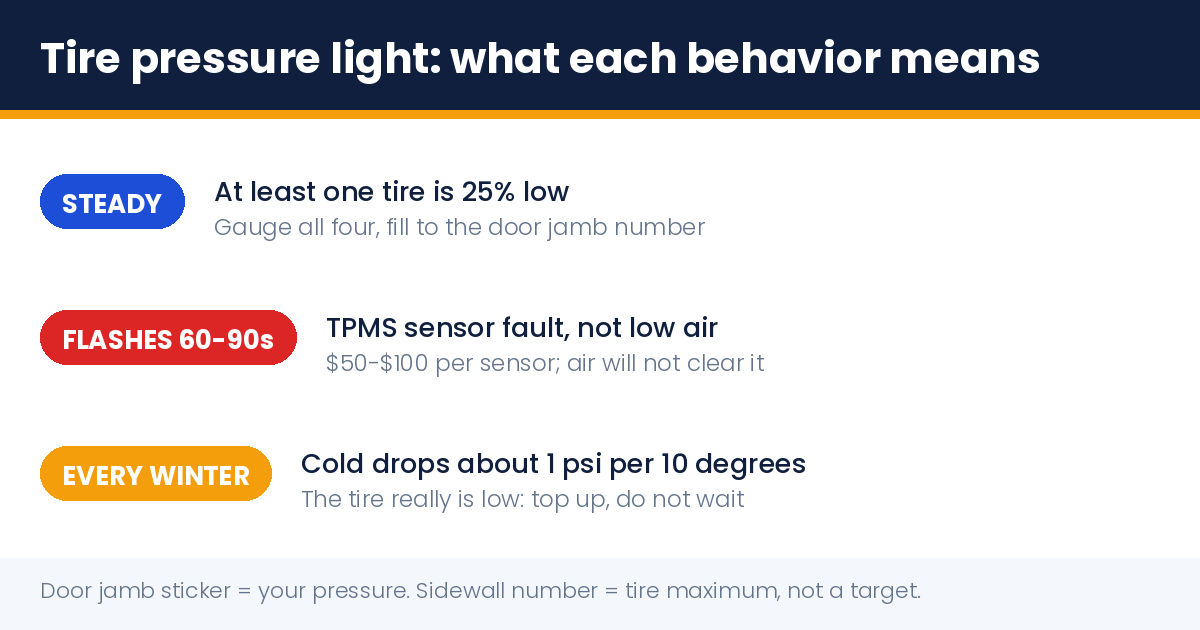
A steady tire pressure light means at least one tire is about 25 percent low: check all four with a gauge and fill to the number on the driver’s door jamb, not the tire sidewall. A light that flashes for 60 to 90 seconds at startup and then stays on means a TPMS sensor fault, which is a $50 to $100 fix, not an air problem.
On this page: Do this first The 5 reasons Flashing light Resets and relearns What fixes cost FAQ
Do this first: gauge, door jamb, all four
Before anything else, check the actual pressures. A $10 gauge or the free machine at many gas stations tells you in two minutes what the light cannot: which tire, and how low. The tire pressure light cannot tell you which tire; the gauge can. The right pressure is on a sticker inside the driver’s door jamb, usually 32 to 36 psi. The number stamped on the tire sidewall is the tire’s maximum, not your car’s spec, and filling to it rides hard and wears the center of the tread. Fill all four to the door jamb number, drive a few miles, and on most cars the light clears itself.
The 5 honest reasons your tire pressure light is on
1. Cold weather. Tires lose about 1 psi for every 10 degree drop, so the season’s first cold morning lights up dashboards across the whole neighborhood at once. Top up; do not just wait for the afternoon warmup to turn the light off for you, because the tire really is low.
2. A slow leak. A nail or screw can seep for weeks before you would ever notice by eye. If one tire needs air again within days, it has a leak, and a $20 to $40 patch beats replacing a tire ruined by running low. Look for the shiny screw head while you are down there.
3. Everyday seepage. All tires lose roughly 1 psi a month through the rubber itself. Skip checks for half a year and all four drift low together until the most sensitive one trips the light. This is the no-villain version, and a monthly 2 minute check prevents it.
4. A dead sensor. Each wheel’s sensor runs on a sealed battery that lasts 5 to 10 years. When one dies, the system cannot see that tire and the light comes on even with perfect pressures. This is the flashing-light case covered below.
5. A confused system after tire work. Rotations, new tires, or a swapped spare can leave sensors registered to the wrong corners, or an unmonitored spare on the car. The fix is a relearn, which some cars do automatically after 10 minutes of driving and others need a shop tool for.
Flashing then solid: that is a sensor, not air
The system has two messages and one bulb. Steady light: a tire is low. Flashing for 60 to 90 seconds at startup, then staying solid: the TPMS itself has a fault, almost always one dead sensor. No amount of air changes a flashing tire pressure light, and a shop with a TPMS tool can tell you which corner in about two minutes. Meanwhile the system is not watching your pressures, so run the gauge weekly until it is fixed. Pressure monitoring exists because underinflation causes blowouts and long braking distances; NHTSA’s TireWise has the plain-language safety case.
The reset button, and when not to press it
Some cars have a TPMS reset button (check the manual, often under the wheel) and a relearn procedure in the menu. Use it after you have set correct pressures or rotated tires, to give the system a clean baseline. Do not use it to make an honest tire pressure light go away: resetting a light caused by a leak just disables your early warning while the tire keeps going flat. The order is always gauge first, air second, reset third, and only if the manual calls for it.
What each fix honestly costs
| The problem | The fix | Fair 2026 price |
|---|---|---|
| Low pressure | Air, 5 minutes | $0-$2 |
| Nail or screw puncture | Patch-plug repair | $20-$40, often free where you bought the tires |
| Dead TPMS sensor | New sensor, mounted and programmed | $50-$100 per wheel |
| System relearn after tire work | Tool relearn | $0-$40, often free with the tire work |
Ranges are national independent-shop figures, July 2026. If a quote for one dead sensor arrives padded with four new sensors “while we are in there,” that is a choice, not a requirement, unless the others are the same age and the labor overlap genuinely saves you money. Our guide to finding a good shop covers how to hear the difference.
Tire pressure light FAQ
Is it safe to drive with the tire pressure light on?
To a gas station air pump, yes, driven gently. As a lifestyle, no. The light means at least one tire is 25 percent low, which hurts braking, handling, tire life, and fuel economy, and a low tire flexes hot, which is how blowouts happen.
Why does the light come on cold mornings and then turn off?
Cold air is denser, so pressure drops overnight, trips the light, then warms and rises past the threshold by noon. The tire is still slightly low. Fill to the door jamb number on a cold tire and the morning show stops.
Will a shop check my TPMS for free?
Many tire shops will scan the sensors free or for a token fee, hoping to sell the fix. That is a fair trade; just take the which-corner answer home and decide with the price table above in hand.
Do I have to replace all four sensors when one dies?
No. But if all four are original and 8 to 10 years old, the others are on the same clock, and doing them together saves mounting labor later. On a 4 year old car with one bad sensor, replace one.