
Car battery replacement cost in 2026 is $150 to $300 installed for most cars: roughly $120 to $250 for the battery and $0 to $50 for installation, which many stores include free. AGM batteries for start-stop cars run $200 to $350. Before you spend any of it, get the free load test, because a third of “dead battery” mornings are really a connection or charging problem.
On this page: Prices by type The free test first 4 ways to save Buying the right one FAQ
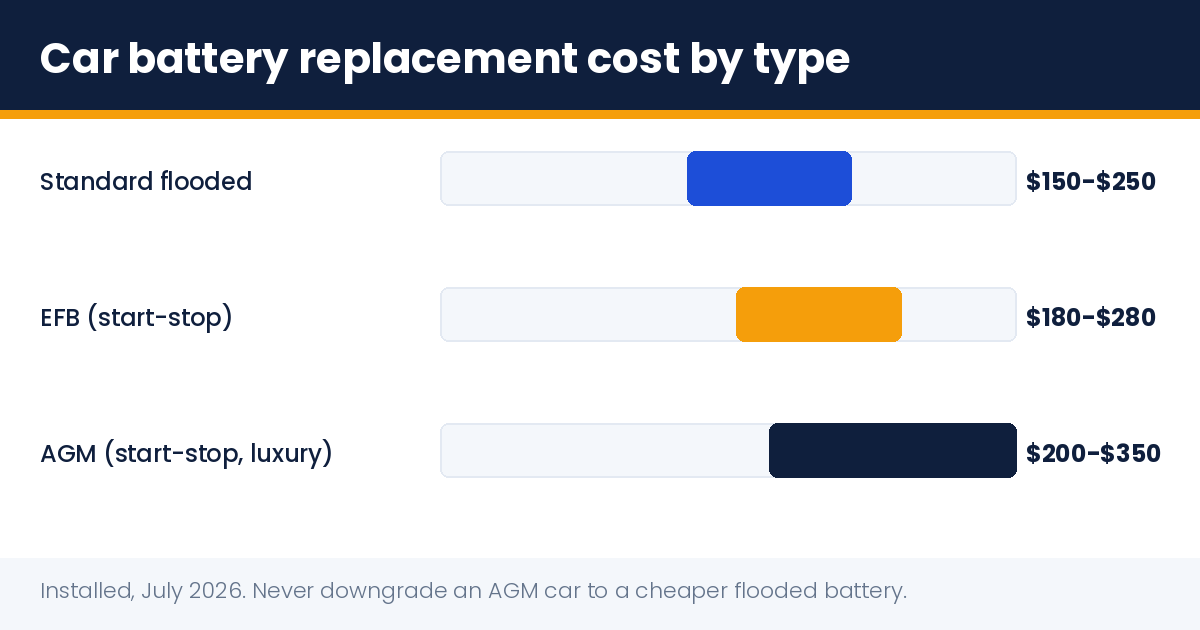
Car battery replacement cost by battery type
| Battery type | Fair 2026 installed price | Who needs it |
|---|---|---|
| Standard flooded | $150-$250 | Most cars without start-stop |
| EFB (enhanced flooded) | $180-$280 | Some start-stop cars, check the label |
| AGM | $200-$350 | Start-stop, luxury, big electronics loads |
| Batteries buried in fender/trunk | Add $50-$150 labor | Some German cars, some SUVs |
| Registration/coding where required | Add $0-$50 | Many European cars after install |
Ranges are national figures, July 2026, parts stores and independent shops. The single biggest car battery replacement cost mistake is downgrading: putting a cheaper flooded battery in a car built for AGM. The start-stop system will quietly murder it in a year, and the second replacement erases the savings from the first.
The free test that comes before any spending
Every major parts store load-tests batteries free, in the parking lot, in five minutes. The test tells you three things a no-start morning cannot: whether the battery is actually failing, whether the alternator is charging it properly, and whether the real problem is a corroded connection pretending to be a dead battery. Skipping this test is how healthy batteries get replaced while the actual alternator problem drives home to kill the new one. Test first is the whole religion here, and it is free.
4 honest ways to save
1. Use the warranty you already have. Batteries carry 2 to 4 year free-replacement warranties, and most people never check. Find the date code sticker or your receipt; a 30-month-old battery with a 36-month warranty is a free battery.
2. Buy where installation is free. Most parts store chains install a battery you buy from them at no charge, on the spot, and handle the old-battery core credit automatically. That alone typically beats a shop’s install labor line, though a buried battery is legitimate shop work.
3. Replace on your schedule, not the battery’s. Most batteries live 3 to 5 years. Once yours crosses 4, a $0 test each fall means you replace it on a calm Saturday at a fair price instead of via tow truck, jump pack, and whatever the nearest shop charges strangers in a hurry.
4. Compare warehouse club prices. Wholesale clubs frequently sell the same-size battery $30 to $60 under parts store prices. The trade: you install it yourself or pay someone, and club return counters move slower than a parts store parking lot.
Buying the right battery, in one paragraph
Match three things: group size (the physical fit code, printed on the old battery), the type your car specifies (flooded, EFB, or AGM, in the manual or on the old battery’s label), and cold cranking amps at or above the spec. Brand matters less than freshness: batteries age on shelves, so check the date code and take one under 6 months old.
That is the entire buying skill, and it makes the car battery replacement cost table above the only negotiation you need. For the fuller picture of how shops price any job, our fair-price hub breaks down parts, labor, and the lines in between; the FTC’s auto repair basics backs the get-it-in-writing habit.
Car battery replacement cost FAQ
Why did the quote double when the shop said AGM?
AGM construction genuinely costs more to make and your start-stop car genuinely requires it. The upcharge is honest; verify the requirement by reading the old battery’s label rather than taking anyone’s word.
Do I really need the registration/coding step some shops charge for?
On many European cars, yes: the car manages charging based on battery age, and telling it about the new battery protects the battery’s lifespan. On most mainstream cars there is nothing to code. It is a fair charge where it applies and a padding line where it does not, so ask which your car is.
Can I replace a car battery myself?
Usually, with a wrench and ten minutes: negative off first, positive off, swap, positive on, negative on last. Skip DIY if the battery is buried, the car needs coding, or you would rather let the parts store do it free, which is honestly the best deal in car repair.
My car died again a week after the new battery. Was I scammed?
Probably not scammed, probably misdiagnosed. A charging system problem or a parasitic drain kills new batteries as happily as old ones. This is exactly what the free load test’s charging check exists to catch, and it is the first thing to demand now.