
Transmission fluid how to change, in one honest paragraph: warm the car, lift it safely, drain the pan, replace the filter and gasket, refill with the exact fluid your manual lists, then check the level with the engine warm and running. A DIY drain and fill costs about $50 to $100 in fluid and parts, while a shop charges $100 to $250 for the same service. Budget 60 to 90 minutes your first time. If your car has a sealed transmission with no dipstick, skip the DIY and let a shop set the level.
On this page: Supplies The 8 steps Drain vs flush When not to DIY Cost FAQ
What You Need Before You Touch a Bolt
Your owner’s manual is the first tool. It lists the exact fluid specification, and transmissions do not forgive substitutes. Note the spec, the refill capacity, and whether your car even has a serviceable pan and dipstick, because plenty of newer cars have neither.
The job needs 3 to 5 quarts of that fluid, a filter kit with a new pan gasket, a wide catch pan, a torque wrench, a long funnel, jack stands or ramps, and gloves. Buy one quart extra. Fluid is the expensive part at $8 to $15 per quart, which is why DIY lands near $50 to $100.
Transmission Fluid How to Change: The 8 Steps
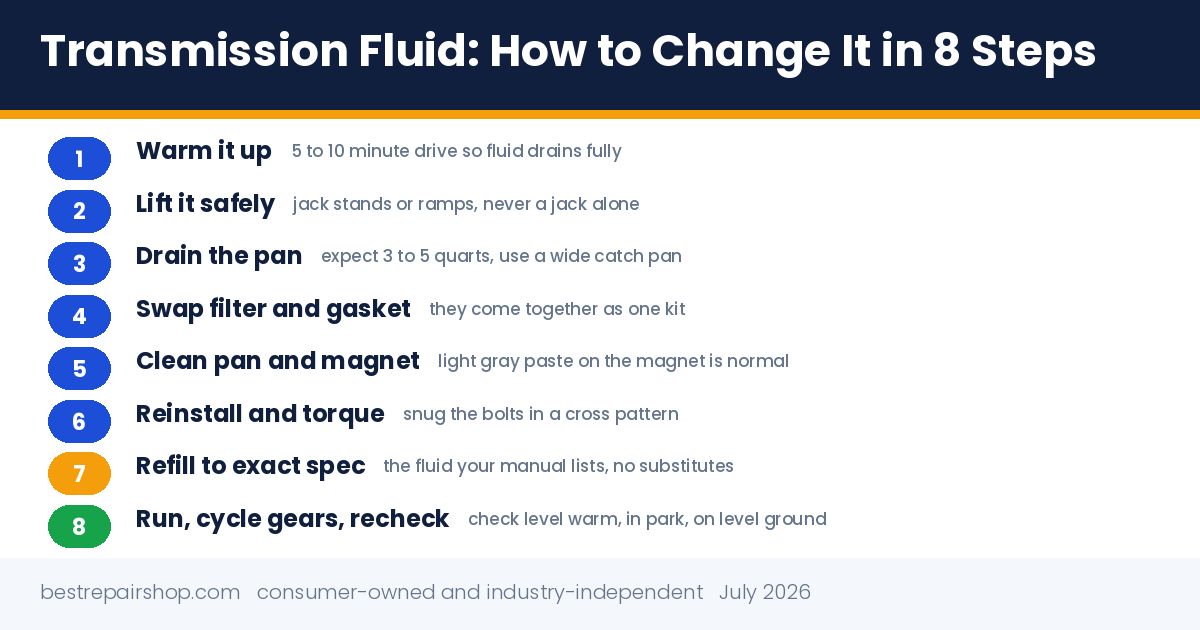
Here is transmission fluid how to change, in the order a careful home mechanic works. The diagram above matches these steps.
Step 1: warm it up. Drive 5 to 10 minutes so the fluid thins and drains completely. Step 2: lift it safely. Jack stands or ramps on level concrete, never a jack alone, and chock the wheels that stay on the ground.
Step 3: drain the pan. If your pan has a drain plug, use it. If not, loosen the pan bolts and let one corner tip down to drain, so use a catch pan wider than the transmission pan. Expect 3 to 5 quarts. Step 4: swap the filter and gasket. The filter usually pulls straight down or unscrews, and the kit’s gasket needs no sealant on most cars.
Step 5: clean the pan and magnet. A light gray paste on the magnet is normal wear. Chunks or glitter mean stop and get a shop’s opinion first. Step 6: reinstall and torque. Snug the bolts in a cross pattern to the manual’s spec, often around 8 to 12 lb-ft. Overtightening warps the pan and causes leaks.
Step 7: refill to exact spec. Pour through the dipstick tube with the funnel, starting with about a half quart less than what came out. Step 8: run, cycle gears, recheck. Start the engine, move the shifter slowly through every gear, then check the level warm, in park, on level ground. Top up in small amounts and check for drips before driving.
Drain and Fill vs Flush: Know the Difference
A drain and fill, which is what most transmission fluid how to change guides describe, replaces the 3 to 5 quarts sitting in the pan. A machine exchange, often sold as a flush, pushes out nearly all 10 to 12 quarts, including what hides in the torque converter and cooler lines.
On a regular schedule, the drain and fill is the gentler, cheaper habit, and doing it twice a few thousand miles apart refreshes most of the fluid. Our transmission flush guide covers when the machine service actually earns its higher price.
When You Should Not DIY This Job
The transmission fluid how to change answer flips to “pay a shop” in a few honest cases. Sealed transmissions with no dipstick often need the level set at an exact fluid temperature with a scan tool watching. Many CVTs demand one specific fluid and a strict procedure, and a mistake there costs thousands, not quarts.
Skip DIY too if the fluid is dark brown and burnt smelling on a high mileage car that has never been serviced. Let a professional look before any fluid decisions. And if you cannot lift the car on solid level ground with proper stands, that settles it, because no fluid change is worth working under a car held up wrong. The FTC’s auto repair basics guide is a good primer on getting that shop visit priced in writing.
What This Costs, DIY and at a Shop
Here are fair national numbers. A shop drain and fill sits at $100 to $250, a machine exchange at $150 to $400, and a filter with gasket adds $75 to $150 to either. The full breakdown lives in our transmission fluid change cost guide.
| Service | Fair range |
|---|---|
| DIY drain and fill, fluid and filter kit | $50-$100 |
| Shop drain and fill | $100-$250 |
| Machine fluid exchange | $150-$400 |
| Filter and gasket, added to either | $75-$150 |
Ranges are national, independent-shop figures, July 2026. Dealers usually run higher, and an unusual fluid spec can move the DIY number up.
Transmission Fluid Questions, Answered
How often should transmission fluid be changed?
Most automatics do well with a drain and fill every 30,000 to 60,000 miles, with towing and stop-and-go duty at the short end of that range. “Lifetime fluid” usually means the lifetime of the warranty, not the car.
What color should transmission fluid be?
Fresh fluid is bright red to pink, and a deeper red with some miles on it is normal. Dark brown or black with a burnt smell means the fluid is overdue and the transmission may already be wearing, so have it inspected before paying for any service.
Can I just top it off instead of changing it?
Topping off only helps if the level is actually low, and a low level means a leak that needs finding. For maintenance, the transmission fluid how to change steps above replace fluid that has worn out, which a top off cannot do. Old fluid loses its friction properties even when the level reads full.
Do I have to replace the filter every time?
If your transmission has a serviceable filter, replace it whenever the pan is off, since the kit costs $15 to $40 and the messy labor is already done. Some transmissions use a permanent metal screen instead, and those just get cleaned and reinstalled.