
How long should an oil change take? Plan on 15 to 30 minutes of actual work at a quick lube, 30 to 60 minutes at an independent or tire shop, and 45 to 90 minutes at a dealership. The wildcard is wait time: a walk-in on a busy Saturday can double any of those numbers. The shop you pick matters less than the appointment you make.
On this page: Shop times Why it varies Wait time Too fast Save time FAQ
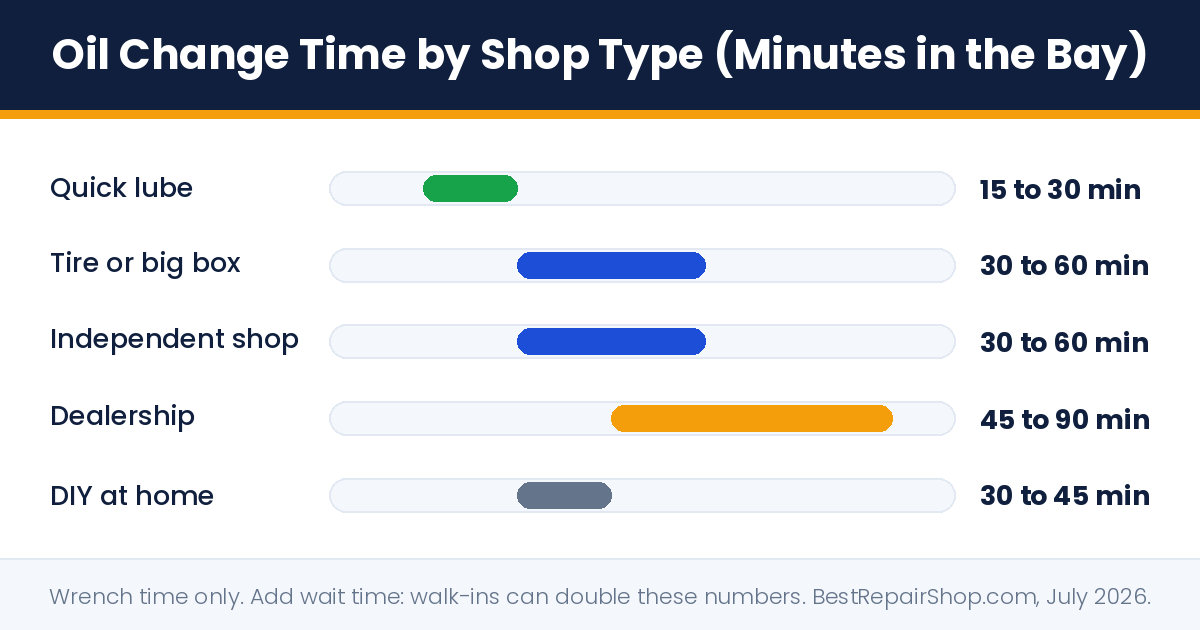
How long should an oil change take at each shop type
A quick lube is built for one job. Your car rolls over a pit, one tech drains from below while another works the top side, and 15 to 30 minutes later you are paying. Tire chains and big box auto centers usually land at 30 to 60 minutes, because your oil change shares the schedule with tire mounting and alignment jobs that were promised first.
A good independent shop also runs 30 to 60 minutes, and that extra time is often the good kind: a tech who knows your car looking at brakes, belts, and leaks while the oil drains. Dealerships run 45 to 90 minutes because your car waits for a bay, gets a multipoint inspection, and the paperwork loops through a service advisor. What each visit should cost is its own question, and we priced all five options in our oil change cost guide.
Why the same job runs 15 minutes or 90
Cars are not equally easy to drain. Plenty of newer engines hide the filter behind a splash shield with a dozen fasteners, or use a cartridge filter buried under intake plumbing. Some European engines call for a specific oil the shop has to order in. Add an occupied lift and a tech who is mid-brake-job, and your simple service waits its turn.
The drain itself also deserves minutes, not seconds. Hot oil pours fast at first, then drips, and those last drips carry debris you want out of the engine. A shop that lets the pan drain while the tech checks tires and tops off fluids is spending your time well.
Wrench time vs wait time: the number nobody quotes
When people ask how long should an oil change take, they usually mean door to door, and that is a different number. The bay work is 15 to 90 minutes depending on the shop, but the queue in front of you is the real schedule. A no-appointment quick lube at Saturday 10 a.m. can hold a 45 minute line for a 20 minute service.
Appointments flip that math. A booked 8 a.m. slot at an independent shop often has you out the door in under an hour, inspection included. Dealers soften long visits with shuttles and loaners, which helps, but it does not shorten the visit. If a shop cannot give you even a rough promise time, that tells you something about how the day is going in there.
When fast is too fast: the 10 minute oil change
Speed is a feature until it eats the job. A change finished in under 10 minutes usually means the pan did not fully drain, and in the worst cases it means a filter that never came off. You cannot watch the pit, but you can check the invoice: it should list the oil brand, weight, and quantity, plus a filter part number.
Fast lanes also lean on add-ons to make the visit pay, so expect a cabin filter or flush pitch before the oil is even in. The FTC’s auto repair basics guide is blunt about this: ask for recommendations in writing and decline anything you did not come in for. A wiper blade today does not need to be a $90 decision.
5 ways to spend less time waiting
First, book the first appointment of the day; the schedule has not slipped yet. Second, drop the car off instead of waiting when you can. Third, bundle the visit: an oil change plus tire rotation costs little extra time on the same lift. Fourth, confirm the shop stocks your oil spec and filter when you book, which is the most common silent delay. Fifth, stop changing oil more often than your engine needs; our how often to change oil guide covers real intervals, and the rest of our maintenance guides work the same way: fewer, better visits.
| Shop type | Time in the bay | Realistic door to door | Typical full synthetic price |
|---|---|---|---|
| Quick lube | 15-30 min | 20-75 min | $65-$110 |
| Tire chain / big box | 30-60 min | 45 min-2 hr | $65-$100 |
| Independent shop | 30-60 min | 45-90 min booked | $65-$115 |
| Dealership | 45-90 min | 1-2.5 hr | $80-$125 |
| DIY at home | 30-45 min | Your driveway, your pace | $35-$60 in parts |
Ranges are national, independent-shop figures, July 2026. Conventional oil, where an engine still allows it, runs $35 to $75 at a shop and shaves little off the clock; the labor is the same job.
FAQ
How long should an oil change take at a dealership?
With an appointment, 45 to 90 minutes is normal, and that includes the multipoint inspection and advisor paperwork. Without an appointment you are at the mercy of the day’s schedule, and two hours is common. Ask for a promise time when you hand over the key.
Why did my oil change take 2 hours?
Almost always the queue, not your car. Walk-in traffic, a filter that had to be ordered, or a lift tied up by a bigger job are the usual suspects. If it happens on a booked appointment more than once, that shop has a scheduling problem you do not have to keep paying for.
Can an oil change really be done in 10 minutes?
Physically, yes, and quick lubes are engineered around it. The tradeoff is a shorter drain and zero inspection time. Fine for a healthy commuter on a tight morning, but nobody catches a weeping gasket or a cracked belt in that visit.
Does synthetic oil take longer to change?
No. The labor is identical; only the price of the oil changes. Expect $65 to $125 for full synthetic at a shop versus $35 to $75 for conventional. Most newer engines require synthetic, so check the cap or the manual before asking for the cheaper bottle.