
Exhaust smoke color meaning breaks three ways: white is coolant or plain steam, blue is oil burning, and black is too much fuel. Thin vapor that clears in 30 to 60 seconds on a cool morning is normal condensation. Smoke that thickens as the engine warms is not, and fixes run from a $20 air filter to a $2,500 head gasket.
On this page: Quick read White smoke Blue smoke Black smoke Repair costs FAQ
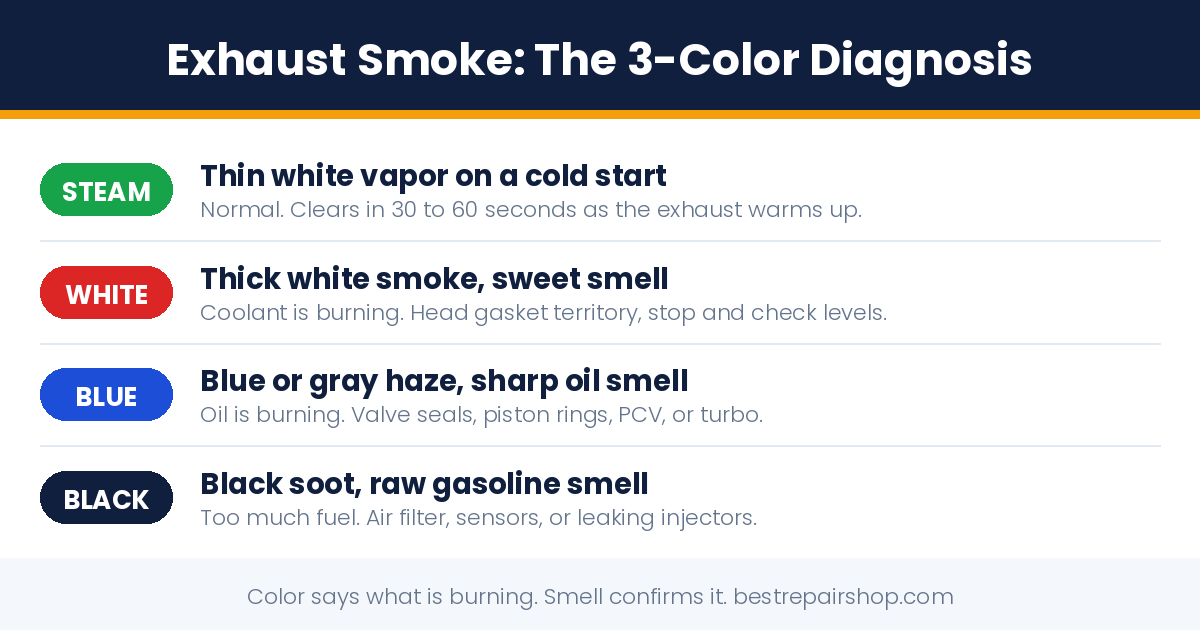
Exhaust Smoke Color Meaning: The 30 Second Read
A healthy gas engine burns nearly invisible. When the tailpipe starts producing a color, the engine is burning something it should not, and the color tells you which fluid it is. That is the entire exhaust smoke color meaning system: match the color to a fluid, then confirm it with your nose.
Sweet like syrup is coolant. Sharp and acrid is engine oil. Raw gasoline is fuel. I have watched people pay for a full diagnostic hour that started and ended with a technician sniffing the tailpipe. You can do that part for free in your own driveway. Our symptoms library reads sounds and smells the same way: cheapest test first.
White Smoke: Steam or Coolant
Start with the clock. Thin white vapor on a cold start that disappears within 30 to 60 seconds is condensation cooking out of the exhaust. Every car on the block does it on a damp morning. If it is gone by the end of your street, so is the problem.
Thick white smoke that keeps rolling after warm up, especially with a sweet smell, means coolant is getting into the cylinders. The usual suspects are a failed head gasket, a cracked cylinder head, or a leaking intake manifold gasket. Check the overflow tank when the engine is cool. If the level keeps dropping and the smoke keeps coming, stop driving: this is the same failure chain we cover in car overheating, and running it hot turns a $1,500 repair into a replacement engine.
Blue Smoke: The Engine Is Burning Oil
Blue or blue-gray smoke is engine oil crossing into the combustion chamber, and the timing is the tell. A puff on startup that clears points to worn valve seals, because oil seeps past them overnight. Smoke under hard acceleration points to piston rings. A steady haze at all speeds points to a stuck PCV valve or, on turbo cars, leaking turbo seals.
Check the dipstick weekly. Burning about a quart every 1,000 miles is where shops start talking about internal work. Until then, keep the level up and stay on schedule with oil changes, because low, dirty oil speeds up every one of these failures. Blue is the slow burner of the exhaust smoke color meaning family: rarely a tow truck, never free.
Black Smoke: Too Much Fuel
Black smoke is unburned fuel, and it is usually the cheapest color on this menu. A choked air filter, a failing oxygen sensor or mass airflow sensor, or a leaking injector all push the mixture rich. You will usually get a check engine light with it, plus worse mileage and sometimes a gasoline smell.
Here is the wallet math. The fix might be a $20 filter, but ignoring it feeds raw fuel into a catalytic converter that costs $900 to $2,400 to replace. That is exactly how a rich mixture becomes a P0420 code. Black is the one color where acting fast almost always saves four figures.
What Each Color Costs to Fix
Once you have the exhaust smoke color meaning down, the estimate should match the color. Here is the fair national spread.
| Repair | Smoke color | Fair 2026 range |
|---|---|---|
| Engine air filter | Black | $20-$85 |
| Oxygen sensor | Black | $150-$400 |
| Fuel injector service | Black | $150-$650 |
| PCV valve | Blue | $25-$150 |
| Valve seals | Blue | $350-$1,200 |
| Piston rings | Blue | $2,500-$5,000 |
| Intake manifold gasket | White | $300-$800 |
| Head gasket | White | $1,500-$2,500 |
Ranges are national, independent-shop figures, August 2026. Diagnostic time runs $75 to $200 an hour at honest shops, and a smoke complaint should take an hour or less to pin down. Get the estimate in writing before you approve anything: the FTC auto repair basics guide backs you on that, and our check engine light diagnosis cost guide covers what the scan itself should cost.
Exhaust Smoke Questions, Answered
Is white smoke on a cold morning normal?
Yes, if it is thin and gone within a minute. That is water vapor condensing in a cold exhaust system, and it shows up more in cold, humid weather. Worry only when it stays thick after warm up or comes with a sweet smell and a dropping coolant level.
Can I keep driving with blue smoke?
Short trips, yes, as long as you watch the dipstick and top up. But burning oil fouls spark plugs and slowly poisons the catalytic converter, a $900 to $2,400 part. Get it diagnosed within weeks, not months, and track how fast the level drops in the meantime.
What does gray exhaust smoke mean?
Gray sits between blue and white and is the trickiest read. Most often it is still oil, from a tired turbo or a stuck PCV valve. On some older automatics it can even be transmission fluid pulled through a failed vacuum modulator. Treat gray like blue until a shop proves otherwise, and let smell break the tie.
Why does black smoke come with a gas smell?
Because black smoke is unburned fuel, and unburned fuel stinks. If you smell raw gas even without visible smoke, do not shrug it off; we walk through the dangerous versions in car smells like gas. Smoke plus smell almost always means a rich mixture that one scan visit can pin down.