
The clearest signs of a good mechanic are all on paper: a written estimate before any work starts, a diagnostic fee of $75 to $200 that gets credited toward the repair, your old parts offered back, and a 12 month or 12,000 mile parts and labor warranty you did not have to ask for. Run the 30 day test below on small jobs before you trust anyone with a $1,000 brake or transmission bill.
On this page: The 30-day test The 8 flags Paper trail Fair prices Red flags FAQ
How the 30-Day Honest Shop Test Works
You do not audition a shop with a transmission. You audition it with an oil change, a tire rotation, maybe a battery test: cheap jobs where the honest answer is often “you do not need anything.” Give a candidate shop 30 days and two or three small visits, and score them against the eight signs of a good mechanic below. A shop that pads a $70 oil change with a fuel system flush will pad a $1,500 brake job too; the invoice just gets bigger, not more honest.
This is the last piece in our 30 day fair repair series, and it is the one that makes the rest work. Every price guide on this site, and everything in our trust section, assumes you can find a shop worth handing the keys to. Here is what worth it looks like from the customer side of the counter.
The 8 Signs of a Good Mechanic
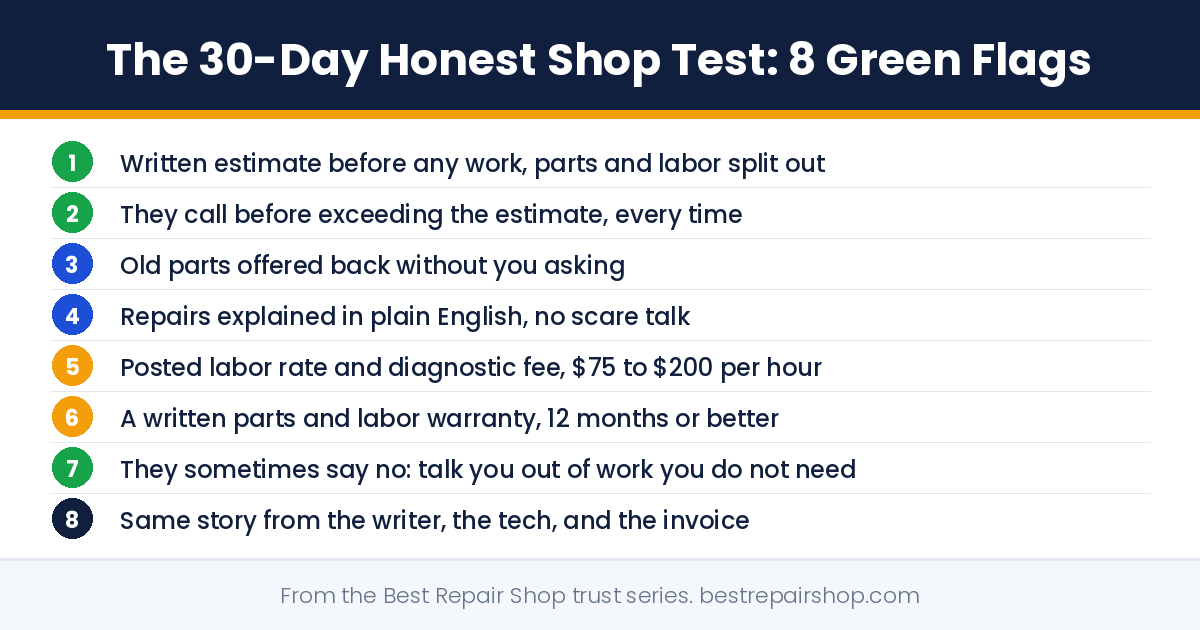
1. A written estimate before any wrench turns. Parts and labor listed separately, not one round number. 2. They call before exceeding it. Every time, even for twenty bucks. The shops that ask permission at $20 are the ones that ask at $800.
3. Old parts come back without you asking. A shop proud of the diagnosis wants to show you the scored rotor or the swollen battery. 4. Plain English explanations. A good writer can tell you what a control arm does in one sentence and does not need the word “catastrophic” to close a sale.
5. Posted rates. The labor rate and the diagnostic fee, $75 to $200 per hour nationally, on the wall or on the site, not revealed at pickup. 6. A real warranty. Parts and labor, in writing, 12 months or 12,000 miles is the honest baseline. “We stand behind our work” is a sentence, not a warranty.
7. They sometimes say no. The single strongest flag on this list. A shop that has ever talked you out of a repair, or resurfaced instead of replaced, is playing the long game with your trust. 8. The story never changes. The service writer, the technician, and the invoice all describe the same problem the same way. When those three drift apart, somebody is improvising.
The Paper Trail Never Lies
Charm is free; paperwork costs discipline. The FTC’s auto repair basics guide notes that many states require a written estimate and your authorization before repairs, and the good shops treat that floor as a starting point. Keep every estimate and invoice from your 30 day test. Then compare: did the final bill match the estimate? Were add-ons explained before, not after? Does the invoice list part numbers and brands, or just “brakes”?
That file does double duty later. If a repair ever goes wrong, the shop’s own paperwork is what a warranty claim or a card dispute stands on. And walking in with your last invoice tells a new shop you are the customer who reads, which is quietly the best upsell repellent on the market.
Fair Prices You Can Sanity Check
| Job | Fair national range | Notes |
|---|---|---|
| Synthetic oil change | $65-$125 | Conventional runs $35-$75 |
| Diagnostic hour | $75-$200 | Should be credited if they do the repair |
| Brake pads, per axle | $130-$320 | Pads plus rotors: $250-$500 per axle |
| Battery, installed | $150-$300 | AGM batteries: $200-$350 |
| AC recharge | $150-$300 | A recharge is not a leak repair |
| Alternator replacement | $350-$900 | Ask for the charging test printout |
Ranges are national, independent-shop figures, August 25, 2026. One quote above a range means nothing; your car, your region, or a premium part can explain it. A pattern of quotes above every range, with no explanation offered, is data. Compare any brake quote against our brake job cost guide before you sign, and do the same with the rest of our cost series.
Red Flags That Cancel Everything
Some behaviors end the 30 day test early. Refusing a written estimate. Finding new “urgent” problems at pickup, when your car is already on the lift and your ride has left. Scare language on a first visit for a car that drove in fine. Repairs authorized only verbally, or a warranty that evaporates when you ask for it in writing. Any one of these outweighs every one of the signs of a good mechanic above, because honesty is not a percentage; it is a policy.
Finding a Shop, Answered
What are the signs of a good mechanic on a first visit?
Watch how they handle the estimate. A written quote with parts and labor split out, a clear diagnostic fee, and a walk to the car to show you the problem are the big three. If all three happen on visit one, the 30 day test usually just confirms it.
Is a dealership more trustworthy than an independent shop?
Neither wins by default; both employ honest people and commission structures. Dealers know your model deeply and charge for it, while good independents often beat them by a third on common repairs. Our dealer versus independent comparison breaks down when each is worth it.
Should a shop really give my old parts back?
Yes, if you ask before the work, and the best shops offer first. Some parts carry a core charge and must be returned to the supplier, but the shop can still show them to you. A shop that gets defensive about showing parts is telling you something.
What is a fair diagnostic fee?
One shop labor hour, so $75 to $200 nationally, and it should be stated up front. The honest version gets applied to the repair if you approve the work. Free diagnostics usually mean the cost is hiding somewhere else in the quote.