
Car repair costs for the most common jobs run between $150 and $1,200 at an independent shop, and every honest quote is built from three numbers: parts, labor hours, and the shop’s hourly rate. Learn those three and you can tell a fair quote from a padded one in about two minutes.
On this page: Fair prices Read any quote Diagnostic fees Book time Extra fees Costs by state Worth fixing? Guides FAQ
Fair prices for common repairs (July 2026)
National ranges for independent shops, parts plus labor. Dealerships usually run 20-40% higher on labor. Where a full guide exists, the repair name links to the math behind the number.
| Repair | Parts | Labor | Fair total |
|---|---|---|---|
| Brake pads (per axle) | $40-$120 | $90-$200 | $130-$320 |
| Brake pads + rotors (per axle) | $150-$300 | $100-$225 | $250-$500 |
| Oil change (full synthetic) | $30-$60 | $25-$60 | $55-$120 |
| Battery replacement | $120-$260 | $0-$75 | $120-$335 |
| Alternator replacement | $180-$450 | $120-$300 | $300-$750 |
| Starter replacement | $150-$400 | $130-$350 | $280-$750 |
We add more car repair costs to this table as each full guide is published. Every figure gets a dated source and a methodology note, so you can quote these numbers with confidence.
How to read any repair quote
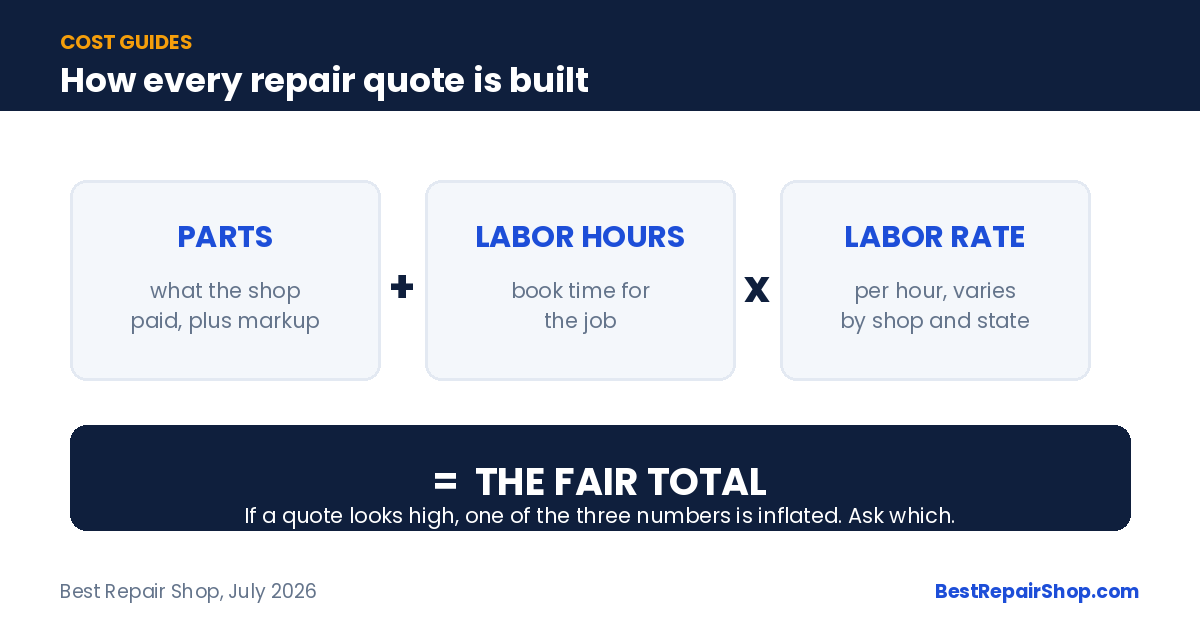
A quote is parts + (hours x labor rate). That is the whole formula. A brake pad job takes a shop that does them daily about 0.8 to 1.2 hours per axle. So if the pads cost $80 and the shop charges $130 an hour, the fair ticket lands near $210, not $450.
When a quote looks high, do not ask “is that a lot?” Ask which of the three numbers is inflated. Shops that show you the breakdown are usually the shops that have nothing to hide. Shops that answer with adjectives instead of numbers are the reason this site exists.
You also have rights here that most drivers never use. The Federal Trade Commission’s guide to auto repair basics explains what a written estimate must contain and what a shop can and cannot charge you for without approval. Read it once and you will negotiate differently forever.
What a diagnostic should cost, and when you should not pay it
Most independent shops charge one hour of labor to diagnose a problem, so $75 to $200 depending on the market. That is a fair charge. Finding out why a car does something is skilled work, and a shop that gives it away for free has to earn it back somewhere else on your ticket.
Two things to ask before you agree. First, does the diagnostic fee get applied to the repair if you approve the work? Many shops do this and will not mention it unless you ask. Second, what is the cap? “One hour to start, we call you before we go past that” is the answer you want. An open-ended diagnostic is how car repair costs quietly double.
A free code read at a parts store is not a diagnosis. It gives you a code, and a code names a circuit, not a broken part. P0420 does not mean “buy a catalytic converter.” Take the code as a starting point and let a real technician tell you what is actually failing.
Book time: why two honest shops quote different labor
Shops do not bill you for the minutes a job actually takes. They bill “book time,” a published estimate of how long the repair should take, from a labor guide such as Mitchell or ALLDATA. If the book says 1.4 hours, you pay 1.4 hours, whether the technician took an hour or three.
This is standard practice across the industry and it is not a scam. It protects you when a bolt snaps and the job runs long. But it explains a lot of the spread you see when you shop car repair costs around town, because different guides list different hours for the same repair, and some shops add their own padding on top.
The question that keeps book time honest is about overlap. When two repairs share the same teardown, the second one should be discounted, because the technician is already in there. Ask it plainly: “Does the labor overlap between these two jobs, and did you take that out?” A good shop will say yes and show you. A shop that gets annoyed at the question has told you something useful.
The line items that are neither parts nor labor
Almost every final invoice carries charges that were not in the quote. Most are legitimate and small. Know the normal size of each one and you will spot the outlier immediately.
| Line item | Normal range | Push back when |
|---|---|---|
| Shop supplies | 2-5% of labor, often capped near $35 | It is a flat percentage of the whole invoice including parts |
| Hazmat or waste disposal | $3-$15 | It appears on a job with no fluids involved |
| Tire disposal | $3-$8 per tire | It is charged on tires you took home |
| Diagnostic fee | $75-$200 | It is billed twice for one visit |
| Shop credit card fee | 0-3% | It was never disclosed before you handed over the card |
None of these should move your total by more than about 5%. If the fees at the bottom of the invoice are meaningfully bigger than that, you are not looking at fees anymore, you are looking at a second labor charge wearing a different name.
Why car repair costs vary so much by state
Car repair costs move with geography more than most drivers expect. Labor rates run from around $75 an hour in rural areas to more than $200 an hour in big coastal cities. Parts pricing shifts too, and rust-belt cars take longer to work on because hardware seizes. National averages hide all of that, which is why the same repair can be fair at $300 in Ohio and fair at $520 in California.
State-by-state labor rates and parts pricing are coming to this page, gathered with help from our state communities, so you will be able to check what a repair should cost where you actually live.
When a repair is not worth doing
There is a point where the right answer is to stop spending. The rough test most shops use privately: if a single repair costs more than about half what the car is worth, and the car has other deferred work waiting, you are funding a rebuild one invoice at a time.
Run the honest version of the math. Look up your car’s private-party value, add up the repairs it needs over the next twelve months rather than just today’s quote, and compare that to a year of payments on a replacement. Repair often still wins, because $2,000 of car repair costs is cheaper than $9,000 of car payments. But you should reach that conclusion on purpose instead of by drifting into it.
Start with these guides
- How much does a brake job cost? The real math behind the quote
- Car AC repair cost: fair prices for 7 common fixes
- Car battery replacement cost and 4 honest ways to save
- Transmission fluid change cost: drain and fill vs exchange
- Do you really need a transmission flush? How to tell before you pay
- Can I keep driving with the check engine light on?
Cost questions, answered straight
Why did I get two quotes that are $300 apart for the same job?
Usually three reasons: different labor rates, OEM versus aftermarket parts, and whether one shop bundled extra services into the ticket. Compare the two quotes line by line using the three numbers, and the gap almost always explains itself.
Is the dealership always more expensive?
Typically 20-40% higher on labor, and dealers quote OEM parts by default. For most out-of-warranty repairs a good independent shop is the better value. For recall work the dealer is free, so check your VIN against the NHTSA recall database before you pay for anything.
Can I bring my own parts to a shop?
Many shops say no, and that alone is not a red flag: they cannot warranty a part they did not source. If saving on parts matters most, ask the shop to price-match a mainstream brand instead.
Do car repair costs go up if I approve the work over the phone?
They should not, but a phone approval is harder to hold a shop to later. Ask them to text or email the revised estimate before you say yes, then reply with your approval in writing. It takes ninety seconds and it turns a conversation into a record.
What if the final bill is higher than the estimate?
In most states a shop has to get your authorization before exceeding a written estimate by more than a set amount or percentage, often 10%. Ask for the written authorization they are relying on. If none exists, say so calmly and ask for the invoice to be corrected before you pay.
Not sure what is wrong yet?
If you have a symptom instead of a diagnosis, start with the symptom guides to find the likely cause and whether it is safe to drive. And if you already have a quote in hand and a bad feeling, read how to find a good mechanic before you say yes.