
The honest answer on 5W30 vs 5W20: both oils flow the same when your engine is cold, and they only differ in thickness once the engine is fully warm. Your owner’s manual, not the shop counter, decides which one your engine gets. Either way, an oil change should run $35 to $75 for conventional or $65 to $125 for full synthetic at an independent shop, because the per-quart price gap between the two grades is pennies.
On this page: The numbers · Find your spec · Hot and cold · Mixing rules · Cost · FAQ
What the Numbers in 5W30 vs 5W20 Really Mean
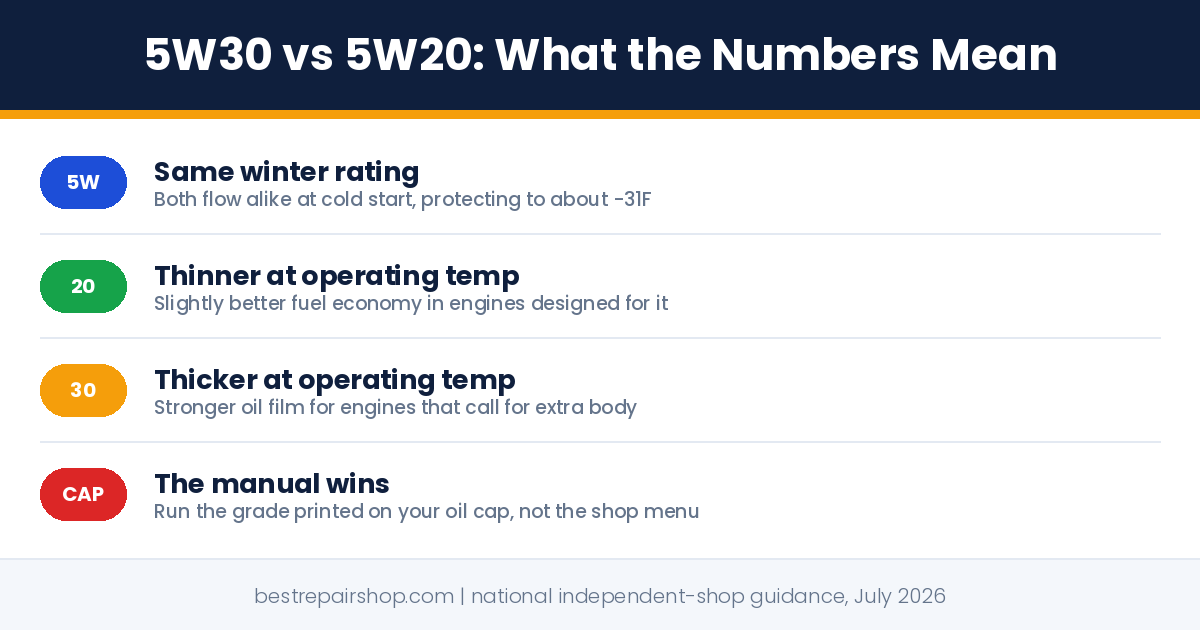
Oil grades read in two halves, and your car is fussy about only one of them. The first half, 5W, is the winter rating: how easily the oil pumps when it is cold. Here is the part most counter guys skip: in the 5W30 vs 5W20 question, the 5W half is identical. Both oils crank and pump the same on a freezing morning, protecting your engine in the seconds after startup when most wear happens.
The second number is the one that matters. It describes how thick the oil stays at full operating temperature, around 212 degrees Fahrenheit. In lab terms, a 20-grade oil runs roughly 6.9 to 9.3 centistokes at that temperature, while a 30-grade runs roughly 9.3 to 12.5. Thinner oil moves faster and steals slightly less power. Thicker oil holds a sturdier cushion between metal parts under load. Your engine was designed around one of those cushions, with bearing clearances and oil passages sized to match.
Why did automakers drift thinner over the past two decades? Fuel economy rules, mostly, but not only that. Modern engines are machined to tighter clearances than the ones your dad topped off with straight 30 weight, and their oil pumps, timing chains, and hydraulic tensioners were all sized around a lighter oil. The thin grade is not a compromise in those engines. It is the design. That is why the answer lives in your manual instead of in a rule of thumb.
Find Your Engine’s Spec in 30 Seconds
Your car tells you what it wants in two places. First, look at the oil filler cap under the hood: most cars built since the mid 2000s print the grade right on it, something like “5W-20” in raised letters. Second, the owner’s manual lists the grade in the maintenance or specifications chapter, usually next to the oil capacity.
If the cap and a shop’s menu board disagree, the cap wins. Quick lube menus default to whatever bulk oil is in their tanks, and the FTC’s auto repair guidance is blunt about this: you choose the parts and fluids, and you are entitled to see what went in. Write the grade inside your service records so you can check every invoice against it. Our guide on how often to change oil covers the interval side of the same habit.
Hot Weather, Cold Weather, and Towing
Cold is the easy case in the 5W30 vs 5W20 comparison: both grades carry the same 5W winter rating and stay pumpable to roughly 31 below zero Fahrenheit, so winter is not a reason to switch. Hot climates tempt people toward the thicker 30, but modern 5W20 engines run happily through Phoenix summers. The cooling system controls oil temperature far more than the outside air does.
The real exception is sustained heavy load. Some manuals, several Ford and Honda truck manuals among them, allow or recommend stepping up a grade for continuous towing, mountain grades, or track use. That is the pattern worth copying: the manufacturer names the condition and the grade. If your manual lists only one grade with no asterisks, that is your answer in every season.
Mixing and Substitution: The Manual Wins
Can you top off a 5W20 engine with a quart of 5W30 at a gas station? Yes. The two oils blend into an in-between viscosity, nothing curdles, and one quart in five barely moves the number. Fix it at the next change and forget it. Stranded-on-the-highway math always favors having oil in the engine over having the perfect oil.
Running the wrong grade for a full interval is a different question. One 5,000 mile stretch on 5W30 in a 5W20 engine will very likely cause no measurable harm. But newer engines with variable valve timing and cylinder deactivation use oil pressure as a control signal, and they were calibrated around the specified grade. Some will set a check engine light on thicker oil. And if an engine fails under warranty, the paperwork asking what oil was used is not a formality.
The same rule covers the old mechanic’s trick of “upgrading” a high mileage engine to thicker oil to quiet it down or slow a leak. Sometimes it helps, sometimes it masks a problem that wanted fixing. Let the manual, or a shop you trust with a diagnosis, make that call rather than the parts store aisle. If you do your own changes, our step by step oil change guide shows where the grade matters in the process.
What Each Grade Costs
Here is the good news in the 5W30 vs 5W20 decision: it is not a money decision. The two grades sit on the same shelf at the same price, and shops charge the same for either. What moves the bill is conventional versus synthetic, and who does the work. Our oil change cost guide breaks down fair prices by shop type, and the maintenance hub collects the rest.
| Item | 5W20 | 5W30 |
|---|---|---|
| 5-quart jug, conventional | $18-$28 | $18-$28 |
| 5-quart jug, full synthetic | $24-$45 | $24-$45 |
| Shop oil change, conventional | $35-$75 | $35-$75 |
| Shop oil change, full synthetic | $65-$125 | $65-$125 |
| DIY change, full synthetic | $35-$60 | $35-$60 |
Ranges are national, independent-shop figures, July 2026. If a shop quotes a premium specifically for one grade over the other, ask why: the wholesale difference does not support it.
5W30 vs 5W20: Fast Answers
Can I use 5W30 instead of 5W20?
For one topping-off or one emergency interval, almost certainly without harm. As a standing choice, no: use the grade your manual specifies. Some manuals list both grades for different conditions, and in that case either printed option is fine.
Will the thicker oil cost me fuel economy?
Slightly. Engines designed for 5W20 typically give up somewhere around one percent when run on 5W30. That is one to two fill-ups a year for most drivers, small but real, and it is part of why the manufacturer chose the thinner grade.
Can I mix the two grades in an emergency?
Yes. They are fully compatible, and the blend simply lands between the two viscosities. The practical 5w30 vs 5w20 difference is small enough that a mixed crankcase will not hurt anything before your next scheduled change. Correct it then.
Does high mileage change which grade I should use?
Not by itself. Stay on spec unless the engine is burning or leaking oil, and even then get a diagnosis first. High mileage formulas with seal conditioners exist in both grades, so you can address age without changing viscosity.