
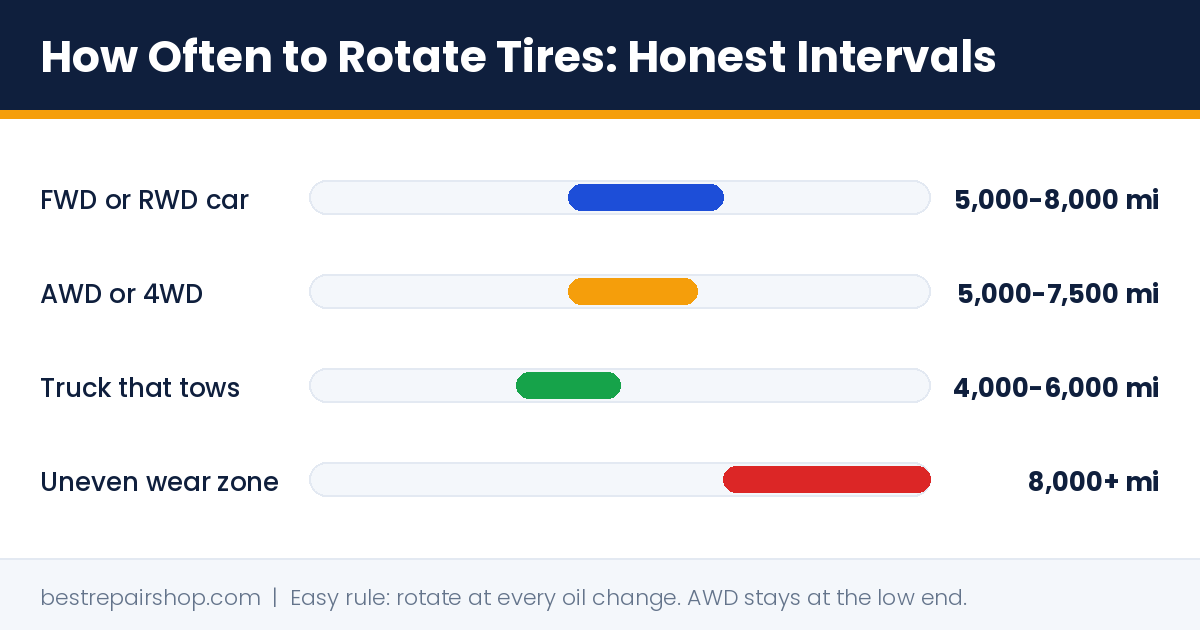
Rotate your tires every 5,000 to 8,000 miles, which for most drivers simply means at every oil change. All wheel drive should stay at the low end, every 5,000 miles. That is the honest answer to how often to rotate tires, and a shop should charge $25 to $50 for it, or nothing at all if they sold you the tires.
On this page: The interval Why it matters By drivetrain If you skip it Free rotations FAQ
How Often to Rotate Tires: The Honest Answer
Ask five drivers how often to rotate tires and you will get five answers, so here is the one your tires would give you: every 5,000 to 8,000 miles. Your owner’s manual gets the final word, and nearly every automaker lands inside that window. The easiest habit is to tie rotation to your oil change. Synthetic oil runs 5,000 to 7,500 miles between changes, which drops you right into the rotation window: one appointment, two jobs done, and your car is already on the lift.
Why a window instead of one number? Because wear depends on how and where you drive. Highway commuters can stretch toward 8,000. City drivers who corner, brake, and hit potholes all day should lean toward 5,000. NHTSA puts regular rotation at the center of basic tire safety for a reason: it is the cheapest item on the whole maintenance list, and it protects the most expensive rubber you own.
Why rotation matters more than it sounds
Tires wear unevenly by position. On a front wheel drive car, the front tires steer, put the power down, do most of the braking, and carry the weight of the engine. They can wear close to twice as fast as the rears. Rotation moves each tire through every position so all four wear down together instead of two dying young.
The money math is friendly. A decent set of tires runs $600 to $1,000, and even wear is worth thousands of extra miles across the set. There is also a fine-print reason: most tire mileage warranties require proof of regular rotation. Skip it, and a claim on a 60,000 mile warranty can be denied over a missing stack of $25 receipts. Your tires are quietly keeping score even if you are not.
FWD, RWD, and AWD: who needs it most
Front wheel drive chews up front tires, rear wheel drive wears the rears faster, and both are happy with the standard window. All wheel drive is the strict one. AWD systems want all four tires within about 2/32 of an inch of tread of each other; let one pair wear ahead of the other and the system works harder, and a single blown tire can turn into buying four. So if you are searching how often to rotate tires on an AWD car, keep it simple: every 5,000 miles, no stretching.
Trucks that tow or haul sit even lower, around 4,000 to 6,000 miles, because load multiplies wear. And if your tires are directional or staggered, the rotation pattern changes, but the interval does not. More on that in the FAQ below.
What actually happens when you skip it
Skipped rotations show up first as sound: a hum or growl that speeds up with the car, often mistaken for a bad wheel bearing. That is cupping and heel-toe wear, and once the tread wears into that pattern, rotation cannot fully undo it. Uneven tires also grip less in rain, and can nag you with a tire pressure light as the worn pair runs a slightly different rolling size.
The bill comes at replacement time. All-season tires should last 50,000 to 70,000 miles, but a never-rotated set can be done by 40,000, with two tires at the wear bars while the other two have half their tread left. Check yourself with the quarter test: if the top of Washington’s head is visible in the groove, you are near 4/32 and it is time to shop, not rotate.
How to pay little or nothing for it
Here is the good news your invoice has been waiting for: most tire shops include free lifetime rotation with tires they sold you. You just have to book it. Many general shops will also fold a rotation into an oil change for $0 to $25 if you ask when you book, since the car is already in the air. Paying full price? A standalone rotation is a 20 minute job and $25 to $50 is fair. The full price breakdown, including balancing, lives in our tire rotation and balance cost guide.
| Service | Fair range | Notes |
|---|---|---|
| Rotation only | $25-$50 | About 20 minutes of work |
| Rotation with oil change | $0-$25 | Ask when you book |
| Rotate and balance | $60-$120 | Add balancing only if you feel vibration |
| With tire purchase | Free | Lifetime at most tire shops |
Ranges are national, independent-shop figures, August 2026. Dealers often charge more for the same 20 minutes of work.
FAQ
How often to rotate tires if you barely drive?
Go by time as well as miles: at least once a year, even if you have not hit 5,000. Rubber ages and cars that sit wear tires in one spot. Age matters too. Six years is a typical tire lifespan and ten is the maximum, no matter how much tread is left.
Can I rotate my tires myself?
Yes, if you have a jack, jack stands, and a torque wrench. It is the same skill as changing a tire, done four times. Torque the lug nuts to spec, usually 80 to 100 lb-ft, in a star pattern, and recheck them after a few miles.
Does a rotation include balancing?
No. Rotation moves the wheels to new positions; balancing adds small weights so each wheel spins true. You do not need to balance at every rotation. Save it for new tires or when you feel a vibration through the seat or wheel.
Do directional tires change the pattern?
They change the pattern, not the schedule. Directional tires only move front to back on the same side, since they must roll one way. Staggered setups with wider rears can only swap side to side, and some cannot rotate at all. Your shop will know at a glance.