
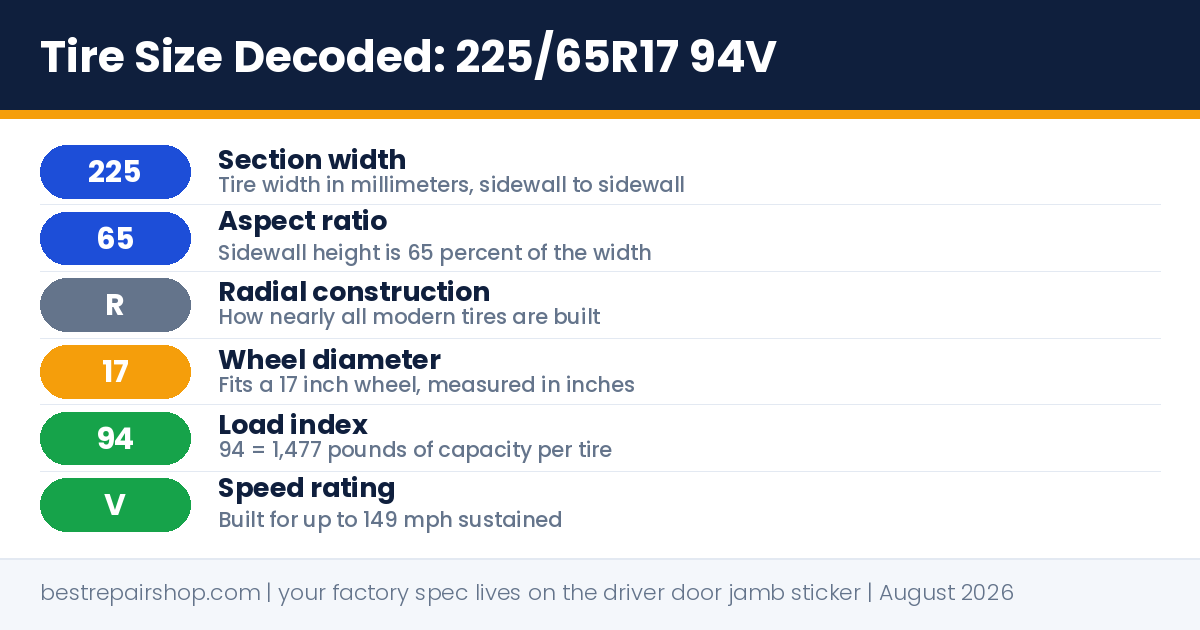
Once you know how to read tire size, the sidewall stops being alphabet soup: a code like 225/65R17 94V means the tire is 225 millimeters wide, the sidewall is 65 percent as tall as that width, it is radial construction, and it fits a 17 inch wheel. The 94V at the end covers how much weight it can carry and how fast it can safely go. Thirty seconds, no decoder ring required.
On this page: The code Three numbers Load and speed Date code Your spec FAQ
How to Read Tire Size on the Sidewall
Your tire has been trying to tell you its whole life story, molded right into the rubber. Find the biggest string of numbers and letters on the sidewall, something like 225/65R17 94V. That is the size code, and every tire sold in the US wears one. Learning how to read tire size is really just learning what those five pieces mean, in order.
Why bother? Because this little code decides what fits your car, what your speedometer believes, and what you should be quoted when it is time to buy. Walk into a tire counter knowing your code and you skip the “let me look that up for you” dance entirely.
The Three Numbers: Width, Sidewall, Wheel
These three chunks are the heart of how to read tire size. The 225 is the tire’s width in millimeters, measured sidewall to sidewall. Bigger number, wider tire. The 65 is the aspect ratio: the sidewall’s height is 65 percent of that 225 millimeter width. A lower number here means a shorter, sportier sidewall; a higher number means more cushion between the wheel and the pothole.
The R just means radial construction, which is nearly every passenger tire made since the 1980s. And the 17 is the one number that switches to inches: the diameter of the wheel the tire fits. A 17 inch tire goes on a 17 inch wheel, no exceptions, no stretching.
Load Index and Speed Rating: The Letters That Matter
The 94 is the load index, a lookup number for how much weight one tire can carry. A 94 handles 1,477 pounds, so four of them carry nearly 6,000 pounds. The V is the speed rating, the maximum sustained speed the tire is built for: V is rated to 149 mph. Common ratings run from S at 112 mph up through T, H, and V.
Here is the honest rule: match or exceed what your car’s door jamb sticker calls for, and do not pay extra for a higher speed rating than your car needs. The NHTSA tire guide covers the ratings in detail, and it is worth a bookmark next time you shop.
The DOT Date Code: Your Tire Has a Birthday
Near the wheel edge of the sidewall is a string starting with DOT. The last four digits are the birthday: week and year. So 3224 means the 32nd week of 2024. This matters because rubber ages even when the tread looks fine, drying out and losing grip.
The working rule at honest shops: tires are due around 6 years old regardless of tread, and 10 years is the absolute maximum, spare included. If a shop flags an old tire and the date code backs them up, that is not an upsell, that is the good kind of nagging. We go deeper in how long do tires last.
Where Your Correct Size Lives (Hint: Not on the Tire)
Here is the trap: the sidewall tells you what is on the car now, not what belongs there. A previous owner or a bargain-minded shop may have already strayed from spec. The factory answer lives on the sticker inside the driver’s door jamb, which lists the exact size and pressure your car was engineered for. That sticker outranks the tire, the tire shop, and your neighbor.
While you are down at the sidewall, do the quarter test: put a quarter in the tread groove, Washington’s head down. If the tread does not reach the top of his head, you are at 4/32 inch and it is shopping time. And that is truly all there is to how to read tire size: five code pieces, one sticker, one quarter.
| Tire numbers worth knowing | Fair figure |
|---|---|
| Flat repair, patch | $20-$40 |
| TPMS sensor, per wheel | $50-$100 |
| All-season tire life | 50,000-70,000 miles |
| Tire age limit | 6 years typical, 10 max |
| Tread minimum, quarter test | 4/32 inch |
| Donut spare limits | 50 mph, about 70 miles, 60 psi |
Ranges are national, independent-shop figures, August 2026. For what full tire work should cost, from patches to a full set, start at our costs hub.
FAQ
Can I put a different tire size on my car?
Stick with the door jamb size unless you know exactly what you are doing. Changing sizes alters your speedometer accuracy, fuel economy, and handling. Plus-sizing to a bigger wheel can be done safely, but only when the overall tire diameter stays nearly identical, which is a math problem best left to a shop you trust.
What does the 94 in 94V actually mean?
It is the load index, and 94 translates to 1,477 pounds of carrying capacity per tire. Never go below your car’s specified load index, especially on trucks, minivans, and anything that tows. Going too low is a safety issue, not a style choice.
Is a higher speed rating always better?
No. Higher ratings like V and W often grip better but wear faster and cost more. Match your door jamb spec: if your car calls for an H rated tire, paying extra for a W is spending money on speed you will never legally use.
How do I know when tires are too old even with good tread?
Check the DOT date code, the last four digits near the rim. Past 6 years, have them inspected yearly and start planning; at 10 years, replace them no matter how they look. Look for tiny cracks in the sidewall rubber, the visible sign of an aging tire.