
The honest answer to how long do car batteries last: 3 to 5 years for most drivers. Brutal heat, short trips, and long stretches of sitting can cut that to 2 years, while gentle highway miles in a mild climate can stretch it past 6. A fair replacement runs $150 to $300 installed, and a free battery test once a year is the cheapest insurance in car ownership.
On this page: Average life 5 warning signs What kills batteries Free testing Fair prices FAQ
How Long Do Car Batteries Last on Average?
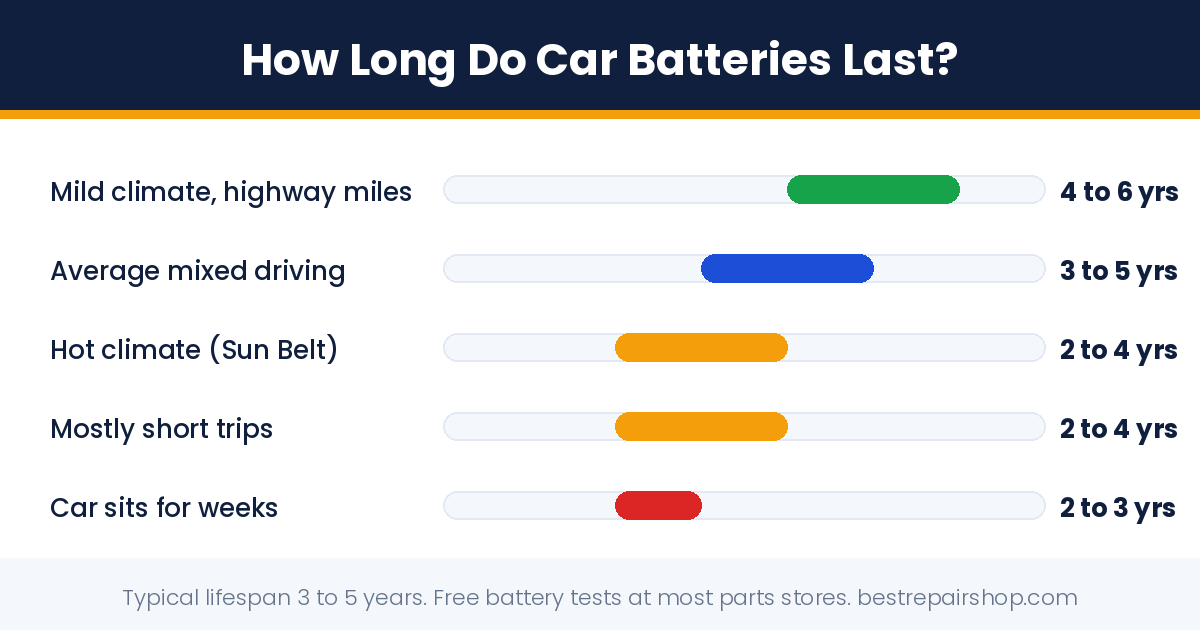
Plan on 3 to 5 years. That is the range we see on real invoices, and it matches what the battery makers quietly design for. The average battery that comes through a shop bay gets replaced at about age 4. A few make it to 6 or 7, and the owners of those cars usually live somewhere cool and drive 30 minutes at a stretch.
Climate is the biggest single factor in how long do car batteries last. Heat cooks the chemistry inside the case, so a battery in Phoenix often dies at year 2 or 3, while the same battery in Vermont hums along to year 5. Cold gets the blame because winter is when weak batteries finally quit, but summer is what killed them.
5 Honest Warning Signs Yours Is Dying
Your car talks to you before a battery dies. First, a slow, groaning crank: the engine turns over like it just woke up, especially on cold mornings. Second, a single click or rapid clicking when you turn the key and nothing else happens. We cover that one in detail in our guide to a car that clicks but will not start.
Third, dim headlights at idle that brighten when you rev, or dash lights that flicker at a stoplight. Fourth, the battery warning light on the dash, which can also point to the alternator, so get it tested rather than guessing. Fifth, a swollen case or a rotten egg smell under the hood. That last one means replace it now, not next month.
One more sign that is not a sound at all: age. If your battery is past year 4, treat every one of these symptoms as the battery until a test proves otherwise. A $20 tow fund decision beats a $200 tow bill.
What Shortens a Battery’s Life
Short trips are the quiet killer. Starting the engine takes a big gulp of power, and a 5 minute drive never puts it back, so the battery lives slightly hungry and sulfates early. Cars that sit for weeks do the same thing in slow motion. Corroded terminals, that white or green crust, choke charging too, and a cheap wire brush fixes it in 10 minutes.
Deep discharges are the other big one. Every time a dome light or phone charger runs the battery flat overnight, you lose a real chunk of its life. Two or three full drains can finish an older battery. If your car sits, a $30 battery maintainer pays for itself the first winter. Ask a tech how long do car batteries last under that kind of neglect, and the honest answer drops by a full year.
How to Test a Battery for Free
You do not have to guess, and you do not have to pay. Most national parts stores will test your battery and charging system for free in the parking lot, and a proper load test tells you far more than a glance at the terminals. At home, a $15 multimeter works: a healthy battery reads about 12.6 volts after the car sits overnight, and below 12.2 it is living on borrowed time.
Make the test a habit every fall once the battery turns 3. And if it does strand you, our jump start guide walks you through the safe cable order: red to dead, red to donor, black to donor, black to bare metal. The Federal Trade Commission’s auto repair basics page is also worth a read before you approve any work a test leads to.
What a New Battery Should Cost
Here is what fair looks like in 2026. Most drivers need the standard flooded battery. AGM batteries cost more and are required on most cars with stop-start systems, so check what came out before you pay the upgrade.
| Battery service | Fair 2026 price |
|---|---|
| Battery and charging test | Free at most parts stores |
| Standard battery, installed | $150-$300 |
| AGM battery, installed | $200-$350 |
Ranges are national, independent-shop figures, July 2026. For the full breakdown by store type, warranty math, and the install fees to question, see our car battery replacement cost guide.
FAQ
How long do car batteries last if you rarely drive?
Often only 2 to 3 years. A car that sits discharges itself a little every day, and staying partly drained is what ages a battery fastest. A weekly 30 minute drive or a plug-in maintainer will pull it back toward the normal 3 to 5 year range.
Can a car battery last 7 or 8 years?
It happens, mostly in cool climates with regular highway driving. Treat it as a bonus, not a plan. Past year 5, test it every fall and keep jumper cables in the trunk, because the end tends to arrive suddenly.
Does jump starting a car damage the battery?
Done correctly, no. The cable order matters: red to the dead battery, red to the donor, black to the donor, black to bare metal on the dead car. What does hurt the battery is whatever ran it flat, so if it needed a jump twice in a month, get it tested.
Should I replace my battery before winter?
Replace it when a load test says it is weak, not by the calendar. That said, fall is the smart time to test, because cold mornings are when a marginal battery finally gives up. If it is past year 4 and tests borderline, replacing it on your schedule beats a tow on winter’s schedule.