
Squeaky brakes are harmless surprisingly often: morning rust squeal and light dust noise cost nothing and fade on their own. The squeal that matters is the steady metallic cry of a wear indicator, which means the pads are nearly done and a $130 to $320 per axle pad job is due before it becomes a $250 to $500 pads-and-rotors job.
On this page: The harmless squeaks The warning squeal All 6 causes Fair costs New brakes squeaking FAQ
The squeaks that are safe to ignore
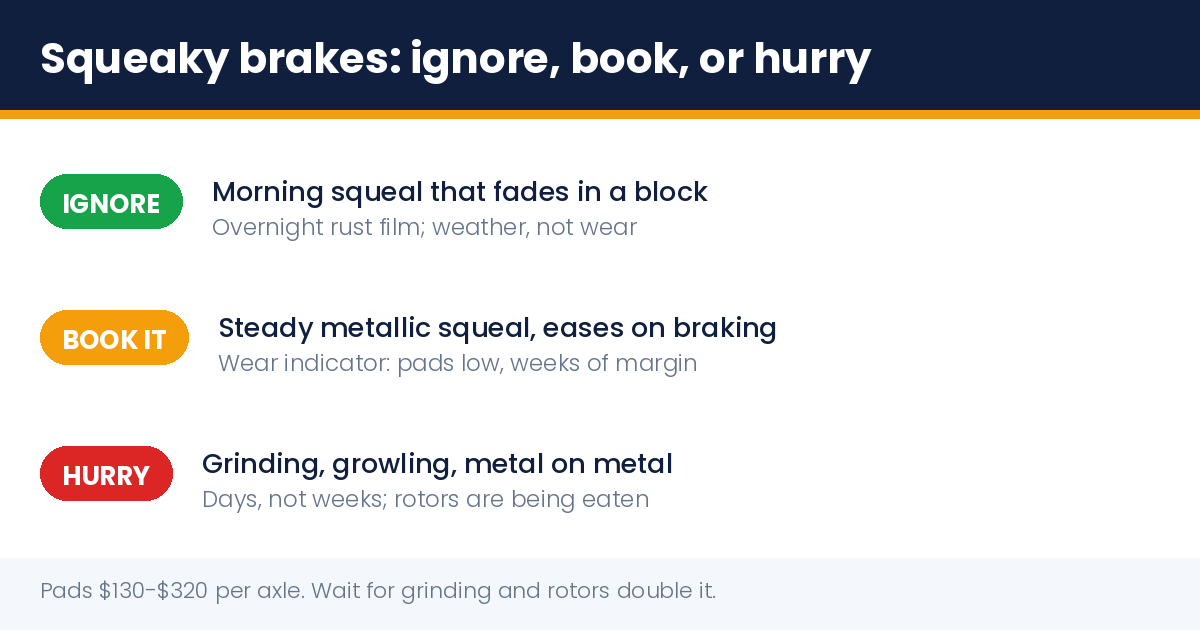
Brake rotors are bare iron, and bare iron rusts overnight, especially after rain or a humid night. The first few stops of the morning scrape that film off, squealing or grinding faintly while they do, and the noise is gone by the end of the street. That is not a repair; that is weather. The same goes for occasional squeaks in damp weather, light noise after the car sits a week, and the soft hiss of brake dust. If the noise disappears once the brakes warm up and does not come back during normal driving, you can spend the repair money on coffee. Those squeaky brakes are weather, not wear.
The squeal that is doing its job
Most brake pads carry a small steel tab called a wear indicator, positioned to touch the rotor when the pad wears down to its last few millimeters. The result is a high, steady metallic squeal that shows up consistently, often while driving and easing when you press the brakes. It is the pad’s built-in appointment reminder, and it is deliberately annoying. Pads at the indicator have weeks of margin, not months. Booked now, it is a pad job. Ignored until the squeal turns into grinding, the rotors join the bill and it roughly doubles.
All 6 causes, sorted by seriousness
| The squeak | What it is | What to do |
|---|---|---|
| First stops of the morning | Overnight rust film | Nothing |
| Damp days, after sitting | Moisture on rotors | Nothing |
| Occasional light squeak, any speed | Dust or glazed spots on pads | Watch, mention at next service |
| Squeal after recent brake job | Cheap pads or missing shims/lube | Back to the shop, often free |
| Steady metallic squeal, eases on braking | Wear indicator: pads low | Book within weeks |
| Grinding, growling, metal on metal | Pads gone, rotor damage underway | Days, not weeks |
What the real fixes fairly cost
When squeaky brakes do point at worn parts, the money looks like this: pads on one axle $130 to $320, pads plus rotors on one axle $250 to $500, and all four corners $500 to $1,000. Ranges are national independent-shop figures, July 2026, and the full arithmetic behind them, including how labor and rotor prices build the quote, lives in our brake job cost guide.
One honest upgrade worth considering: if your budget pads squeal and it bothers you, ceramic pads run quieter and dust less for $30 to $60 more per axle. That is a comfort purchase, not a safety one, and a shop should present it that way.
New brakes squeaking? That has rules too
Fresh pads squeaking lightly for the first few hundred miles while they bed into the rotors is normal, and some pad compounds simply talk more than others. A loud, constant squeal that starts right after a brake job is different: usually missing anti-rattle shims, skipped caliper lubrication, or bargain pads. That is a workmanship issue, and a decent shop fixes it free. Go back with the receipt and calm words; how that conversation should go is covered in our guide to finding a good mechanic, and the FTC’s auto repair basics backs you on getting warranty terms for parts and labor in writing.
Squeaky brakes FAQ
Are squeaky brakes dangerous?
The squeak itself, no. The brakes still stop the car. The question is which squeak: weather noise means nothing, a wear indicator means the clock is running, and grinding means the safe window already closed.
Can I just spray something on squeaky brakes?
No. Anything slippery near a rotor or pad surface reduces braking, which is the one thing brakes must not do less of. Real squeal fixes happen at the pad hardware: shims, lubrication on contact points (never the friction surface), or better pads.
How long can I drive on squealing wear indicators?
Figure weeks of normal driving, less with heavy stop-and-go. The indicator touches when a few millimeters of pad remain. It is a generous warning, but it is the last one the car gives politely.
Why do my brakes only squeak in reverse, or only at low speed?
Low-speed and reverse squeaks are usually pad vibration against the caliper hardware, the mildest and most fixable kind of noise. Mention it at your next service; it rarely justifies its own appointment.