
Transmission slipping means the transmission is briefly losing its grip between the engine and the wheels: the revs climb, but the car does not pull. Caught at the first sign, the fix is often a $100 to $250 fluid service. Ignored for months, the same problem can grow into a $2,500 to $4,500 rebuild. Here are the 5 early signs in the order they usually show up, and what each one means for your wallet.
On this page: Feels Like The 5 Signs Causes Costs Next Steps FAQ
What Transmission Slipping Feels Like
You press the gas, the engine note rises like you dropped a gear, and the speedometer barely moves. That mismatch is the tell. In a healthy automatic, engine speed and road speed climb together in a fixed relationship. When the clutches inside start losing their hold, the engine spins ahead of the car for a beat before the gear catches up.
Watch the tachometer. A shift that used to happen around 2,200 rpm now flares to 2,700 before it lands. It can feel like a shudder, a rubber band surge, or a half second of neutral where the power simply disappears. Any of those is worth taking seriously this month, not eventually.
The 5 Early Signs, in the Order They Show Up
Shops see these five in a fairly predictable sequence. The earlier you are on this list, the cheaper the fix tends to be.
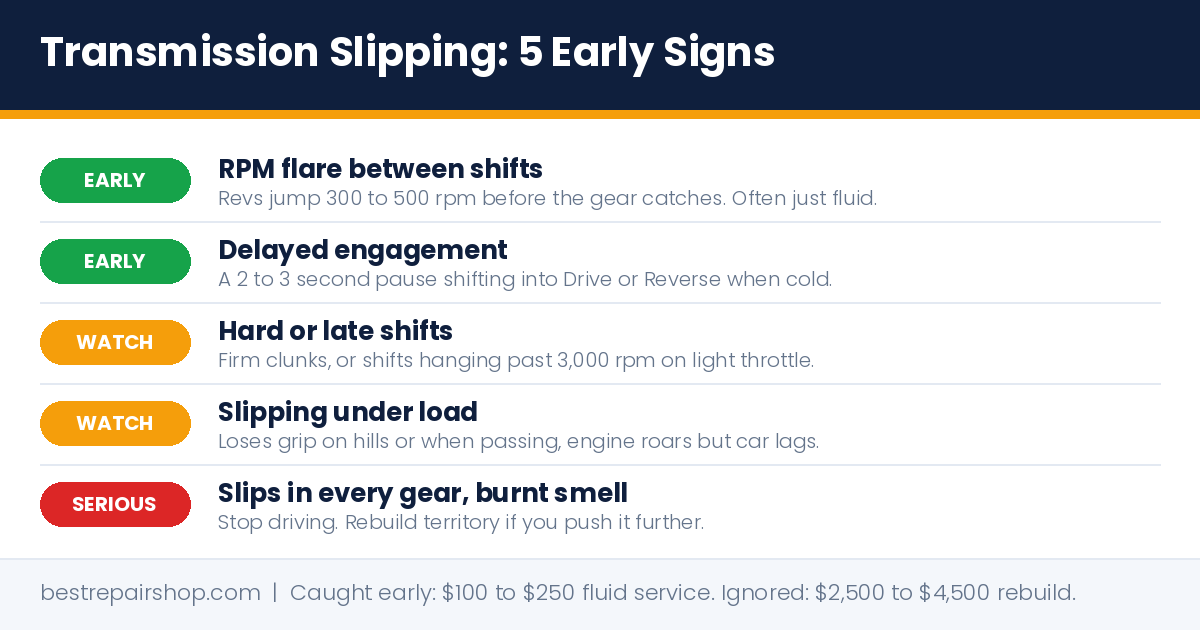
1. RPM flare between shifts. The engine jumps 300 to 500 rpm mid shift before settling into the next gear. At this stage the most common culprit is fluid that is low, worn out, or both. This is the $100 to $250 stage, and it is the cheapest exit you will ever get.
2. Delayed engagement. You move the lever from Park to Drive or Reverse and the car waits 2 to 3 seconds before it takes, usually worse on a cold morning. Low fluid and tired internal seals show up here first.
3. Hard or late shifts. Shifts start banging in, or they hang past 3,000 rpm on light throttle. Worn fluid changes how the clutches grip, and the computer starts compensating with pressure changes you can feel.
4. Slipping under load. On a hill or during a highway pass, the engine roars while acceleration lags behind. The clutch packs are now slipping under real torque. That builds heat, and heat is what kills transmissions.
5. Slipping in every gear, with a burnt smell. Fluid that smells like burnt toast and shows dark brown or black on the dipstick. Stop driving and get it inspected. At this point you are negotiating with a rebuild, not a fluid service.
What Causes a Transmission to Slip
Roughly in order of likelihood: low fluid from a slow leak, degraded fluid that has lost its friction additives, a sticking shift solenoid, worn clutch packs, or a failing torque converter. The first two are maintenance problems, which is why our maintenance guides lean so hard on fluid intervals. The last two are hardware, and hardware is where invoices get long.
One caution from the shop floor: transmission slipping on a unit past 120,000 miles that has never had a fluid service is a special case. An aggressive flush at that point can make things worse, not better. Ask for a simple drain and fill plus a road test first, a distinction we cover in our transmission flush guide.
What Each Fix Costs
Here is the honest spread, from catching it at sign 1 to ignoring it until sign 5. Full pricing detail lives in our transmission fluid change cost guide.
| Repair | Fair range |
|---|---|
| Fluid drain and fill | $100-$250 |
| Fluid exchange | $150-$400 |
| Add filter and gasket | $75-$150 |
| Shift solenoid replacement | $250-$600 |
| Torque converter replacement | $600-$1,200 |
| Full rebuild | $2,500-$4,500 |
Ranges are national, independent-shop figures, August 2026. Dealer prices typically run 20 to 40 percent higher. A shop that quotes a rebuild without first checking fluid level, fluid condition, and stored codes is skipping the cheap steps, and you are the one paying for the shortcut.
What to Do This Week
First, check the fluid if your car still has a dipstick: level, color, smell. Pink and translucent is healthy. Dark brown and burnt is not. Second, get the codes read. Slipping often sets codes like P0730 or P0894, and a basic code read is free at most parts stores, as we covered in our check engine light guide. Write down what you find before anyone quotes you anything.
Third, if the fluid is tired, schedule the service and match the interval to how you actually drive using our guide on how often to change transmission fluid. Keep your paperwork too: the FTC’s auto repair basics page is clear that you can ask for a written estimate before any major work.
Transmission Slipping FAQ
Can low fluid cause transmission slipping?
Yes, and it is the most common cause we see. Automatics rely on fluid pressure to clamp the clutches. Even a quart low can let them slip under load, and the fix can be as simple as finding the leak and topping up with the correct fluid.
Is it safe to keep driving when it slips?
For signs 1 and 2, you can drive gently for a short while, but get it looked at within the week. From sign 4 onward, every slipping event generates heat that permanently damages the clutches. Past that point, driving it is spending rebuild money by the mile.
Will a fluid change fix the slipping?
Often, if you catch it early and the cause is low or degraded fluid. A drain and fill runs $100 to $250 at an independent shop. If the clutches are already worn or a solenoid has failed, fresh fluid helps but will not undo the damage.
How long will a slipping transmission last?
Anywhere from months to days, and heat decides which. Gentle around-town driving on a mild slip can go a while. Towing, hills, and highway passing accelerate the damage fast. Treat the first slip as your cheap warning, because the second warning costs more.