
A fair price for car repair is one that lines up with what shops in your area actually charge, based on public-record labor rates and parts pricing, not on what a service writer says with a straight face. Our fair price widget compares your quote to those records and calls it low, fair, or high. Here is the honest part: low is not automatically a deal, and high is not automatically a rip-off. Each verdict has a story, and this page tells all three.
On this page: How verdicts work Low price High price Fair price 5 checks FAQ
Where a Fair Price for Car Repair Comes From
Every repair price is really three numbers: the shop’s hourly labor rate, the book time the job is supposed to take, and the parts. Labor rates are the big swing. Most independent shops bill somewhere between $90 and $180 an hour, and that number tracks local rent, wages, and taxes far more than skill. The widget takes your quote, your area, and the job, compares them against public-record figures, and returns one of three verdicts.
The verdict is a starting point, not a judgment. It works like a thermometer: you still decide whether the reading is a fever or a hot day.
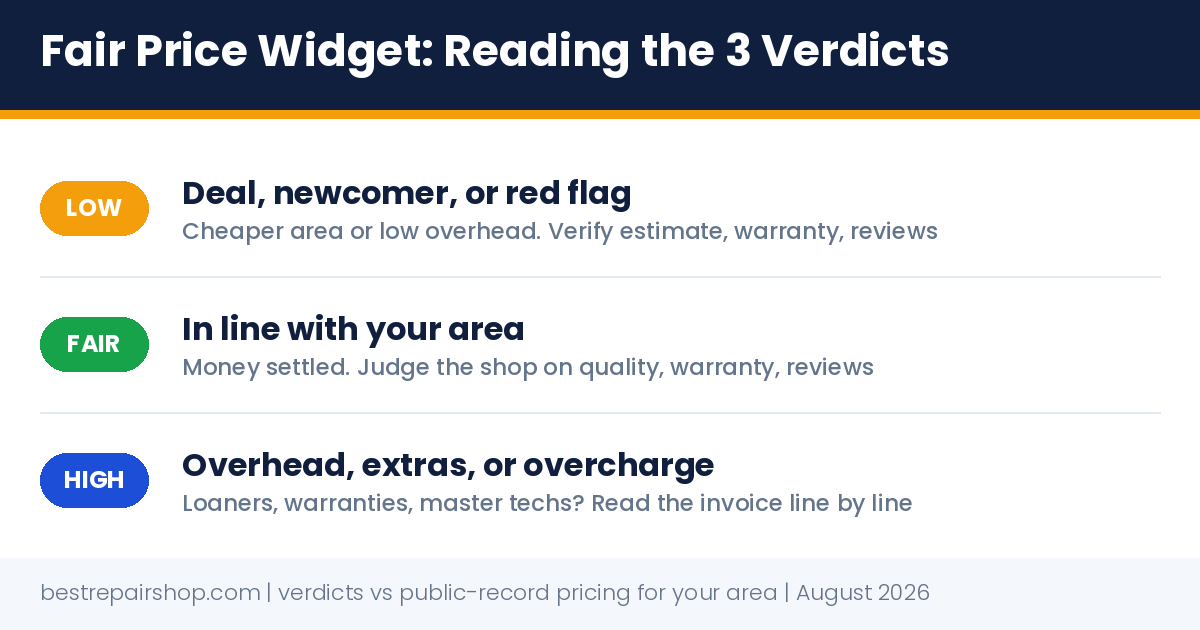
The Low Verdict: Deal, Newcomer, or Red Flag
A low price has three honest explanations, and only one should scare you. First, geography: in a lower cost-of-living area, rent, wages, and insurance all run cheaper, so an honest shop can quote well under the national number and still make a living. Second, the newcomer: a mechanic fresh out on their own, or a traveling mechanic working without a shop, has almost no overhead and every reason to win you over on price while they build a reputation. Neither is a problem, and both can be a real bargain.
The third explanation is the one to rule out: someone pricing low to get cash moving, doing the job badly or not at all. These are usually small-dollar plays, low enough that nobody calls a lawyer, which is exactly why they work. The tells are familiar: cash only, no written estimate, no parts brand named, no warranty offered, and a phone number with no fixed address. Our guide to finding a good mechanic covers the full vetting list. A low quote from someone who passes those checks is a discount; from someone who fails them, it is bait.
The High Verdict: Overhead, Extras, or Actual Overcharging
A high verdict reads like an accusation, but hold on. High-tax, high-rent areas produce high labor rates for the same reason they produce seven dollar coffee. And plenty of shops price in things the quote does not spell out: loaner cars, shuttle service, a wash and vacuum, longer parts-and-labor warranties, master techs, or a service advisor who actually answers the phone. That is not padding, it is product. A dealership works this way almost by definition; see our honest comparison of dealer versus independent pricing.
So when the widget says high, do two things before deciding it is not a fair price for car repair. Read the invoice line by line and see what you are actually buying: parts brand, warranty length, and what is included. Then read what people say about the business itself. A high price with a 4.8 star average and a three year warranty is a choice. A high price with two stars and a lifetime supply of excuses is the verdict you thought it was.
The Fair Verdict: Average, With Everything That Implies
Fair means the number lands where the public records say it should for your area. That is useful: nobody is reaching into your pocket. It promises nothing about the experience. A fair price for car repair can come from a great shop having a normal day or a mediocre shop charging the going rate. Average price, average promise.
So a fair verdict shifts the question from money to quality. Reviews, warranty terms, and how the shop answers questions become the whole ballgame, and our 7 questions to ask before approving a repair is built for that conversation.
5 Checks to Run on Any Verdict
Whatever the widget says, the same five checks settle it. Get the estimate in writing with parts and labor split out, which the FTC lists as your basic right. Ask what brand of parts and what warranty, in months and miles. Read recent reviews for the pattern, not the star count. Ask what is included, since loaners and inspections explain a lot of high verdicts. And on any job over about $500, a second opinion on a fair price for car repair is an hour well spent.
For reference, the national numbers underneath the verdicts:
| Line item | Typical range | What moves it |
|---|---|---|
| Diagnostic hour | $75-$200 | Region, equipment, whether it is credited to the repair |
| Brake pads, per axle | $130-$320 | Pad quality, labor rate |
| Synthetic oil change | $65-$125 | Oil spec, filter, inspection included or not |
| Battery, installed | $150-$300 | Battery type, AGM runs $200-$350 |
Ranges are national, independent-shop figures, August 2026. Full breakdowns live in our cost guides.
FAQ
Is the cheapest quote always a scam?
No. Most low quotes are geography or a newer mechanic with low overhead. It only turns into a red flag when the low price travels with no written estimate, no warranty, and cash-only terms. Vet the shop, not just the number.
Does a high price mean better work?
Sometimes, and you can find out before paying. Better warranties, better parts, loaner cars, and experienced techs all cost real money and often ride inside a higher price. If the invoice and the reviews cannot explain the premium, then no, it is just a higher price.
What is a fair price for car repair labor?
Most independent shops land between $90 and $180 an hour depending on region, with diagnostic time at $75 to $200. Dealers typically run higher. The rate matters less than the total: rate times book hours plus parts is the number to compare.
Should I negotiate if the verdict says high?
Ask questions first, then negotiate. Start with what is included and whether any line items can move, like a house-brand part. Shops move more often when you ask about specifics than when you demand a discount.