
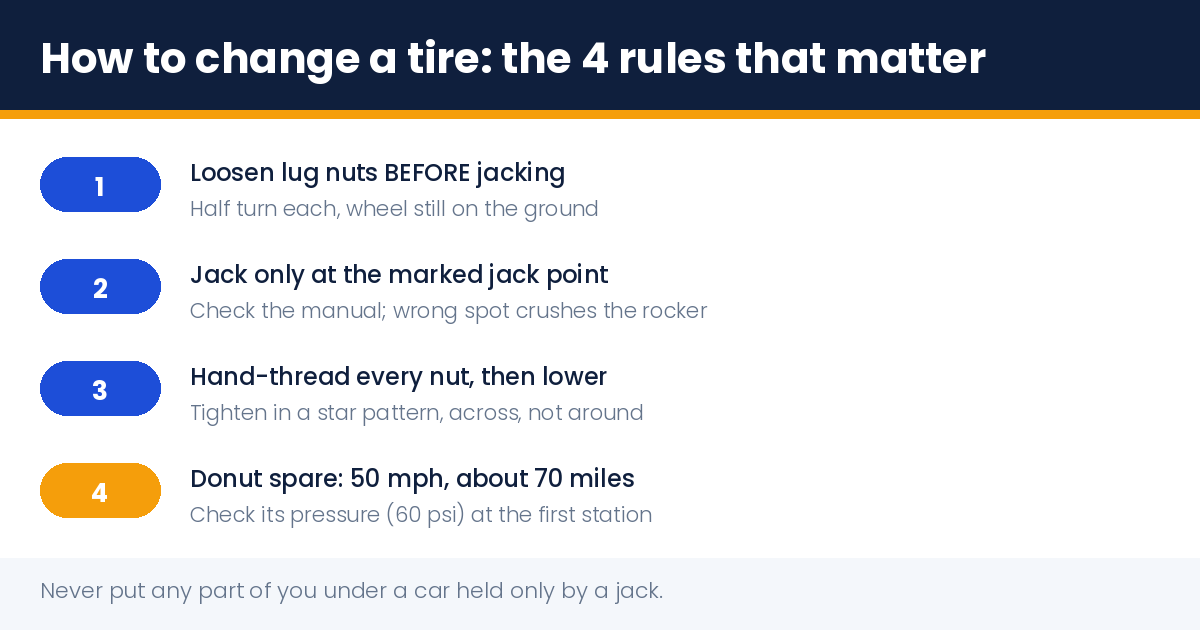
How to change a tire safely: get fully off the road, loosen the lug nuts before jacking, lift at the marked jack point, swap the wheel, and tighten the nuts in a star pattern. The whole job takes 15 to 30 minutes. A donut spare then limits you to 50 mph and about 70 miles, so the tire shop is your next stop, not next week’s errand.
On this page: Get safe first The 8 steps After the swap Common mistakes Know your spare FAQ
Get safe before you touch a lug nut
Knowing how to change a tire starts with where, not how. A flat is an inconvenience; changing it two feet from live traffic is a hazard. Drive slowly on the flat if you must, because a ruined tire is cheaper than a bad location. You want flat, solid ground away from the travel lane: a parking lot, a wide shoulder, a side street. Hazards on, parking brake set, and if you carry road triangles or flares, use them. Passengers should wait away from the car, behind a barrier if one exists. NHTSA’s tire safety guidance treats location as step one, and so do we.
How to change a tire in 8 steps
- Get out the spare, jack, and lug wrench, usually under the trunk floor. Check the spare has air by pressing it; a squishy spare changes the plan to a tow.
- Pry off the wheel cover if there is one, and loosen each lug nut a half turn while the wheel is still on the ground. They may take real force; use your body weight, never your foot bouncing on the wrench.
- Place the jack at the marked jack point nearest the flat. Your manual shows it, and there is usually a notch or arrow on the pinch weld. Wrong placement crushes the rocker panel.
- Jack up until the flat tire clears the ground by about an inch.
- Remove the loosened lug nuts into your pocket or a cup, and pull the wheel off with both hands.
- Hang the spare on the studs (or line up the bolt holes), and thread every lug nut on by hand until snug.
- Lower the car until the tire touches, then tighten the nuts firmly in a star pattern: across, not around the circle. Then lower fully and give each one a final firm pull.
- Stow the flat and tools, and check the spare’s pressure at the first gas station. Donuts want about 60 psi, and they are almost always low from years of sitting.
After the swap: donut rules
A compact spare is a get-to-the-shop device, not a tire. Keep it under 50 mph, skip the highway when you can, and plan on roughly 70 miles of total use. Braking distances grow and stability control gets confused by the smaller wheel, so drive gently. Get the real tire patched or replaced promptly: a simple puncture repair runs $20 to $40, and a tire near the end of its life may not be worth patching at all. Within a week, re-check your lug nuts for tightness; new-mounted wheels can settle.
The mistakes that hurt people and cars
The big one is jacking first and loosening second: the wheel just spins in the air, and wrestling it can rock the car off the jack. Loosen on the ground, always. Second is bad jack placement, which at best dents the rocker and at worst drops the car. Third is going under the car; a scissor jack is for lifting a corner, never for holding a car above any part of you. Fourth is tightening around the circle instead of across, which can seat the wheel unevenly and warp the brake rotor over time, a repeat guest in our car shakes when braking guide.
Know what spare you actually have
| What is in your trunk | The deal | Limit |
|---|---|---|
| Donut (compact spare) | Light, common, needs 60 psi | 50 mph, ~70 miles |
| Full-size spare | A real tire; rotate it into the set | No special limit |
| Run-flat tires | No spare; drive on the flat itself | ~50 mph, ~50 miles |
| Inflator kit only | Sealant handles small punctures only | Sidewall damage = tow |
Part of how to change a tire is knowing which of these you own, so check the trunk today, not on the shoulder. Roughly a third of new cars ship with no spare at all, and finding that out at night in the rain is the expensive way.
Tire change FAQ
How tight should lug nuts be?
Firm two-handed pull on the factory wrench, in a star pattern, then a final check with the car on the ground. If you own a torque wrench, most cars spec 80 to 100 lb-ft; the manual has your number. What you must avoid is leaving them loose, so re-check within a week.
Can I drive on the highway with a donut?
You can if you must, held under 50 mph in the right lane, but surface streets are the safer honest answer. The donut’s grip and braking are genuinely worse, not just theoretically worse.
What if the lug nuts will not budge?
Stand on the wrench arm steadily with your weight (no bouncing), or extend the leverage with a length of pipe. If an air gun over-tightened them beyond that, that is a tow or roadside assistance call, not a heroics moment.
How to change a tire on a hill?
You do not. Jacks want flat, hard ground. On a slope or soft dirt, call roadside assistance; a rolling or falling car is not a risk with an upside.