
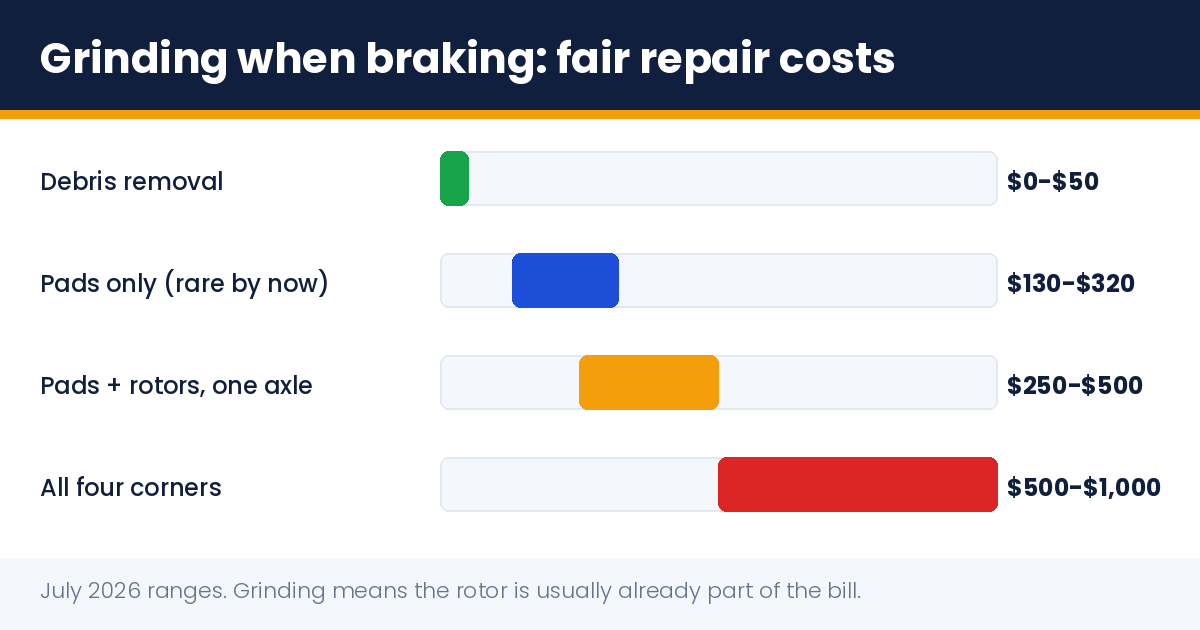
A grinding noise when braking usually means the brake pads are gone and metal is pressing metal. That is a days, not weeks repair: expect $250 to $500 per axle for pads and rotors, because grinding almost always takes the rotors with it. One exception is harmless: brief morning grinding from overnight rust that clears within a few stops.
On this page: The 4 causes Safe to drive? Fair costs Why it got expensive FAQ
The 4 causes of a grinding noise when braking
1. Pads worn to the backing plate. The main event. The friction material is gone and the pad’s steel backing is machining your rotor every time you stop. It often follows weeks of ignored wear-indicator squealing, and it converts a pad job into a pads-and-rotors job with every drive.
2. Overnight rust film. The harmless one. Rotors rust after rain or humidity, and the first few stops of the morning grind it off. If the noise is gone by the end of the street and the brake pedal feels normal, it was weather. If it persists past a few stops, it was not.
3. A stone or debris caught between rotor and shield. A constant scraping or grinding that happens even when you are not braking, often after gravel roads. Annoying, loud, and cheap: a shop pops the wheel and clears it in minutes.
4. Failed pad hardware or a seized caliper. Broken clips let a pad sit crooked and grind at an angle; a seized caliper drags a pad constantly, grinding and overheating one wheel. Both come with clues: the grinding noise when braking arrives with pulling, a burning smell, or one hot wheel.
Is it safe to drive with grinding brakes?
Honest answer: to the shop, driven gently, yes. Beyond that, no. Metal-on-metal braking still slows the car, but with longer stopping distances, less predictability, heat that can cook the caliper, and a rotor bill growing with every stop. A grinding noise when braking that comes with a soft pedal, a pull to one side, or a burning smell upgrades from “this week” to “today, and consider the tow.” Ten free seconds of prevention while you are thinking about it: run your VIN through NHTSA’s recall lookup, since brake hardware recalls are not rare.
What the fix fairly costs
| The verdict | Fair 2026 price | Note |
|---|---|---|
| Debris removal | $0-$50 | The lottery win of brake noises |
| Pads only (caught barely in time) | $130-$320 per axle | Rare once real grinding starts |
| Pads and rotors, one axle | $250-$500 | The standard grinding outcome |
| All four corners | $500-$1,000 | When both ends were ignored equally |
| Add a seized caliper | $150-$400 each | Plus the rotor it cooked |
Ranges are national, independent-shop figures, July 2026, consistent with our full brake job cost guide, which shows how pads, rotors, and labor build the number. Get the estimate in writing with parts named, per the FTC’s auto repair basics, and ask for your old parts back; ground-down pads make the diagnosis self-evident.
How a $200 job became a $450 one
The costly part of a grinding noise when braking is the timeline behind it. Pads announce their retirement with weeks of squealing; grinding means the announcement ran out. By then the steel backing has scored the rotor surface past saving, so the rotor joins the bill, roughly doubling it. The lesson costs nothing going forward: at the first steady squeal, book the appointment, and the shudder that sometimes follows uneven rotors never gets its chance either. Brakes are the one system that always tells you first.
Grinding brakes FAQ
How long can I drive with a grinding noise when braking?
Measure it in trips, not weeks: enough to reach a shop. Every stop grinds more rotor away, so the delay itself is what gets billed.
Why does it grind only at low speed or the end of the stop?
Low-speed, end-of-stop grinding is where worn pads and light rust noise both live. The tiebreaker is persistence: rust noise dies within the first few stops of the day, worn pads grind every single time.
It grinds even when I am not braking. Same problem?
Different suspects: a caught stone, a bent dust shield, a dragging pad from a seized caliper, or a wheel bearing. Constant noise is worth mentioning precisely, because it steers the diagnosis away from pads.
Can I replace just the pads to save money?
Once real grinding has happened, new pads on scored rotors brake poorly, noisily, and briefly. Pads-and-rotors on the affected axle is the repair that actually ends the story, and the fair prices for it are in the table above.