
When your car won’t start, run a five step triage before you spend a dollar: listen to the key, read the dash, jump it correctly, rule out fuel and anti theft, then decide. Most no starts come down to a battery at $150 to $300 installed, a starter at $350 to $700, or an alternator at $350 to $900, and the sound the car makes in the first two seconds usually names the suspect for free.
On this page: Listen first Lights and dash Jump start Fuel and security Costs and decision FAQ
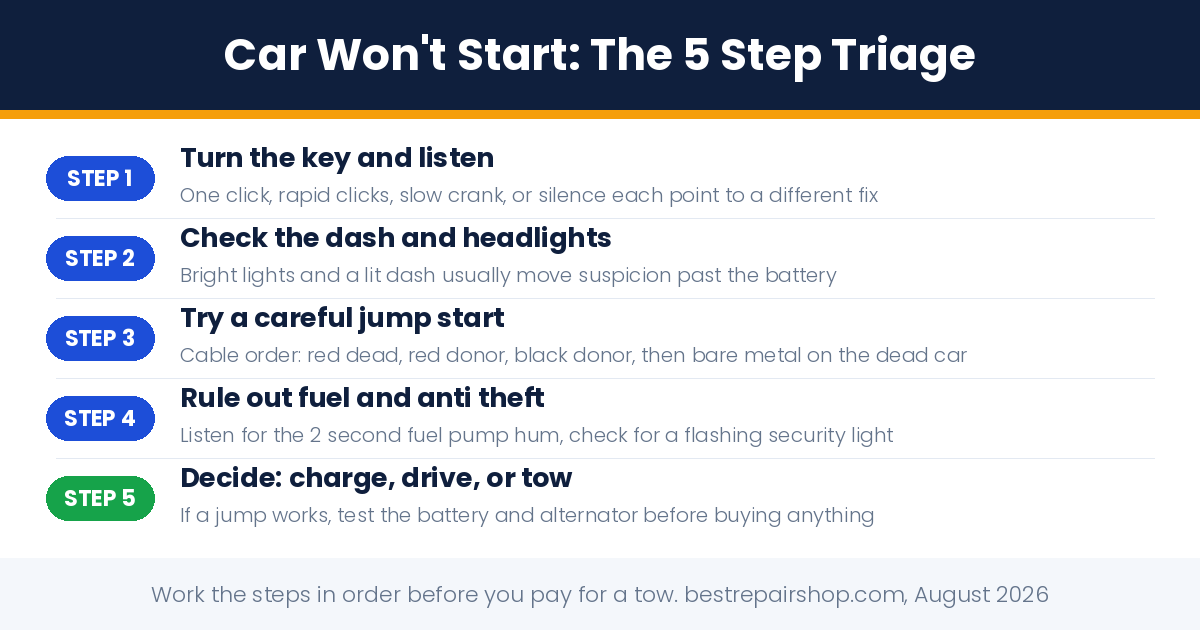
Step 1: Your Car Won’t Start, So Listen Before You Pay
Turn the key or press the button and pay attention, because the car is talking to you. One loud click and then nothing usually means the starter solenoid is engaging but the motor is not spinning: a starter problem or a very tired battery. Rapid machine gun clicking is the classic sound of low voltage, and nine times out of ten that is the battery or its connections.
A slow, dragging crank that sounds like the engine is moaning points to a weak battery or corroded cables. Total silence points to the ignition switch, the neutral safety switch, or a battery too dead to click. And a strong, healthy crank with no start at all moves the whole investigation to fuel, spark, or security, which is step four.
Step 2: Read the Dash and Headlights
Your headlights are a free voltmeter. Turn them on and try to start the car. If they stay bright while the engine refuses to crank, suspicion moves past the battery toward the starter or the ignition switch. If they dim hard or die the moment you turn the key, the battery or its terminals are the story.
Pop the hood and look at the battery posts. White or green crust on a terminal can strand a perfectly good battery, and cleaning it off with a wire brush costs nothing. Batteries last 3 to 5 years; if yours is past that and it picked a cold morning to quit, you can guess the ending. Our guide to how long car batteries last walks through the early warning signs.
Step 3: Jump Start It the Right Way
Cable order matters: red clamp to the dead battery’s positive post, red to the donor’s positive, black to the donor’s negative, and the last black clamp to bare metal on the dead car, away from the battery. Let the donor run for two or three minutes before you try the key. The full walkthrough is in how to jump start a car.
What happens next is diagnostic gold. If the car starts and keeps running after the cables come off, you likely have a battery or charging problem, and most parts stores test both for free. If it starts and dies the second you disconnect, the alternator moves to the top of the list. If it still will not crank with a healthy donor attached, you are in starter territory.
Step 4: Rule Out Fuel and Anti Theft
If the engine cranks strong but the car won’t start no matter how long you hold the key, stop cranking and listen instead. Turn the key to on without starting: you should hear a two second hum from the tank area as the fuel pump primes. No hum can mean a failed pump, a blown fuse, or a tripped inertia switch.
Check the dash for a flashing key or padlock icon. A confused immobilizer will let an engine crank forever without firing, and the fix can be as cheap as trying your spare key or locking and unlocking the doors. And trust the fuel gauge less: a stuck sender showing a quarter tank on empty is a classic, embarrassing tow bill.
Step 5: What Each Fix Costs, and When to Take the Tow
Here is what the usual suspects cost at a fair independent shop. Our symptoms library has a deeper guide on each.
| Likely fix | Fair 2026 range | The clue that points there |
|---|---|---|
| Battery, standard, installed | $150-$300 | Rapid clicking, slow crank, battery past 3 years old |
| Battery, AGM, installed | $200-$350 | Same clues on start-stop and luxury vehicles |
| Terminal and cable cleanup | $0-$40 | Crusty posts, no start that comes and goes |
| Starter replacement | $350-$700 | One click, no crank, headlights stay bright |
| Alternator replacement | $350-$900 | Starts with a jump, dies when cables come off |
| Shop diagnostic time, per hour | $75-$200 | Cranks fine, will not fire, no obvious cause |
Ranges are national, independent-shop figures, August 2026. A local tow adds roughly $100 to $150 on top, so five minutes of triage earns its keep. The FTC’s auto repair basics guide is worth reading before you approve anything. But if the car won’t start after a jump, will not crank at all, or the security light is flashing, take the tow: grinding away at a dead system can cook a good starter.
Car Won’t Start: Quick Answers
Why does my car click once but not start?
A single solid click means the starter solenoid engaged but the motor never spun: usually the starter itself, a bad connection, or a battery with just enough juice to click. Our guide to a car clicking but not starting breaks down each click pattern.
How do I tell the battery from the starter?
Use the lights and the jump. Bright headlights plus a single click points at the starter; dim lights and rapid clicking points at the battery. A free load test at a parts store settles it in ten minutes.
Is it safe to keep jump starting my car every morning?
It works, but it is not a plan. Every deep discharge shortens the battery’s life, and a car that needs a jump daily is telling you the battery or the charging system is done. Expect $150 to $300 installed for a standard replacement, and get the alternator tested at the same time.
Why won’t my car start when it gets cold?
Cold weather cuts a battery’s cranking power sharply while thickened oil makes the engine harder to spin, so a battery that was marginal in September fails on the first hard freeze. If yours is past three years old, get a free load test before winter.