
Changing your own brake pads takes about 1 to 2 hours per axle and saves roughly $100 to $250, since pads run $30 to $80 in parts and shops charge $130 to $320 per axle installed. This guide covers how to change brake pads in 10 steps, the tools required, and the honest skill level involved. If any step below reads like a foreign language, pay a shop: brakes are not the system to learn on halfway.
On this page: Tools The 10 Steps Skill Level DIY vs Shop Cost When Not to DIY FAQ
The Tools You Need Before You Start
You need a floor jack and two jack stands, a lug wrench or breaker bar, a basic socket set, a C-clamp or caliper piston tool, a small tube of brake grease, and a torque wrench. Buying all of it new runs about $120 to $180, which is less than one axle of shop labor. The torque wrench is the tool people try to skip. Do not skip it: lug nuts want 80 to 100 lb-ft, and the caliper bolts have their own spec in your service manual.
Pads for most sedans and crossovers cost $30 to $80 per axle for a quality set. The $18 bargain-bin set is how you end up learning how to change brake pads twice in one summer. Mid-grade ceramic pads from a brand you have heard of are the honest sweet spot.
How to Change Brake Pads in 10 Steps
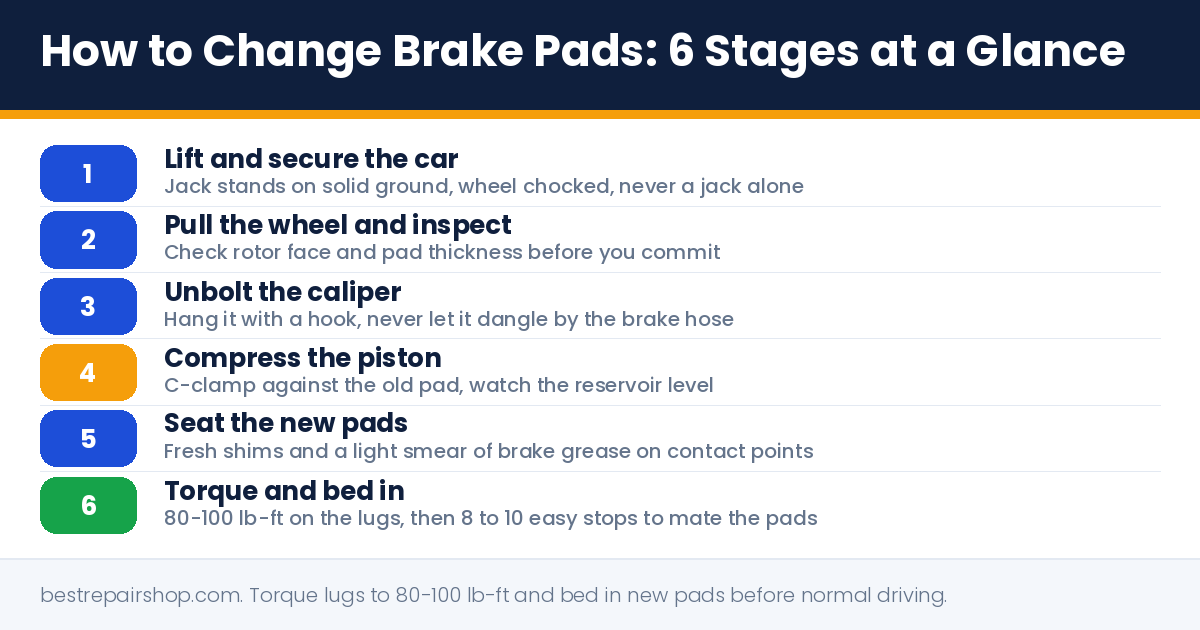
This is the full job for one axle with a standard sliding caliper. Read all 10 steps before you touch a wrench.
- Park on flat concrete, set the parking brake if you are working the front axle, and chock the opposite wheels.
- Crack each lug nut a half turn while the wheel is still on the ground.
- Jack the car at the factory lift point and set it on jack stands. The jack lifts the car; the stands are what keep it up.
- Remove the wheel and look at the rotor. Deep grooves or a tall lip at the edge mean the job just grew.
- Remove the two caliper slide bolts and hang the caliper from the coil spring with a wire hook. Never let it dangle by the brake hose.
- Slide the old pads out of the bracket and note exactly how the clips and shims sit before you toss anything.
- Open the brake fluid reservoir cap, then compress the piston slowly with a C-clamp against an old pad. Watch the reservoir so it does not overflow.
- Fit the new clips, put a light smear of brake grease on the contact tabs and slide pins, and seat the new pads. Nothing greasy ever touches the friction face.
- Rebolt the caliper to spec, mount the wheel, lower the car, and torque the lugs to 80 to 100 lb-ft in a star pattern.
- Pump the pedal until it firms up before moving the car. Then bed the pads in: 8 to 10 easy stops from about 35 mph, no panic stops.
The Honest Skill Level Required
On an honest 1 to 5 wrench scale, this is a 2 for a standard sliding caliper. If you can manage changing a tire, you already own half the motions. Plan on 2 to 3 hours for your first axle and about 1 hour once you have done it twice.
The rating jumps to a 4 fast, though. Many newer cars have electronic parking brakes that need a scan tool to retract the rear pistons. Rusted slide pins, a frozen bleeder screw, or a rounded caliper bolt can turn a Saturday project into a tow bill. Knowing how to change brake pads includes knowing when to put the wrench down.
DIY vs Shop: What the Job Costs Either Way
Here is the invoice math, the part a shop would rather you skip.
| Route | Fair 2026 price |
|---|---|
| DIY, pads only (parts) | $30-$80 per axle |
| Shop, pads only | $130-$320 per axle |
| Shop, pads and rotors | $250-$500 per axle |
| Shop, all four wheels | $500-$1,000 |
| Seized caliper, if found | $150-$400 |
Ranges are national, independent-shop figures, August 2026. Dealers typically land 20 to 40 percent higher for the same friction material. For the full breakdown of parts, labor, and the line items worth questioning, see our brake job cost guide.
When You Should Not DIY This Job
Book a shop if you hear metal-on-metal grinding, because the pads are gone and the rotors are almost certainly involved. Same call if the pedal pulses, if the car has an electronic parking brake you cannot retract, or if any hardware fights back. A seized caliper is a $150 to $400 repair, and forcing one is how a $60 pad job becomes a four-figure invoice.
If you do hand the job over, walk in informed. The FTC’s plain-English auto repair guide covers your rights on written estimates and getting your old parts back, and it is shorter than most warranty pamphlets.
FAQ
How long does it take to change brake pads?
Plan on 2 to 3 hours per axle your first time and about 1 hour once the motions are familiar. A shop with a lift and air tools does it in 30 to 45 minutes per axle, which is part of what that $130 to $320 buys.
Do I have to replace the rotors at the same time?
Not automatically, no matter what the service writer implies. Rotors that are smooth and above minimum thickness can take a second set of pads. Deep grooves, a heavy lip, or a pulsing pedal mean machining or replacement; our brake rotor replacement cost guide covers fair prices for that add-on.
Why do my new brake pads squeak?
Light squeaks during the first few dozen stops are normal while pads bed in. Squealing that persists usually means missing shims, dry contact points, or cheap friction material, and it earns a look under the wheel.
Is it cheaper to change your own brake pads?
Almost always. Parts run $30 to $80 per axle against $130 to $320 at a shop, so learning how to change brake pads pays for the tools on the first job. The savings only count if you have the time, the jack stands, and the patience to torque everything to spec.