
A fair brake rotor replacement cost in 2026 is $250 to $500 per axle for pads and rotors together, or $500 to $1,000 for all four corners. Rotors alone, without pads, run about $200 to $400 per axle. If your quote sits well north of those numbers, the extra is usually in one of three padded line items we walk through below.
On this page: Fair prices Why not resurface 3 padded lines A fair invoice When to skip rotors FAQ
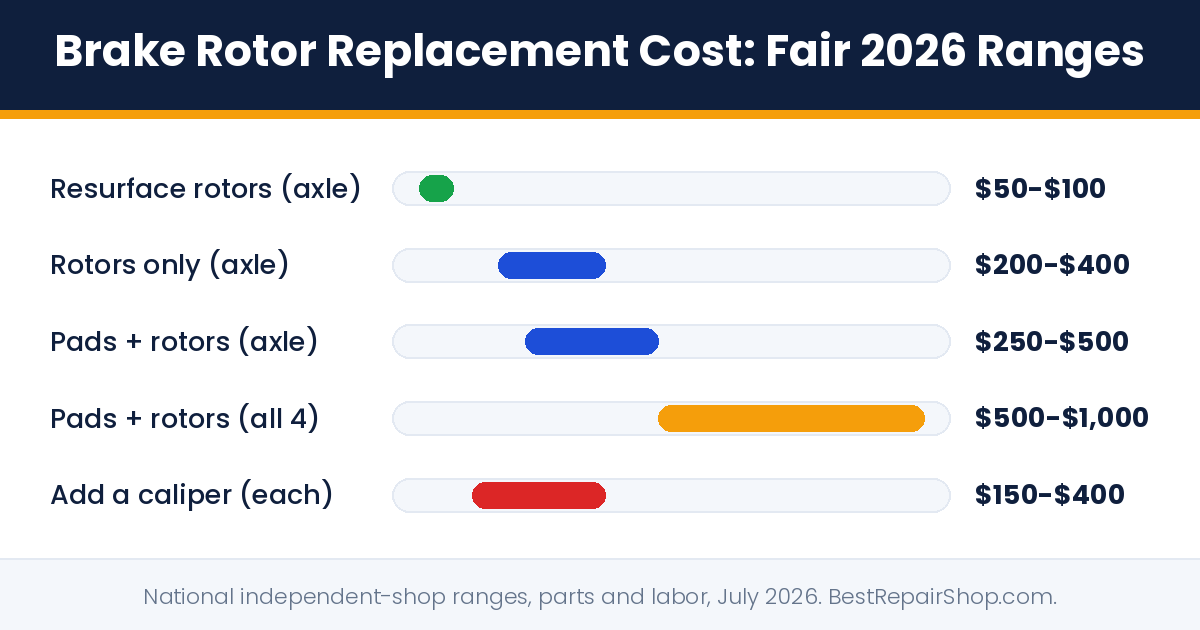
Brake rotor replacement cost: what fair looks like in 2026
The math is simple enough to check from the waiting room. Mainstream aftermarket rotors run $40 to $100 each at retail, quality pads $30 to $80 an axle set, and the job takes a competent tech 1 to 1.5 hours per axle at shop rates of $75 to $200 an hour. Stack it up and pads plus rotors at $250 to $500 per axle is honest money for everyone involved.
Front axles usually cost a bit more than rears because front rotors are bigger and do most of the stopping. Trucks, performance packages, and anything with oversized calipers push toward the top of the range on parts alone. For the full picture including pads-only jobs at $130 to $320 per axle, start with our brake job cost guide.
Why shops replace rotors instead of resurfacing now
Twenty years ago the default was machining a lip off your rotors for pocket change. Modern rotors are cast thinner to save weight, so many arrive with barely enough meat above the minimum thickness stamped on the hub to survive one cut. Resurfacing still makes sense when there is material to spare: expect $50 to $100 per axle where a shop still offers it.
That said, replace is not automatically an upsell. A rotor below minimum thickness after a cut is a liability no honest shop will sign, and a pulsing brake pedal often traces back to rotor problems; we cover that symptom in why your car shakes when braking. The upsell question is whether YOUR rotors measured thin, not whether thin rotors exist.
3 ways shops pad a rotor invoice
First: rotors on every brake job, no measurement offered. Rotors are a wear item, not a pads-side accessory. Ask for the measured thickness against the spec stamped on the rotor. A shop that measured will tell you in ten seconds; a shop that did not will get vague.
Second: stacked labor. Pads and rotors on the same axle overlap almost completely; the caliper comes off once either way. If the estimate shows separate full labor lines for pads and for rotors on one axle, you are being billed twice for one disassembly.
Third: the while-we-are-in-there bundle. A caliper at $150 to $400 each, a hardware kit at triple retail, or a mandatory fluid flush attached to every brake job. Each of those is sometimes legitimate and none of them is automatic. The FTC’s auto repair basics advice holds: get the written estimate first and make them justify each line.
What a fair rotor invoice looks like
Four or five lines, no mystery. A pair of rotors with a brand and part number, one axle set of pads if you are doing both, one labor line of 1 to 1.5 hours for the axle, and maybe a modest shop supplies fee. A road test before and after should be mentioned, not billed as its own hour.
Parts markup over retail is normal and fair; the shop warranties the part and eats the comeback if it fails. 30 to 50 percent over their cost is standard practice. What you are checking for is not markup, it is the $95 rotor sold as a $240 rotor, which is why asking for the part number matters more than asking for a discount.
When you can skip rotors entirely
Pads-only is a legitimate job when the rotors measure above minimum, the surface is smooth without deep grooves or a pronounced lip, and braking is pulse-free. That describes a lot of first brake jobs on gently driven cars. If you are already hearing metal, the decision has been made for you: a grinding noise when braking means the pads are gone and the rotors are being machined by the backing plates as you drive.
Prices for every brake scenario, pads to calipers, live in our costs hub. The table below is the rotor-specific slice.
| Job | Fair 2026 range | Notes |
|---|---|---|
| Resurface rotors (per axle) | $50-$100 | Only if thickness allows a cut |
| Rotors only (per axle) | $200-$400 | Rare; pads usually go in too |
| Pads + rotors (per axle) | $250-$500 | The standard job |
| Pads + rotors (all four) | $500-$1,000 | Ask if rears truly measured worn |
| Caliper, if seized (each) | $150-$400 | Legitimate only with evidence |
Ranges are national, independent-shop figures, July 2026. Dealerships commonly run 20 to 40 percent above these numbers, mostly on factory-branded parts. That gap is the easiest brake rotor replacement cost saving there is.
FAQ
Can I replace brake pads without replacing rotors?
Yes, when the rotors measure above the minimum thickness stamped on them and the surface is smooth and pulse-free. New pads on badly scored rotors wear fast and brake worse, so this is a measurement call, not a preference. Make the shop show you the number.
How long do brake rotors last?
Commonly 30,000 to 70,000 miles, and often two sets of pads per set of rotors on gently driven cars. City traffic, towing, and mountain driving eat rotors faster. There is no calendar interval; thickness and surface condition decide.
Why is my brake rotor replacement cost quote over $1,000?
Either you have a truck or performance car with expensive rotors, or the quote includes all four corners plus extras like calipers or a flush. Ask for the per-axle breakdown and the rotor part numbers. A $1,200 quote that survives that conversation is rare on a mainstream sedan.
Is a brake fluid flush required with new rotors?
No. Fluid service is a real maintenance item on its own schedule, typically every 2 to 3 years, but it is not mechanically required by a rotor swap. If it is due anyway, bundling saves a visit. If it was flushed last year, decline politely.