
The clearest signs you need an alignment: the car pulls to one side on a flat road, the steering wheel sits off center, or the tires wear down on one edge. A proper alignment runs $50 to $100 for two wheels and $100 to $200 for all four, and it protects tires built to last 50,000 to 70,000 miles from wearing out in half that.
On this page: The 5 signs The 2 myths Common causes Cost Free check FAQ
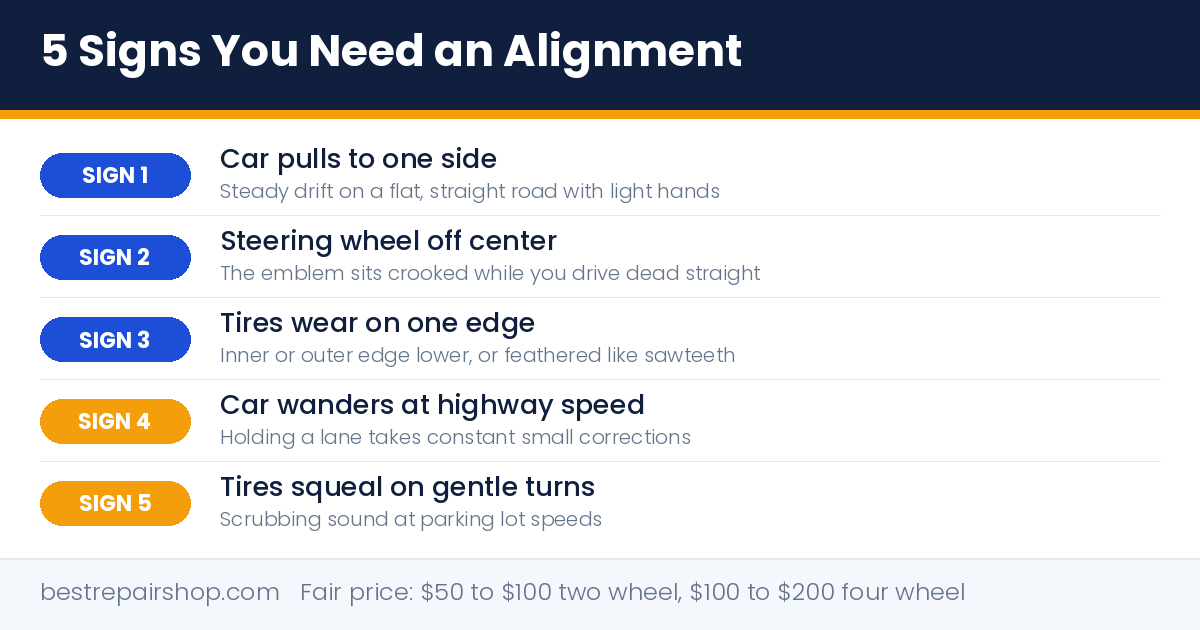
The 5 clearest signs you need an alignment
Alignment trouble whispers before it shouts. Here are the five signs working techs trust, in the order you will notice them.
1. The car pulls to one side. On a flat, straight road with light hands on the wheel, the car drifts left or right within a few seconds. American roads are crowned to shed water, so a faint lean to the right is normal. A steady pull you have to correct is not.
2. The steering wheel sits off center. You are driving dead straight and the emblem is cocked ten or fifteen degrees. The steering has adjusted itself around bent geometry, and your tires are quietly paying for it.
3. The tires wear on one edge. Run a palm across the tread. If the inner or outer edge is clearly lower than the rest, or feathered like little sawteeth, alignment is the usual suspect.
4. The car wanders at highway speed. If holding your lane takes constant small corrections, the toe angles are likely off and the tires are fighting each other instead of rolling together.
5. The tires squeal on gentle turns. A scrubbing squeal at parking lot speeds, with no hard cornering involved, means a tire is being dragged sideways instead of rolling free. Spot two or more of these signs you need an alignment and it is time to book; every mile in between is grinding off rubber you paid for.
2 alignment myths that waste your money
Myth 1: A vibrating steering wheel means the car needs an alignment. It almost never does. Vibration at speed points to wheel balance, a bent rim, or a worn suspension part. A shop selling you an alignment for a vibration is guessing with your money. Ask for a balance check first; it is the cheaper test and the likelier fix.
Myth 2: Alignment belongs on a schedule. There is no honest every-six-months or every-oil-change interval. Cars need an alignment after a cause: a hard pothole hit, a curb strike, new suspension parts, new tires after uneven wear, or the warning signs above. An annual check is fair if your commute is all rough pavement. A recurring alignment on every visit is a profit line, not maintenance; the honest intervals for everything else live in our maintenance hub.
What knocks a car out of alignment
Alignment does not drift much on its own. Something moves it. Potholes and curb strikes are the big two, and one solid hit at speed is plenty. Worn tie rod ends, ball joints, and bushings let the angles wander a little more every month. Suspension work, lowering, or lifting changes the geometry and needs a follow-up alignment.
One thing a good shop always does first: check those parts before aligning. An alignment done over worn components is wasted money, because the angles walk right back out. A shop that inspects before it aligns is showing you one of the green flags from our guide to finding a good mechanic.
What a wheel alignment costs
Alignment is one of the more honestly priced services in the industry. Here is the fair range.
| Service | Fair price | Notes |
|---|---|---|
| Alignment check only | Free-$50 | Many shops credit it toward the work |
| 2-wheel (front) alignment | $50-$100 | Enough for many older and simpler cars |
| 4-wheel alignment | $100-$200 | The right call for most modern cars |
| Lifetime alignment package | $200-$300 | Pays off for pothole-country commuters |
Ranges are national, independent-shop figures, August 2026. The full pricing breakdown, including when a 2-wheel alignment is honestly enough, is in our wheel alignment cost guide.
A free 60-second check before you book
First, rule out the impostor: tire pressure. One soft tire fakes a pull convincingly, so check all four and top them up; our tire pressure light guide covers the right numbers. NHTSA’s tire safety page is a solid reference for pressure and wear basics.
Then, on an empty flat lot, drive straight at low speed, briefly ease your grip, and note any drift. Run your palm across each front tire feeling for edge wear or feathering. While you are down there, do the quarter test: tread below 4/32 of an inch means tires are your first problem, not angles; our guide to how long tires last shows what to look for.
FAQ
How often do you need a wheel alignment?
There is no fixed interval, and be wary of a shop that insists on one. Get one after a hard impact, with new suspension parts, after tires that wore unevenly, or when the signs you need an alignment show up. If your roads are rough, an annual check, often free, is cheap insurance.
Will an alignment fix my steering wheel vibration?
Usually not. Vibration is a balance problem, a bent wheel, or a worn part, not an angle problem. Ask the shop to road-test and check balance first. Balancing costs noticeably less than an alignment at most shops, and it is the fix that actually matches that symptom.
Do I need an alignment with new tires?
A check is smart; an automatic sale is not. If the old tires wore evenly and the car tracks straight, you can politely decline. If edge wear or feathering killed the old set, align before the new rubber goes on, or the new tires will simply repeat the damage.
Is it safe to drive when you see signs you need an alignment?
A mild pull is safe to drive short term, but it costs you a little tire life every mile. A hard pull fights you in an emergency maneuver and can chew through a tire edge in weeks. Book the mild case soon and the hard case now.