
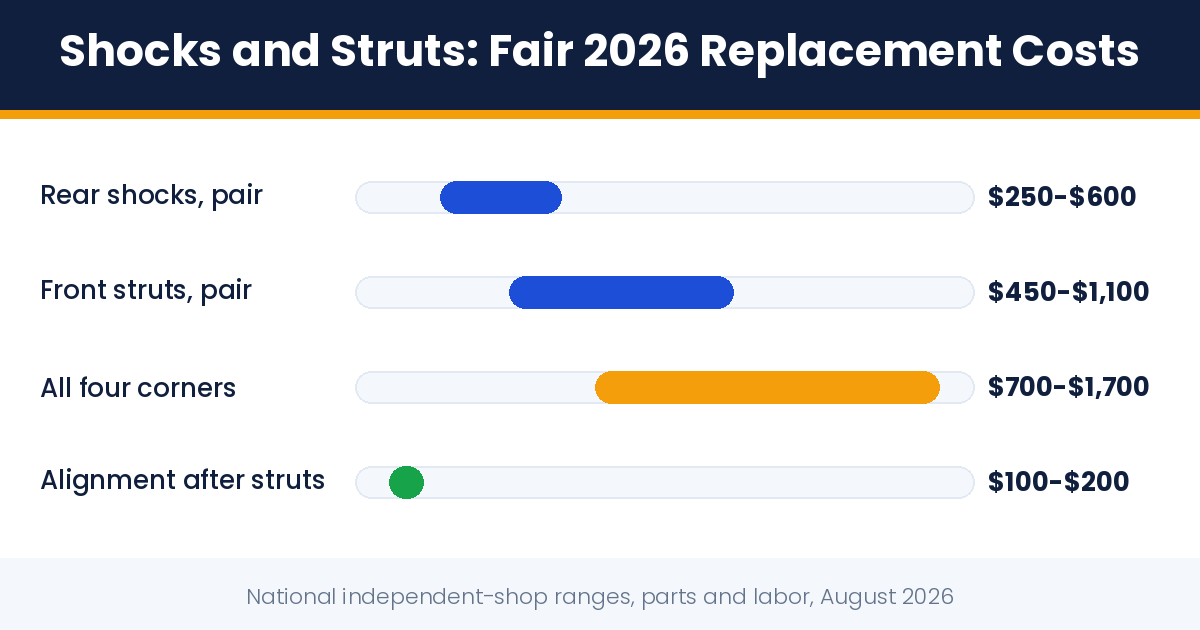
A fair shocks and struts replacement cost at an independent shop runs $250 to $600 for a pair of rear shocks and $450 to $1,100 for a pair of front struts, parts and labor included. Doing all four corners lands between $700 and $1,700 depending on the car and parts quality. Budget another $100 to $200 for the alignment your car genuinely needs after strut work.
On this page: Fair prices Shocks vs struts Why pairs 3 test drives Bill padding FAQ
Shocks and Struts Replacement Cost in 2026
Three things move the number: which end of the car, what parts, and whose labor rate. Rear shocks are usually simple bolt-in parts, about an hour of labor per pair on most cars. Struts carry the spring and steering geometry, so they take two to three hours, and the job ends with an alignment. That labor gap is why the same invoice line reads so differently front to rear.
Parts choice matters just as much. Complete quick-strut assemblies cost more in parts but cut labor, and on a car past 100,000 miles they are usually the smart buy because the mounts and springs come new. Trucks, luxury badges, and anything with electronically adjustable dampers can push a shocks and struts replacement cost well past these ranges, sometimes to four figures per axle.
Shocks vs Struts: Know Which One You Have
A shock is a damper and nothing more; it slows the spring’s bounce. A strut is a damper built into a structural assembly that holds the spring and locates the wheel. Most modern cars run struts up front and shocks or struts in the rear. It matters because struts cost more, need that alignment afterward, and affect steering feel when they wear. Your estimate should name which part, per axle, in writing.
Why Shops Quote in Pairs, and When All Four Is Real
Replacing dampers in pairs per axle is honest practice, not padding. One new damper next to one worn damper brakes and corners unevenly, and on struts it can pull the steering. Front and rear are a different story: they wear at different rates, and plenty of cars need front struts at 90,000 miles while the rear shocks still pass every test.
So when a shop quotes all four corners, ask what failed on each axle specifically: leaking oil on the damper body, a torn mount, or a bounce the road test showed. “While we are in there” is not a diagnosis. The full shocks and struts replacement cost for all four is fair when all four are actually worn, and about $400 to $900 too high when only one axle is.
The 3 Test Drives Before You Pay
Test 1, before you approve: drive the car with the advisor and have them point at what they hear and feel. Worn dampers show up as floating after bumps, cupped tire wear, and clunks over broken pavement. The NHTSA tire guidance is useful here, because scalloped wear patterns are a damper symptom, not a tire brand problem.
Test 2, after the work, rough road: the car should settle in one motion after a bump, with no knocks from the new corners. Test 3, highway: one firm lane change and one solid stop. It should feel planted, with less nosedive than before. Any shop confident in its work will hand you the keys for ten minutes; our guide to finding a good mechanic calls this the cheapest quality check in the business.
Where the Bill Gets Padded
Three add-ons to read closely. First, automatic all-four replacement, covered above. Second, separate line items for strut mounts and bearings on a car getting complete quick-strut assemblies; those parts are already inside the assembly. Third, an alignment charged at a premium bundled rate. An alignment after struts is legitimate, but it should cost the same $100 to $200 it costs on any other day; see our wheel alignment cost guide for the honest numbers.
Sway bar end links are the borderline case. They often really do break during strut jobs on rusty cars, and at $100 to $250 a pair installed they are not a scandal. Fair play is a shop that shows you the seized or snapped link, not one that pre-prints it on every strut estimate.
The Numbers on One Page
| Job | Fair price, parts and labor | Notes |
|---|---|---|
| Rear shocks, pair | $250-$600 | Simple bolt-in job on most cars |
| Front struts, pair | $450-$1,100 | Quick-strut assemblies at the upper end |
| All four corners | $700-$1,700 | Only when both axles actually test worn |
| Alignment after struts | $100-$200 | Required after strut replacement |
| Sway bar end links, pair | $100-$250 | Fair only if shown the broken part |
Ranges are national, independent-shop figures, August 2026. Dealers typically run 20 to 40 percent above these numbers for the same shocks and struts replacement cost, mostly on labor rate and OEM-only parts policies.
FAQ
How long do shocks and struts last?
Plan on 50,000 to 100,000 miles, with rough roads, towing, and winter salt pulling that number down. They fade gradually, which is why owners rarely notice; the road test comparison against a healthy car is what tells the truth.
Can I replace just one strut?
Only in one situation: a nearly new car with one damper lost to a defect or crash damage. On anything with real miles, replace per axle in pairs. Mismatched damping side to side makes braking and cornering uneven, and it can chew the new tire on that corner.
Is it safe to drive on worn shocks or struts?
For a while, yes, but worn dampers stretch stopping distance and reduce control in emergency swerves, and they accelerate wear on tires and brakes. If the car keeps bouncing after a bump or shakes when braking, get it inspected soon rather than someday.
Is a shocks and struts replacement cost quote negotiable?
The labor hours mostly are not, but the parts tier is. Ask for a quote at two parts levels, standard and premium, and drop line items you cannot see evidence for. A good shop will walk you through the difference without pressure.