
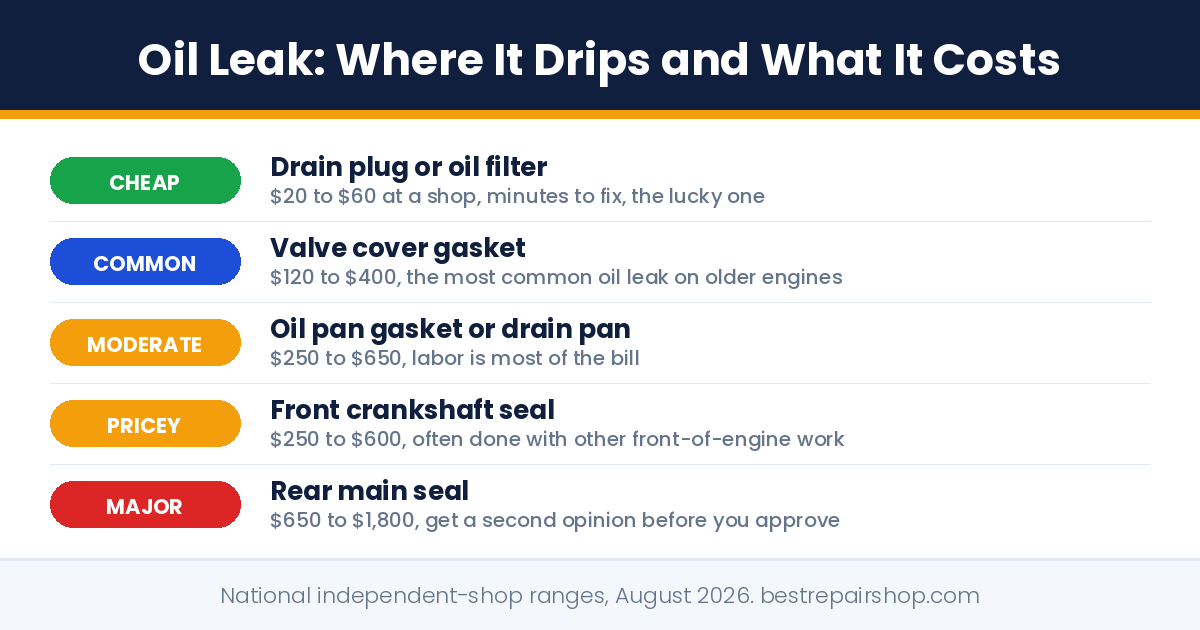
An oil leak almost always starts at one of five places, and the spot on your driveway tells you the price before a shop does. A loose drain plug or filter runs $20 to $60 to fix, a valve cover gasket $120 to $400, and a rear main seal $650 to $1,800. Slide clean cardboard under the engine overnight, match the drip to the chart below, and you will walk in knowing what a fair quote sounds like.
On this page: Confirm the leak The 5 spots Repair costs When to stop Cheap fixes FAQ
First, Make Sure It Is Engine Oil
Cars leak four main fluids, and they color code themselves. Engine oil is amber when fresh, dark brown when old, and slick between your fingers. Transmission fluid is red to reddish brown. Coolant is green, orange, or pink, watery, and sweet smelling. Brake fluid is clear to light amber, usually near a wheel.
The cardboard test settles it in one night. Park over clean cardboard and note the color and position in the morning. The front third of the car is engine territory; dead center, where the engine meets the transmission, is the spot to take seriously. Then pull the dipstick: the level tells you how fast you are actually losing oil, which matters more than the size of the spot.
The 5 Most Common Oil Leak Spots
1. The drain plug or oil filter. If the drip started within a week of an oil change, this is the odds-on favorite: a crushed washer, a loose plug, or a double stacked filter gasket. The shop that did the change should fix it free; worst case runs $20 to $60.
2. The valve cover gasket. The most common oil leak on engines past 80,000 miles. The gasket on top of the engine hardens with age and seeps down the sides, often onto hot exhaust, so you smell burning oil before you see a drip. Fair price: $120 to $400.
3. The oil pan gasket. The pan is the low point of the engine, so gravity makes every leak look like a pan leak. A real one seeps from the seam where the pan meets the block. Parts are cheap, but the pan can hide behind subframes and exhaust, so labor pushes the job to $250 to $650.
4. The front crankshaft seal. This seal rides behind the crank pulley and flings a fine mist that coats belts and pulleys rather than leaving a tidy puddle. Expect $250 to $600, often paired with belt or timing work already in that area.
5. The rear main seal. The big one. It sits between the engine and transmission, so the transmission usually has to move to replace a part that costs less than dinner, and the quote reads $650 to $1,800. A slow seep here is a watch-it item, not an emergency.
What an Oil Leak Costs to Fix
| Leak source | Fair shop price | Notes |
|---|---|---|
| Drain plug or oil filter | $20-$60 | Free if a recent oil change caused it |
| Valve cover gasket | $120-$400 | Most common fix on older engines |
| Oil pan gasket | $250-$650 | Labor is most of the bill |
| Front crankshaft seal | $250-$600 | Often bundled with belt work |
| Rear main seal | $650-$1,800 | Transmission usually has to move |
Ranges are national, independent-shop figures, August 25, 2026. Almost every dollar of spread is labor, not parts. Before approving anything over a few hundred dollars, ask the shop to show you the wet spot after cleaning and rechecking, since oil travels and the top leak often gets blamed on a bottom part. Our cost guides cover the related jobs shops like to bundle in.
When to Stop Driving
Most leaks are a seep, and a seep is a scheduling problem, not a roadside one. Two things change that. First, the oil pressure light: if the red oil can glows, pull over and shut the engine off, because minutes without pressure can finish an engine. Second, smoke: oil on a hot exhaust manifold can ignite, so smoke from under the hood means stop now.
In between, let the dipstick decide. A quarter of a quart between changes is background noise; a quart every 300 to 500 miles means it is time to fix the leak rather than feed it. Keep a quart of the right oil in the trunk either way. When your car starts talking like this, our symptoms guides help you translate.
Cheap Fixes Worth Trying First
Before anyone says the word reseal, work the cheap end of the list. Have the drain plug torqued and the filter checked, especially after a recent change. If the valve cover is the source, replace that one gasket instead of approving a reseal-everything quote. On engines past 75,000 miles with a light seep, a high mileage oil with seal conditioners can slow old seals for zero extra labor.
Whatever you approve, get it in writing first. The FTC’s auto repair basics guide says you can ask for a written estimate and require authorization before extra work; an honest shop offers both unprompted. A leak diagnosis should be shown, not described: dye tests and a degreased engine make the source visible to anyone.
Oil Leak Questions, Answered
Can I keep driving with an oil leak?
Usually yes, for a while, if the level stays in the safe zone on the dipstick and no warning lights are on. Check weekly and top off as needed. Stop immediately if the oil pressure light comes on or you see smoke from the engine bay.
Why does my car only drip after it is parked?
While you drive, airflow spreads seeping oil thinly across the underbody and some burns off on hot parts. Parked, everything cools, the film collects at low points, and gravity finishes the job overnight. That is why the cardboard test works so well.
Do stop leak additives actually work?
Sometimes, temporarily. Most work by swelling old rubber seals, which can slow a rear main or crank seal seep for months. They are a reasonable bridge on an older car, but they repair nothing and will not help a gasket or a loose plug.
How much oil loss is normal?
Many healthy engines consume a little oil with no leak at all. Up to a quart every 1,500 miles is livable on an older engine; a quart every 300 to 500 miles needs attention. Track it with the dipstick rather than guessing from spots.