
Car symptoms fall into four groups: noises, dashboard lights, smells, and how the car feels. Find yours below and we will tell you the likely causes ranked by probability, whether it is safe to keep driving, and what the fix should cost before you ever call a shop.
On this page: Safe to drive? Dash lights Sounds Smells and leaks How it feels Diagnosis cost Guides FAQ
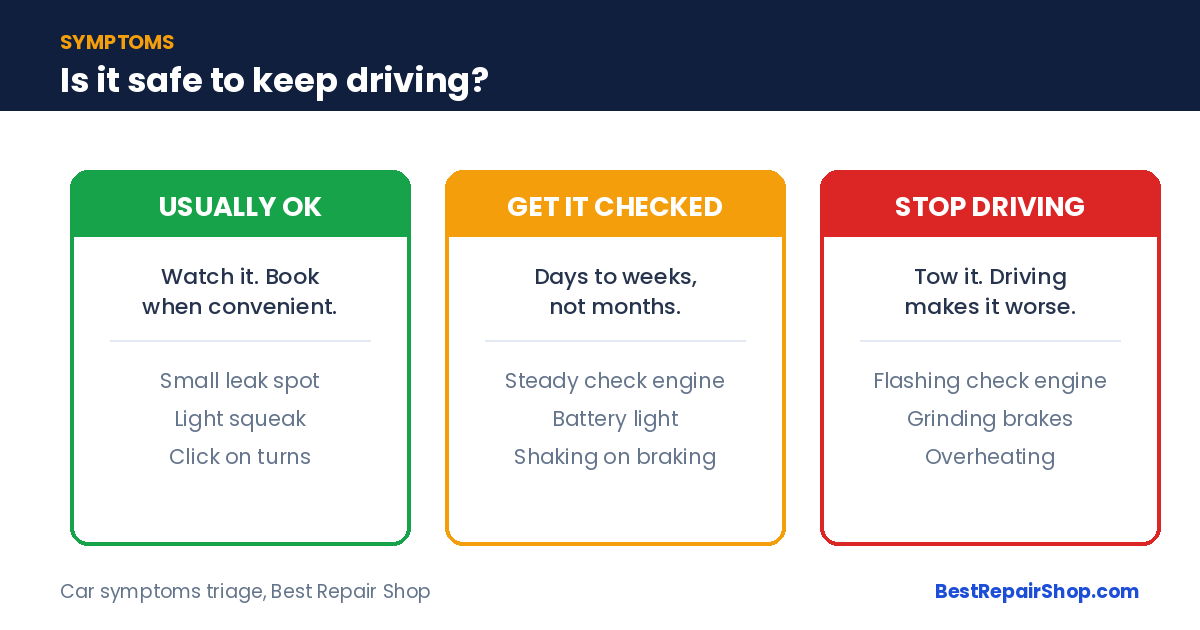
First: is it safe to drive?
Most car symptoms are not emergencies, and three rules cover the ones that are. A flashing check engine light means stop driving; an active misfire can destroy your catalytic converter in minutes. Grinding brakes mean metal is cutting metal, and every extra mile turns a pad job into a rotor job. Anything involving brake failure, steering failure, or a fuel smell is a tow, not a drive. Almost everything else buys you time to read, compare, and choose a shop calmly.
One check worth doing before you spend anything: run your VIN through the NHTSA recall lookup. If your symptom matches an open recall, the repair is free at a dealer, and thousands of drivers pay out of pocket every year for work they were entitled to for nothing.
Dashboard lights
A steady check engine light is a schedule-it problem, not a panic problem, and the first step is free: most parts stores will read the code at no charge. Start here: Can I keep driving with the check engine light on?
The battery light rarely means the battery. It means the charging system is not keeping up, which is usually the alternator or the serpentine belt. If it comes on while driving, you have roughly 20 to 40 minutes of stored power before the car stops, so drive straight to a shop rather than home.
The oil pressure light is the one exception to staying calm. Low oil pressure destroys an engine in minutes, not miles. Pull over, shut the engine off, and check the dipstick before you drive another foot. Guides coming next in this section: battery light, oil pressure light, TPMS light, ABS light.
Car symptoms you can hear
Noises are the most searched car symptoms in the niche, and they are also where drivers get scared into repairs they do not need. Squeaking while braking is often a wear indicator doing its job, or even humidity on a damp morning. Grinding is urgent. Clicking on turns points at a CV axle, which gives you weeks of margin, not hours.
The useful trick is matching the noise to what the car is doing. A sound that changes with road speed is usually tires or wheel bearings. A sound that changes with engine speed while parked is belts or pulleys. A sound that only appears when braking is brakes. A sound that only appears over bumps is suspension. That one distinction narrows most diagnoses to a short list before anyone touches the car.
Smells and leaks
A sweet smell usually means coolant. A burning smell needs a same-day look. A spot on the driveway can be identified by color and location before you spend a dollar: dark brown is engine oil, red is transmission or power steering fluid, green or orange is coolant, and clear water under the front passenger side is just the air conditioner doing its job.
Size matters more than color for urgency. A spot the size of a coin after a week is a seep worth watching. A puddle you can see forming while the car sits is a leak worth fixing now, especially with coolant or brake fluid, where running low is a safety problem rather than a maintenance one.
How the car feels
Shaking when braking points at rotors or suspension, and the speed where it starts tells you which. Pulling to one side is alignment, tire pressure, or a sticking caliper, checked cheapest-first. A car that will not start gives away its problem by sound: a click, a slow crank, and silence are three different repairs with three different prices.
Vibration that appears only at highway speed is usually tire balance, one of the cheapest fixes on this whole site. Before paying for anything bigger, check your tire pressures and tread; NHTSA’s TireWise guidance covers what to look for and how age alone can make a tire unsafe even with good tread left.
What a diagnosis should cost
Reading a code is free at most parts stores. A real diagnosis at a shop fairly runs $75-$150, and a good shop credits some or all of it toward the repair. Paying a diag fee is not a rip-off; it is paying a professional to think. Paying it twice because the first shop guessed is the thing we help you avoid. Once you have a diagnosis, check the fair price on the cost guides before you approve anything.
Write down what you notice
Car symptoms are easiest to diagnose when they are described precisely, and hardest when they are described from memory a week later. Keep a note on your phone: what you heard or felt, the speed, whether the engine was cold or warm, whether you were braking, turning, or accelerating, and whether the air conditioning was running.
Intermittent faults are the most expensive kind to chase, because a technician who cannot reproduce the problem is being paid to hunt for it. A specific description is the cheapest diagnostic tool you own, and it is free.
Symptom guides, one problem each
- Check engine light on? Steady vs flashing, decoded
- P0420 code explained: 4 honest fixes and fair costs
- Tire pressure light on? 5 honest reasons and costs
- Car shakes when braking? 5 causes and fair costs
- Squeaky brakes: which squeals are safe to ignore
- Grinding noise when braking: the urgent version
- Car smells like gas? Stop and check these 6 causes
- Car clicking but not starting? Check things in this order
Symptom questions, answered straight
The shop found extra problems during an inspection. Is that a scam?
Not automatically. Cars over 80,000 miles usually do have more than one aging part. The test is whether the shop shows you measurements and severity, or just a longer bill. Ask what happens if you wait 5,000 miles on each item; honest shops answer that question happily.
Can a noise just go away on its own?
Sometimes, and that is exactly why we rank causes by probability. A one-time squeal on a damp morning is weather. A noise that changes with speed, braking, or turning is mechanical and will not fix itself.
Should I describe car symptoms to the shop or let them find it?
Describe your car symptoms in detail. When it happens, at what speed, hot or cold engine, and what it sounds like. Diagnosis is billed by time, so the more precisely you narrow it, the less you pay. Saying “it makes a noise” can cost you an extra hour of labor.