
A coolant leak usually announces itself three ways: a sweet, syrupy smell after you park, a reservoir that keeps dropping, or a puddle of green, orange, or pink fluid under the front of the car. Most leaks start at a hose, a clamp, or the radiator, and fixes run from free to about $1,500 depending on the part. Look into it the same week you notice it, because driving low on coolant is the fastest road to an overheated engine.
On this page: The sweet smell 5 places to look Safe to drive? What fixes cost Free checks FAQ
That sweet smell is your car talking
Coolant is mostly ethylene glycol, and ethylene glycol smells sweet, almost like maple syrup or butterscotch. Nothing else under your hood smells like that, so trust your nose. If what you smell is fuel instead, that is a different and more urgent problem, and we cover it in our guide to a car that smells like gas.
Where you smell it matters. Outside the car near the front usually means a hose, radiator, or water pump. Through the vents with the heat on points at the heater core. Color helps too: coolant is bright green, orange, pink, blue, or yellow, while a dark rusty puddle means it is old on top of leaking.
The 5 places to look for a coolant leak first
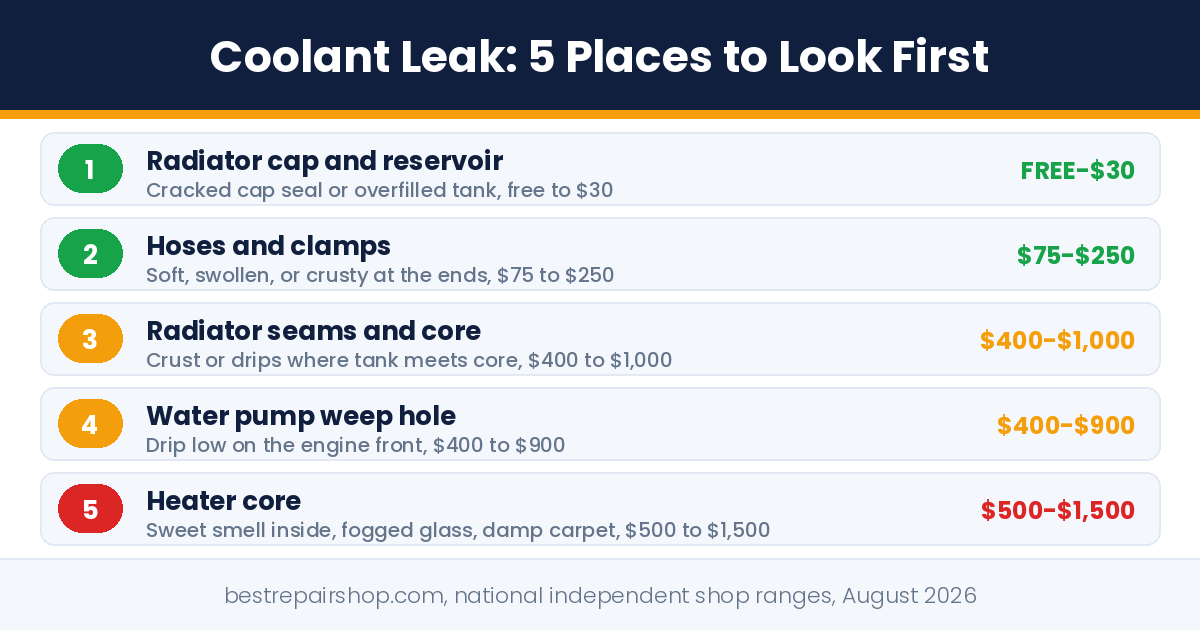
1. The radiator cap and reservoir. Start with the cheapest suspects. A worn cap seal stops holding pressure and lets coolant escape as steam, and a cracked or overfilled reservoir drips from the seam. A new cap is $15 to $30. Only open a cap on a cold engine, never a hot one.
2. Hoses and clamps. Squeeze the big upper and lower radiator hoses when the engine is cold. Soft, spongy, swollen, or crusty white or green residue at the ends means the hose or clamp is going. Shops charge $75 to $250 for most hose jobs, a fair and honest repair.
3. The radiator itself. Look along the seams where the plastic tanks meet the metal core, and across the fins. Dried coolant leaves a chalky, colored crust. A radiator replacement runs $400 to $1,000 at an independent shop, and a leaking seam usually means replacement, not repair.
4. The water pump weep hole. Water pumps are built to warn you: when the internal seal wears, coolant seeps from a small weep hole and drips low on the front of the engine. A steady drip there means the pump is done, typically $400 to $900 installed.
5. The heater core. This one hides inside the dashboard. The clues are a sweet smell through the vents, a windshield that fogs with an oily film, and damp carpet on the passenger side. It is the most labor-heavy fix on this list at $500 to $1,500, so get a second opinion before approving it.
Is it safe to drive with a coolant leak?
A slow seep with a normal temperature gauge buys you a few days, not a few months. Top off the reservoir to the cold-fill line, check it every morning, and get it looked at within the week. A fast drip, visible steam, or a gauge that climbs past the middle means park it now and arrange a tow.
The math is brutal and worth saying plainly: ignoring a $150 hose can cook a head gasket or warp the engine, and that bill starts around $1,500 and climbs fast. If the gauge ever spikes on you, follow the first steps in our guide to a car that is overheating before anything else.
What each coolant leak fix costs
| Repair | Fair range, parts + labor |
|---|---|
| Radiator cap | $15-$30 |
| Radiator hose and clamps | $75-$250 |
| Thermostat or housing | $150-$300 |
| Water pump | $400-$900 |
| Radiator replacement | $400-$1,000 |
| Heater core | $500-$1,500 |
| Drain and fill after repair | $65-$150 |
Ranges are national, independent-shop figures, August 2026. Dealers typically run 20 to 40 percent higher. Any leak repair should end with fresh coolant, so read our companion guide to coolant flush cost before you approve that line on the estimate.
Free checks before you pay a shop
Slide clean cardboard under the engine overnight. The drip pattern tells you where to look, and the color confirms it is coolant and not oil or plain-water AC condensation, which is normal. Check the reservoir level cold, against the marked line, once a week for two weeks. Photograph everything before you visit a shop.
Then ask the shop for a cooling system pressure test, usually $30 to $70 and sometimes free with the repair. It finds a coolant leak in minutes instead of guessing. Ask for a written estimate before any work, which the FTC’s auto repair guide recommends in writing, and run your VIN through the free NHTSA recall lookup, because some cooling system failures are covered recalls you should not pay for at all.
Coolant leak FAQ
Why do I smell coolant but see no puddle?
Small seeps often land on hot engine parts and evaporate before they reach the ground, leaving only the smell and a faint white crust. The other classic cause is the heater core, which leaks inside the dashboard where you will never see a puddle, only damp carpet. A pressure test finds both.
Can I use a stop leak product?
Only as a get-home measure, and know the trade. Stop leak seals small gaps by design, which means it can also clog the heater core and radiator passages you want open. If you pour it in, plan on a proper repair and a full coolant exchange soon after.
How far can I drive with a slow leak?
Think in days, not weeks. Keep the reservoir at the cold-fill line, carry a gallon of the correct coolant, and watch the gauge like it owes you money. The moment you are topping off more than once a week, the leak is no longer slow and the risk curve gets steep.
What color should coolant be?
Bright and translucent, whatever the shade: green, orange, pink, blue, or yellow depending on the formula. Brown or rusty coolant is overdue for a change, and a milky milkshake look can mean oil mixing in, which needs a shop diagnosis right away.