
Coolant flush cost at an honest independent shop runs $100 to $200 for a machine exchange in 2026, and a simpler drain and fill runs $65 to $150. That is the whole invoice: coolant, labor, done. Most modern cars need the service every 5 years or 100,000 miles the first time, so when a shop pushes one at every 30,000 mile visit, keep a hand on your wallet.
On this page: Fair prices Flush vs drain and fill By shop type How often The upsell FAQ
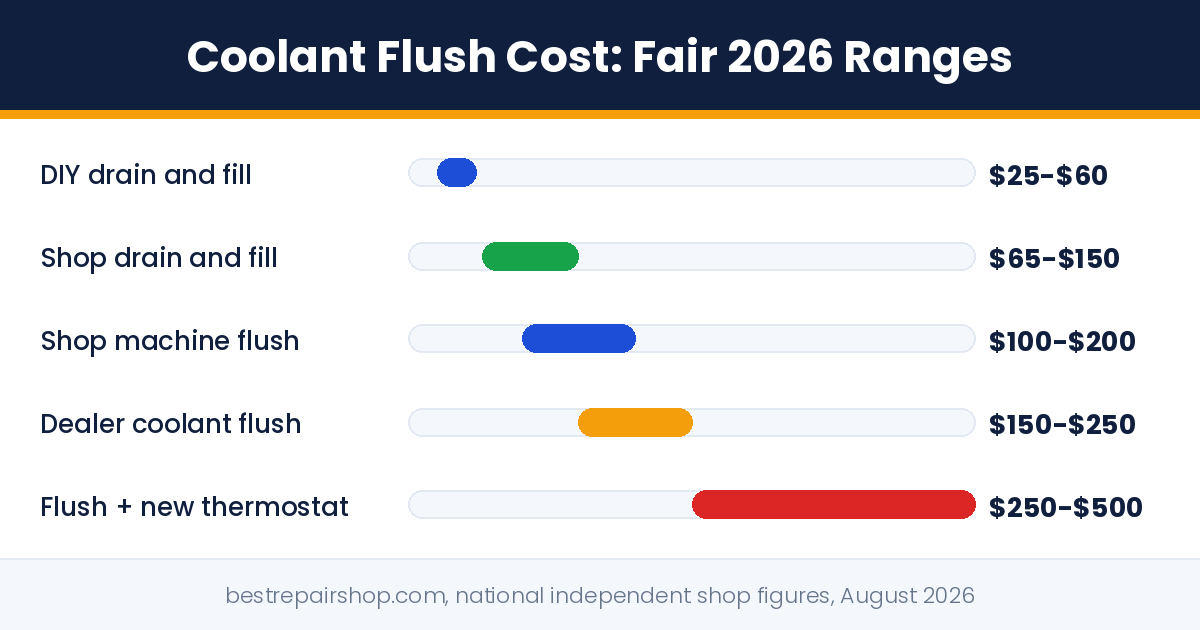
What a fair coolant flush cost looks like in 2026
Here is what you are actually paying for: 1 to 2 gallons of the correct coolant at $15 to $25 per gallon, about a half hour to an hour of labor at $75 to $200 per hour, and the machine time if it is a true exchange. Run that math and $100 to $200 covers it almost everywhere in the country. An invoice past $250 for a flush alone, with no other parts, deserves a question or two.
One honest caveat from the invoice side: some engines bury the drain or demand a slow air-bleed procedure afterward, and European cars often want pricier factory coolant. Those jobs can fairly land at the top of the range. What does not belong on the ticket is a mystery “cooling system service package” that nobody can itemize for you.
Flush vs drain and fill: what you are actually buying
A drain and fill opens the radiator drain, lets gravity do the work, and refills. It swaps roughly half the coolant, because the rest hides in the engine block and heater core. A machine flush, sometimes sold as a coolant exchange, pushes new coolant through the whole system and replaces nearly all of it.
Which should you buy? On a car that has been serviced on schedule, a $65 to $150 drain and fill is plenty, and two of them a year apart beat one flush for less money. The machine exchange earns its keep when the coolant is years overdue, rusty, or the wrong mix. That difference is most of the honest spread in coolant flush cost between shops.
Coolant flush cost by shop type
| Service | Fair 2026 range |
|---|---|
| DIY drain and fill | $25-$60 |
| Independent shop drain and fill | $65-$150 |
| Independent shop machine flush | $100-$200 |
| Quick lube flush | $90-$180 |
| Dealership flush | $150-$250 |
| Flush plus new thermostat | $250-$500 |
Ranges are national, independent-shop figures, August 2026. The quick lube coolant flush cost is priced fine on its own, but it is the add-ons stapled to it that inflate the ticket. If the estimate keeps growing, our repair cost guides cover what each line should run, and our guide to finding a good mechanic covers who deserves the work.
How often is honest
Modern long-life coolant is rated for 5 years or 100,000 miles on the first change, then about every 3 years or 50,000 miles after that. Older cars on traditional green coolant need it every 2 years or 30,000 miles. Your owner’s manual wins every argument on this page: it knows your engine, and the service counter does not.
The 30,000 mile flush pitch survives because coolant looks dirty to a customer long before it stops working. Same playbook as transmission service, where we found the identical gap between the sticker on the wall and the manual in your glovebox: see our transmission flush guide for that story. The FTC’s auto repair basics says it plainly: follow the manufacturer’s schedule, not the shop’s.
The upsell to avoid
Three moves to watch. The color test: an advisor holds up a sample and says it looks dirty, but coolant condition is measured with test strips and a refractometer, not eyeballs, so ask for the numbers. The conditioner add-on: $20 to $40 for additives already blended into quality coolant. The bundle: a flush quietly stapled to every 30,000 mile service package whether the schedule calls for it or not.
And one thing that is not an upsell: if you are topping off the reservoir every week, you do not need a flush, you need a diagnosis. Coolant does not evaporate on a healthy system. Start with our guide to finding a coolant leak, because flushing a leaking system is paying to pour new coolant on the ground.
Coolant flush cost FAQ
Is a coolant flush ever really necessary?
Yes, on the manual’s schedule. Coolant carries corrosion inhibitors that wear out even when the color still looks fine, and depleted coolant slowly eats the radiator, heater core, and water pump seal from the inside. The service is real. Only the every-30,000-miles urgency is invented.
How long does a coolant flush take?
Plan on 30 to 60 minutes for a machine exchange and about the same for a careful drain and fill, since many engines need an air-bleed cycle with the heater running afterward. A shop that quotes several hours of labor for a routine flush on a common car is padding the ticket.
Can I just keep topping it off instead?
Topping off a small seasonal dip is fine, and use the coolant type on the reservoir cap, not whatever is on sale. But steady topping off means coolant is going somewhere, and diluting old coolant with fresh does not restore its worn-out additives. It postpones the service, it does not replace it.
What happens if I never change the coolant?
Corrosion, quietly and then all at once. Acidic old coolant clogs heater cores, pits water pump seals, and scales up radiators until they fail. You skip a $100 to $200 service and buy a $400 to $1,000 radiator or a $400 to $900 water pump instead. The house always wins that trade.