
Wheel bearing noise usually starts as a low hum or drone around 40 mph that grows with speed and shifts when you swerve gently. It will not heal on its own, and a bearing that fully fails can let the wheel wobble or lock. A fair independent shop charges about $250 to $500 per wheel for the common hub assembly fix, so plan the repair in days or weeks, not months.
On this page: The sound 3 free tests Sound-alikes Safe to drive? Fair cost FAQ
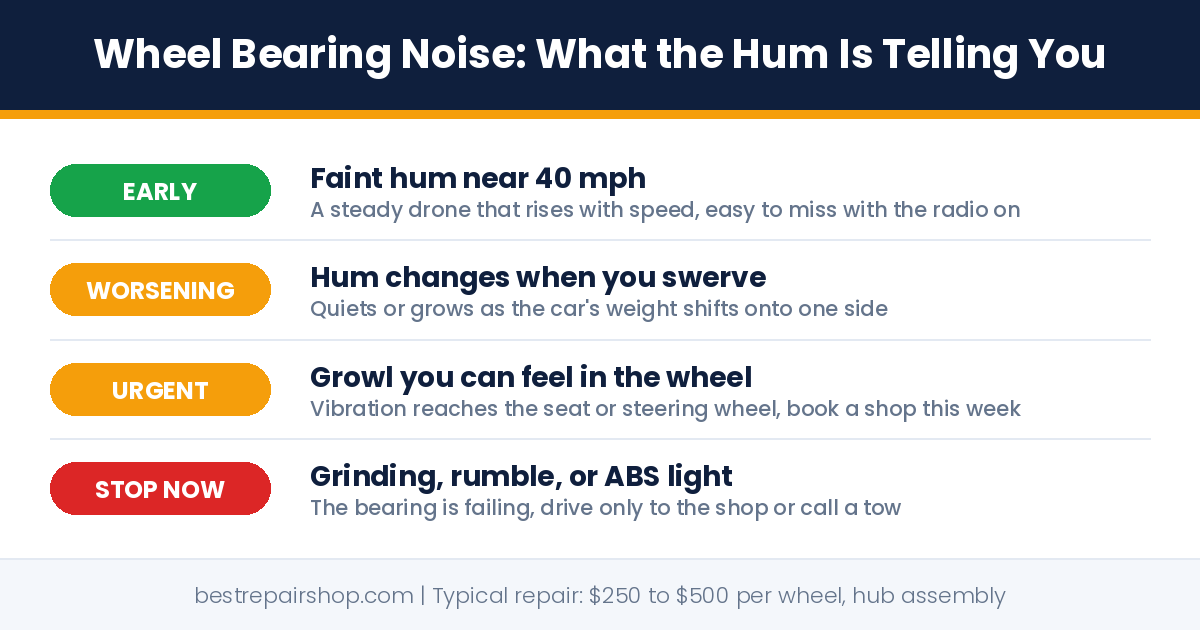
What wheel bearing noise sounds like
A healthy bearing is silent, so the first symptom is a sound you cannot quite place: a low hum, a steady drone, or what many drivers describe as tire roar that never changes tune. It usually becomes audible somewhere between 30 and 45 mph, and 40 mph is the classic speed where it settles in and stays.
Here is the telltale. The pitch follows road speed, not engine speed. Shift to neutral at 40 mph and let the car coast. If the hum keeps right on humming while the engine drops to idle, the engine is innocent. Something that spins with the wheels is talking to you, and the bearing is the most common voice.
Left alone, the hum grows into a growl, then a rumble you can feel through the floor. By the grinding stage, the bearing is chewing itself apart and the repair window is closing.
Three free tests before you pay for diagnosis
Test 1: the swerve. On an empty road at about 40 mph, make gentle, lane-width swerves. Weight shifts away from the direction you steer, so if the hum gets louder on an easy left swerve, suspect the right bearing, and the reverse. A hum that changes with the swerve is the single strongest bearing clue there is.
Test 2: the wiggle. With the car safely on a jack stand, grip the tire at 12 and 6 o’clock and rock it. A good bearing allows no play at all. A clunk or a visible wobble means the bearing is loose, and that wheel goes to the shop, not back on the road.
Test 3: the spin. Same wheel in the air, spin it by hand and listen. A bad bearing sounds gritty, like rolling a can of gravel. When you put the wheel back on, torque the lugs to 80 to 100 lb-ft. None of these tests costs a dime, and our symptoms library covers the other noises you might meet while you are down there.
Four sound-alikes that fool people
Tires are the big one. Cupped or feathered tread makes a near-identical drone. Run a hand across the tread; if it feels like scallops, the tires are the noise, not the bearing. NHTSA’s tire safety pages show what healthy wear looks like, and our guide to how long tires last covers the quarter test.
A worn CV joint clicks in tight, slow turns, a parking-lot sound rather than a highway hum. Brakes grind when you press the pedal, not steadily with speed; if that is your noise, start with grinding noise when braking. And uneven wear from bad alignment can sing too, which is a cheaper fix covered in our wheel alignment cost guide.
Is it safe to keep driving?
The honest answer depends on the stage of the wheel bearing noise. A faint early hum gives you weeks to book the repair, not months. A growl with vibration you feel in the seat or wheel means this week. Grinding, a wobble, or an ABS light means stop: drive only to the shop, or call the tow.
A failing bearing runs hot, can take out the wheel speed sensor that feeds your ABS, and in the worst case lets the wheel separate from the car. While you wait for your appointment, skip the trailer, the roof box, and the mountain pass. The bearing carries every pound you add.
What the fix should cost
Wheel bearing noise almost always ends in one repair: a new hub assembly for that corner. It is a fair, contained job, and it is priced per wheel because bearings fail one at a time.
| Repair (per wheel) | Fair range |
|---|---|
| Front hub assembly | $250-$500 |
| Rear hub assembly | $240-$480 |
| Press-in bearing (older or smaller cars) | $350-$600 |
| Diagnosis, if billed separately | $75-$200 |
Ranges are national, independent-shop figures, August 2026. Most good shops fold the diagnosis into the bill when you approve the repair on the spot. For the full invoice breakdown, front versus rear, and the pairs upsell to watch for, see our wheel bearing replacement cost guide.
Wheel bearing noise FAQ
Can I drive with wheel bearing noise?
For a short while, yes, if it is still a faint hum. Treat it like a countdown, not background music. Book the repair within a couple of weeks, and stop driving the moment you feel vibration, hear grinding, or see the ABS light.
Why does the hum change when I turn or swerve?
Steering shifts the car’s weight from one side to the other, which loads one bearing and rests the other. A worn bearing complains under load and quiets down when unloaded. That load-sensitive change is exactly what separates a bearing from tire noise.
Do wheel bearings need to be replaced in pairs?
No. Bearings are independent parts at separate corners, and replacing the quiet one buys you nothing. The honest exception is when both sides hum, or both have very high mileage and the shop shows you play in each. Otherwise, one corner, one repair.
How long do wheel bearings last?
Most last 100,000 to 150,000 miles, and plenty outlive the car. Potholes, curb strikes, and deep water crossings are the usual killers, because they dent the races or wash out the grease. If one fails young, think back to the winter the road ate your rim.