
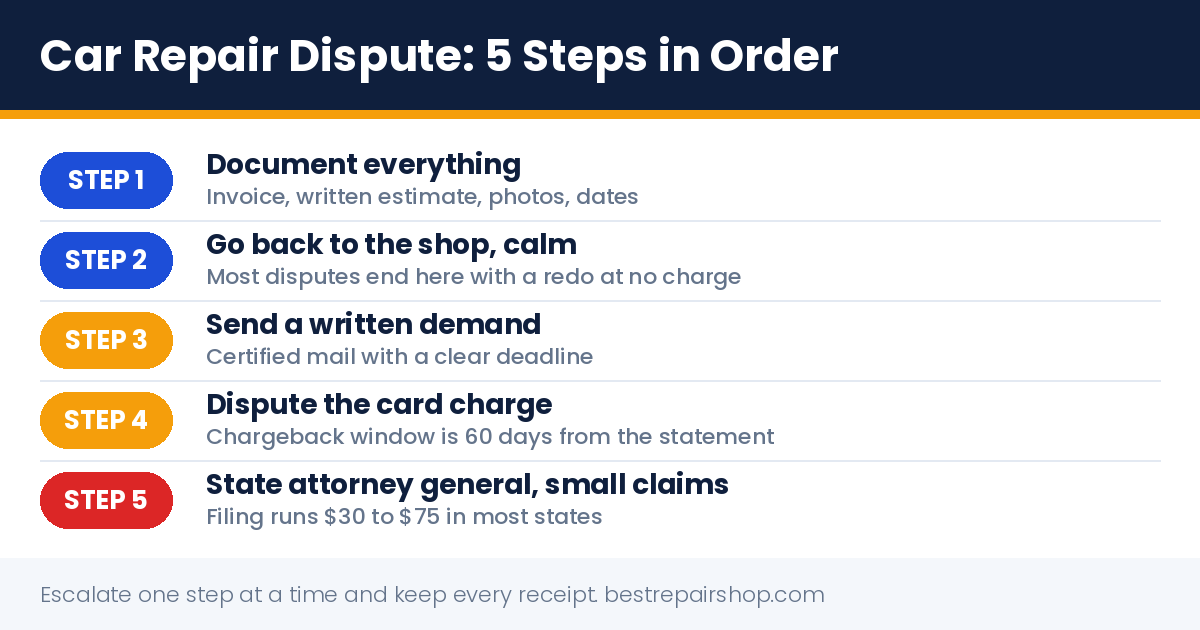
Most of a car repair dispute is won with paperwork, not volume. Keep the invoice and written estimate, give the shop one calm chance to make it right, then escalate in order: a certified demand letter, a card chargeback within 60 days of the statement, your state attorney general, and small claims court, where filing runs $30 to $75 in most states. Shops resolve the majority of complaints at step two, because a redo is cheaper than a reputation.
On this page: Paperwork Go back first Demand letter Chargeback AG and small claims Costs FAQ
Step 1: Build the Paper Trail Before You Argue
I have watched a lot of arguments at service counters, and the customer who wins is holding paper, not a phone on speaker. Before you say a word, gather the written estimate, the final invoice, any text or email approvals, and dated photos of the problem. If the car came back worse, photograph that too.
Federal guidance backs you here: the FTC’s auto repair basics lays out your right to a written estimate, authorization before work, and your old parts back in most states. A car repair dispute that starts with “your invoice says X and the car does Y” is halfway settled already. One that starts with an accusation is not.
Step 2: Give the Shop One Honest Chance
Go back to the same shop, ask for the owner or service manager, and describe the problem in two sentences without assigning blame. Then ask the question that matters: “What will you do to make this right, and by when?” Get the answer in writing on the repair order.
Most legitimate shops will recheck the work at no charge, and many carry a 12 month or 12,000 mile parts and labor warranty that covers exactly this. In my experience the majority of disputes end here. If the manager stonewalls, do not argue. You are done collecting: their refusal, said out loud, is your next piece of evidence, so note the date and who said it.
Step 3: Put It in Writing With a Deadline
A one page letter, sent certified mail for $5 to $10, changes the temperature of everything that follows. State the facts in order, what you want (refund, redo, or payment for the corrective repair), and a deadline, 10 business days is standard. No adjectives, no threats, just “if this is not resolved by the date above, I will pursue the remedies available to me.”
Keep a copy and the mailing receipt. Judges and card issuers both love a clean demand letter, and shops know it. A surprising number of checks get written in the ten days after one arrives.
Step 4: Dispute the Charge With Your Card Issuer
If you paid by credit card, you can dispute the charge for services not rendered as described. The standard window is 60 days from the statement date, so do not let a shop slow walk you past it. Upload your estimate, invoice, photos, and the demand letter; the issuer takes the money back while it investigates.
A chargeback is leverage, not a lottery ticket. Use it when the work was not done, was not authorized, or left the car demonstrably worse, and be accurate, because the shop gets to respond with its own paperwork. This is also the moment to get a second opinion in writing from another shop, which typically costs a fair diagnostic fee of $75 to $200 and is the strongest single document in a car repair dispute.
Step 5: Where a Car Repair Dispute Goes Next
Two venues, both consumer friendly. Your state attorney general’s consumer protection office takes complaints online for free, and a letter from that office gets answered in a way yours may not. Some states also license repair shops, and a licensing board complaint has real teeth.
Small claims court handles amounts up to $5,000 to $12,500 depending on the state, no lawyer required. Filing runs $30 to $75, you present your paper trail, and repair cases are bread and butter there. Shops know the math: a morning in court costs more than most refunds. Many settle on the courthouse steps.
What Each Step Costs
| Step | Typical cost |
|---|---|
| Second opinion inspection, in writing | $75-$200 |
| Certified demand letter | $5-$10 |
| Credit card chargeback | $0 |
| State attorney general complaint | $0 |
| Small claims filing | $30-$75 |
| Attorney demand letter, optional | $100-$300 |
Ranges are national, independent-shop figures, August 2026. Notice the pattern: every step of a car repair dispute costs less than the repair you are disputing. The expensive move is the one that feels cheapest in the moment, which is paying twice and telling yourself it is not worth the hassle.
Car Repair Dispute FAQ
Can I just refuse to pay for a bad repair?
Be careful. In most states a shop can hold your car under a mechanic’s lien until the bill is paid, and storage fees stack daily. The stronger play is usually to pay by credit card, take the car, and dispute from home with your paperwork. Never leave the car hostage over a standoff you can win later.
How long do I have to file a chargeback?
The federal baseline is 60 days from the date the statement containing the charge was sent, though many issuers accept disputes for 120 days on service quality claims. File as early as you can and keep escalating in parallel. Waiting on a shop’s promises is the most common way people run out the clock.
Do I need a lawyer for small claims court?
No, and in several states lawyers are not even allowed in small claims. You need your timeline, your documents in date order, and the second shop’s written findings. If the amount at stake is above your state’s small claims limit, a one time attorney demand letter for $100 to $300 often resolves it without a suit.
The shop’s warranty should cover this but they refuse. Now what?
Get the refusal in writing or note who said it and when, then follow the same ladder: demand letter, chargeback if the original work was on a card, attorney general, small claims. A written warranty they will not honor is one of the easiest cases to win. Our guide to repair warranties covers what a good one promises.