
A clunking noise over bumps almost always comes from the suspension, and the fix is often cheaper than you fear. The most likely causes, in order, are worn sway bar end links ($100 to $250 a pair), sway bar bushings, control arm bushings, ball joints, and finally struts or strut mounts ($600 to $1,100 a pair). A shop can usually pin down which one with a 15 minute inspection on a lift.
On this page: 5 causes Free checks Fair costs Safe to drive? At the shop FAQ
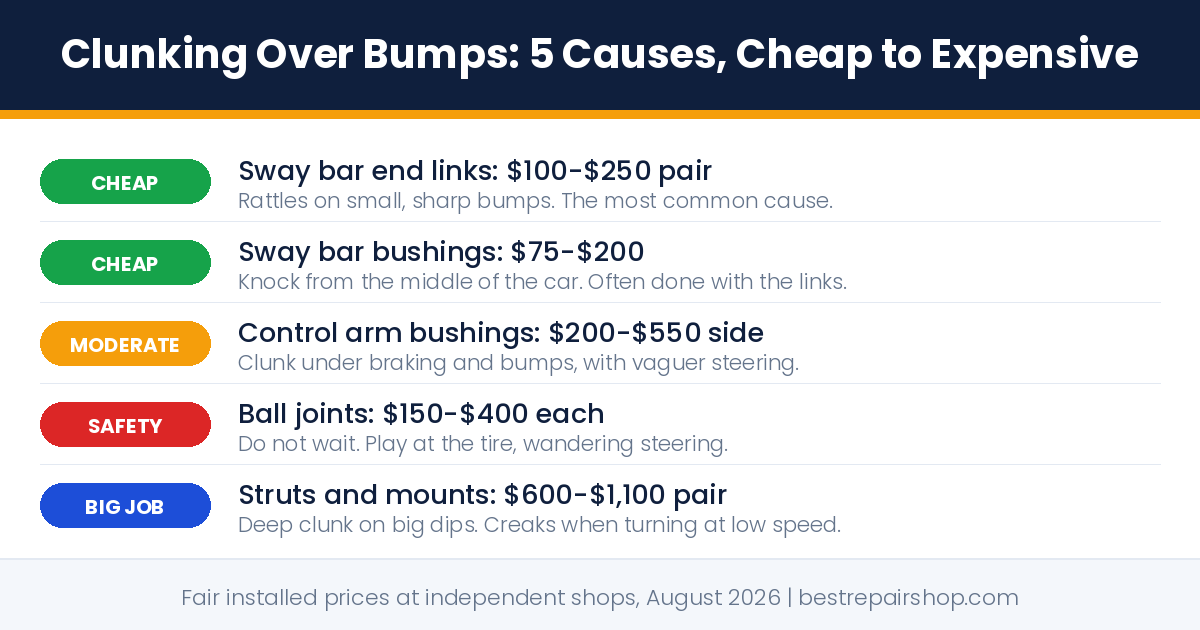
The 5 causes of a clunking noise over bumps, cheap to expensive
Nine times out of ten, that knock is your suspension telling you a joint or a rubber cushion has worn out. Suspensions are full of bushings and small joints that let parts move without metal touching metal; when one wears, you hear the clunk through the floor. Here are the five usual suspects, starting with the cheapest.
Sway bar end links are cause number one and the cheapest fix on the list. These short rods connect the sway bar to the suspension; when their joints wear, they rattle over small, sharp bumps like expansion joints and manhole covers. Sway bar bushings, the rubber blocks that clamp the bar to the frame, are cause number two and just as affordable.
Control arm bushings come next. When they crack, the arm shifts under braking and over bumps, so the clunk often comes with vaguer steering. Ball joints are cause four, and the one to take seriously, because a badly worn ball joint can eventually separate. Struts and strut mounts round out the list: a worn mount clunks over big dips and speed bumps, and often creaks when you turn the wheel at parking speed.
Free checks you can do in the driveway
Park on level ground and push down hard on each corner of the car, then let go. One smooth rebound is healthy; extra bouncing points at tired struts or shocks. Next, grab the top of a front tire and rock it firmly in and out. Obvious play or a knock you can feel usually means a ball joint or a wheel bearing.
Listen to the pattern too. A clunking noise over bumps that only shows up on small, quick hits usually means end links or bushings. A deeper clunk on big dips, driveway ramps, and speed bumps leans toward struts and mounts. A clunk while turning with no bump at all points at strut mounts.
Fair 2026 repair costs for each cause
Here is what independent shops charge for each fix with quality aftermarket parts. Dealers typically run 20 to 40 percent higher for the same work. End links, bushings, and struts should be replaced in pairs so the car stays balanced side to side.
| Repair | Fair installed price | Notes |
|---|---|---|
| Sway bar end links (pair) | $100-$250 | Most common cause |
| Sway bar bushings | $75-$200 | Often done with the links |
| Control arm bushings or arm (per side) | $200-$550 | Arm is often replaced whole |
| Ball joint (each) | $150-$400 | Safety item, do not wait |
| Struts with mounts (pair) | $600-$1,100 | Add an alignment after |
Ranges are national, independent-shop figures, August 2026. If struts are replaced, budget another $100 to $150 for the alignment that should follow; our wheel alignment cost guide covers what is fair there. For the full strut and shock picture, front versus rear, see our shocks and struts replacement cost guide.
Is it safe to keep driving?
Usually yes, for a little while. A clunking noise over bumps from end links or sway bar bushings is a comfort problem, not an emergency, and control arm bushings can wait for an appointment within a couple of weeks. Ball joints are the exception: if the clunk comes with a tire that wobbles when you rock it, or steering that wanders, get the car inspected now. A separated ball joint can drop a front corner at speed.
Two sound-alikes to rule out. A clunk paired with a hum that rises with road speed may be a wheel bearing instead; our wheel bearing noise guide covers that sound. And if the car also pulls to one side, mention both symptoms together, because one worn front end part can cause both.
What a good shop will do
A good shop puts the car on a lift, pries on every joint to check for play, and shows you the worn part before quoting anything. Expect a written estimate that names the specific component, not a vague front end kit. The FTC’s auto repair basics guide backs you up: you are entitled to an estimate up front and to your old parts back if you ask before the work starts.
Push back politely if a small clunking noise over bumps turns into a quote for struts, control arms, and ball joints all at once on a car under 100,000 miles. Whole front ends do wear together on older, salty-road cars. On a newer one, ask the shop to rank the parts by measured play and start with the worst offender.
FAQ: clunking and knocking over bumps
Why does my car clunk only over small bumps?
Small, sharp hits shake the sway bar hardest, so a clunk you only hear on expansion joints and rough pavement usually means end links or bushings, the cheapest outcome on the list. Big dips and speed bumps work the struts and mounts instead.
Can I keep driving with a clunking noise over bumps?
For most causes, yes, for a week or two while you book an appointment. The exception is a suspected ball joint: visible tire play, wandering steering, or a clunk that is getting louder fast; that one earns an inspection right away.
Why does it clunk when I turn, too?
A clunk or creak while turning at low speed points at strut mounts, whose bearings carry the strut as it rotates. A rhythmic clicking during turns under power is different: that is the classic CV axle sound.
Will a clunk fail a state inspection?
In states with safety inspections, a ball joint or tie rod with measurable play is a common failure item. Worn sway bar links and bushings usually pass, since they affect comfort more than control. Fix them anyway; they get louder, and they mask new problems.