
If your car pulls to one side, start with the free fix: tire pressure. A tire that is low on one side causes roughly half of the pulling complaints a shop sees, and correcting it costs nothing. After that, the likely causes in order are uneven tire wear, an alignment out of spec at $75 to $200, and a sticking brake caliper at $150 to $400.
On this page: Check order Tire pressure Tire wear Alignment Brake caliper Costs FAQ
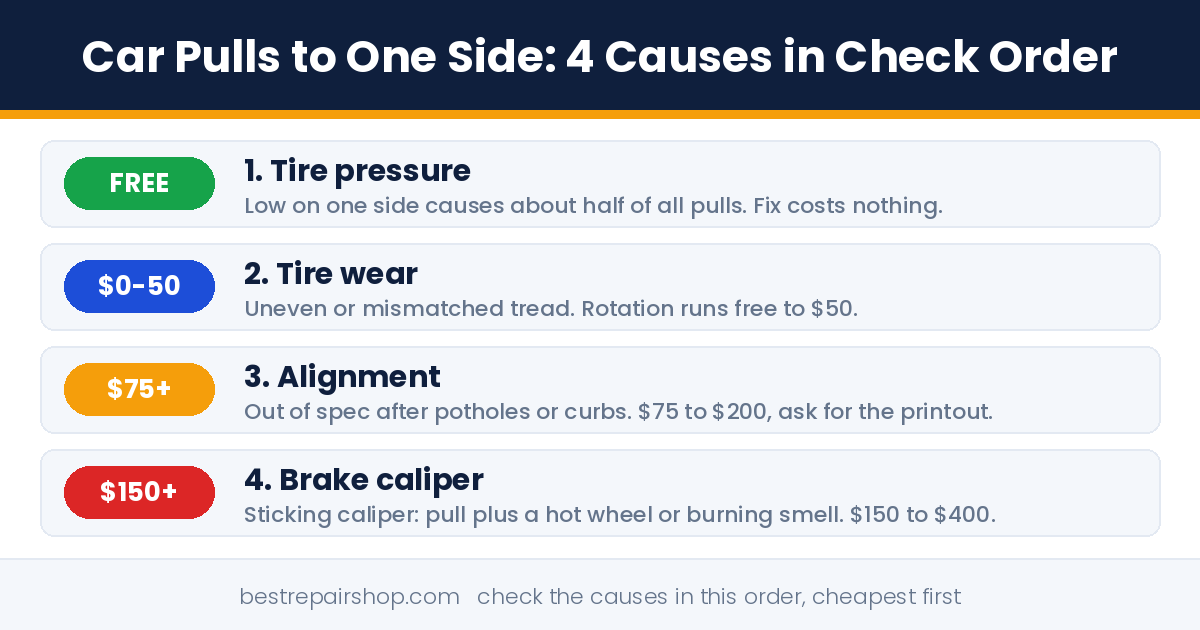
Why your car pulls to one side: 4 causes in check order
Your car is talking to you, and a steady tug on the steering wheel is one of the clearer things it says. The tricky part is that four very different problems produce the same pull, and they range from a free driveway fix to a real repair bill. You lose nothing by ruling out the cheap causes first.
Before you check anything, notice when it happens. A pull that is there all the time points to tires or alignment. A pull only while braking points to the brakes. That one detail cuts the list in half before you spend a dollar. More guides like this live in our symptoms library.
Cause 1: low tire pressure, the free fix
A front tire that is 8 or 10 psi lower than its partner drags, and the car drifts toward the soft side. Check all four tires cold with a $5 gauge and fill to the number on the driver door jamb sticker, not the maximum printed on the tire sidewall. Half of pulling complaints end right here.
Do not wait for the dashboard to warn you. The pressure monitoring system in most cars stays quiet until a tire is about 25 percent low, which is plenty to cause a pull. If the light is already on, our tire pressure light guide walks through what to do next.
Cause 2: uneven tire wear
Tires with mismatched tread depth side to side will steer the car toward the more worn tire. Check depth with the quarter test: place a quarter upside down in the groove, and if the tread does not reach Washington’s head you are at about 4/32 inch and shopping time is close. Compare left to right, not just front to back. The tire safety basics at NHTSA are worth ten minutes if yours are older.
A rotation, which runs free to $50 at most shops, can confirm the diagnosis for cheap: if the pull follows the tires to the other side of the car, the tires are your answer. New tires can do this too, a defect called conicity, and a reputable tire shop will swap those under warranty. Our guide to how long tires last covers the age limits.
Cause 3: alignment out of spec
Potholes, curb strikes, and plain old miles knock your wheel angles out of specification, and the car stops tracking straight. An alignment is the most common paid fix when a car pulls to one side, and a fair price is $75 to $120 for two wheels or $100 to $200 for all four. Other tells: a steering wheel that sits off center on a straight road and feathered wear on a tire edge.
Two rules keep this purchase honest. First, ask for the before and after printout: a real alignment produces one every time. Second, if the shop finds a worn tie rod or ball joint, fix that part first, because aligning worn parts is money down the drain. We list the other tells in 5 honest signs you need an alignment.
Cause 4: a sticking brake caliper
This is the one that earns a same-week appointment. A caliper that will not release keeps squeezing one brake all the time, so the car pulls steadily toward that corner, the wheel gets hot, and you may smell something burning after a drive. Caliper replacement runs $150 to $400 per corner at an independent shop.
If the car only pulls in the moment you press the brake pedal, suspect the same family of parts: a sticking caliper, uneven pads, or a failing brake hose. Do not sit on this one. A single dragging brake eats pads and cooks the rotor while it waits.
What each fix costs
Here is the fair range for each reason a car pulls to one side, cheapest first. Two of the five cost little or nothing, which is exactly why the check order matters.
| Fix | Fair range |
|---|---|
| Air top up to door sticker pressure | Free |
| Tire rotation | Free-$50 |
| Two wheel alignment | $75-$120 |
| Four wheel alignment | $100-$200 |
| Brake caliper replacement, per corner | $150-$400 |
Ranges are national, independent-shop figures, August 2026. Dealers typically run 20 to 40 percent higher, and rust belt cars can add labor when hardware seizes.
FAQ: pulling, drifting, and what is normal
Is it safe to drive when my car pulls to one side?
A mild, constant drift is usually safe for a careful trip to the shop. Two exceptions: a pull strong enough that the car changes lanes when you relax your grip, or a pull with a hot wheel or burning smell. Those mean park it and get it looked at now.
Why does my car drift slightly right on the highway?
American roads are crowned, meaning they slope toward the shoulder so rain drains, and a slight right drift on a two lane road is normal. A pull that fights your hands, or a left pull, is not road crown. Test on a flat, empty parking lot if you are unsure.
Can brand new tires make my car pull?
Yes. A new tire can be built slightly cone shaped, a defect called conicity, and it will steer the car from day one. Go back to the installer: swapping the front pair side to side takes minutes, and a defective tire is a warranty replacement, not a bill.
Why does my car only pull when I brake?
A brake-only pull points at a sticking caliper, uneven pad wear, or a collapsing brake hose on one side. Have a shop inspect both front corners. If you also feel shaking, read our guide to a car that shakes when braking.